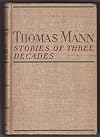
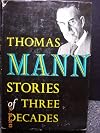
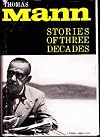
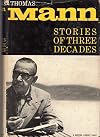
Stories of Three Decades
by Thomas Mann 
On This Page
Tags
Recommendations




















Member Reviews
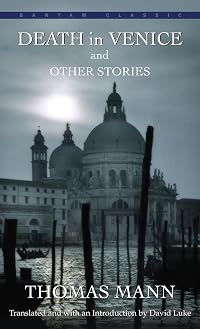
Thomas Mann is a difficult author to approach. Your choices at the bookstore are usually Magic Mountain, Doctor Faustus, or Death in Venice. Of course, like any sensible reader, I began with Death in Venice. I was immediately struck by his style, and over the course of years the initial awe I felt reading that first novella only deepened into reverence. Unlike Hermann Hesse, one of the other German authors to receive the Nobel Prize, Mann's writing transcends its own content, engages in deep philosophical discussions and simultaneously possesses lyrical resonance. Hesse is still one of my favorite writers, but I cannot compare the experience of reading his work with that of Mann. Where Proust wrote with heartfelt consistent brilliance, show more constructing sentences of vast architectural significance, Mann never wrote a bad sentence, at least as far as my minuscule understanding of structure will allow me to comprehend, and wrote the polished, heady sort of prose Kafka and Calvino could only imitate - in my opinion, while pushing Proust's invalid worldview into the open air, until it inevitably descends back into interior explorations.
Whether or not you will enjoy Mann, I think, does not depend on your enjoyment of his sentences alone, for his stories, characters and occasional humor are all vastly superior to the norm. You will meet clowns and dogs, families and artists, cast with the precision of Chekhov into universal human dramas of great power and elegance. He does not often write from the perspective of women, and many of his protagonists are similar to each other - that is, they are the types of people Mann most likely knew, and he sought to portray them in semi-authentic ways.
Perhaps it is only necessary to say that you cannot go wrong starting with this collection. For those who are not sure they want to tackle the breathtaking masterpiece of Magic Mountain or the seemingly infinite difficulty of Joseph and His Brothers, you will find a lot of literary manna waiting in this generous collection. He demonstrated that it is not only possible, but necessary to create moving scenes on the panoramic canvas of everyday life. show less
Whether or not you will enjoy Mann, I think, does not depend on your enjoyment of his sentences alone, for his stories, characters and occasional humor are all vastly superior to the norm. You will meet clowns and dogs, families and artists, cast with the precision of Chekhov into universal human dramas of great power and elegance. He does not often write from the perspective of women, and many of his protagonists are similar to each other - that is, they are the types of people Mann most likely knew, and he sought to portray them in semi-authentic ways.
Perhaps it is only necessary to say that you cannot go wrong starting with this collection. For those who are not sure they want to tackle the breathtaking masterpiece of Magic Mountain or the seemingly infinite difficulty of Joseph and His Brothers, you will find a lot of literary manna waiting in this generous collection. He demonstrated that it is not only possible, but necessary to create moving scenes on the panoramic canvas of everyday life. show less
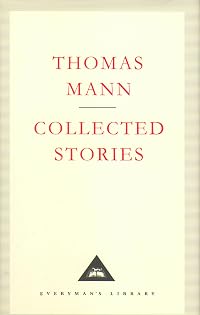
2396 Stories of Three Decades, by Thomas Mann translated from the German by H. T. Lowe-Porter (read 14 Jul 1991) While reading a biography of Mann and his brother I decided I should read these stories. The book was first published in the US in 1936 and contains all of Mann's fiction prior to 1940 except the long novels. There are 24 stories, and some were a burden to read. For instance, "Tristan" was so boring I cannot now remember a thing about it! "Death in Venice," a 1911 story, is of course famous and is a sickening and memorable story. But "A Man and His Dog," for instance, I found extremely boring, though it tells a simple little plotless tale of a dog. The last story, a 1929 one titled "Maria and the Magician," at least told a show more story of some interest and made one want to keep reading. I cannot say it was worth my time to read most of the stories in this book. show less
Currently the only translation available of almost all of his shorter works, including his [I must admit, rather boring] play Fiorenza. All but his earliest efforts are included in this volume.
Ratings
Members
- Recently Added By
Lists

Harold Bloom - The Western Canon: D. The Chaotic Age
833 works; 24 members
Author Information

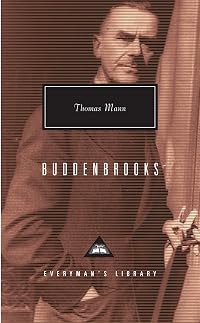
Thomas Mann was born into a well-to-do upper class family in Lubeck, Germany. His mother was a talented musician and his father a successful merchant. From this background, Mann derived one of his dominant themes, the clash of views between the artist and the merchant. Mann's novel, Buddenbrooks (1901), traces the declining fortunes of a merchant show more family much like his own as it gradually loses interest in business but gains an increasing artistic awareness. Mann was only 26 years old when this novel made him one of Germany's leading writers. Mann went on to write The Magic Mountain (1924), in which he studies the isolated world of the tuberculosis sanitarium. The novel was based on his wife's confinement in such an institution. Doctor Faustus (1947), his masterpiece, describes the life of a composer who sells his soul to the devil as a price for musical genius. Mann is also well known for Death in Venice (1912) and Mario the Magician (1930), both of which portray the tensions and disturbances in the lives of artists. His last unfinished work is The Confessions of Felix Krull, Confidence Man (1954), a brilliantly ironic story about a nineteenth-century swindler. An avowed anti-Nazi, Mann left Germany and lived in the United States during World War II. He returned to Switzerland after the war and became a celebrated literary figure in both East and West Germany. In 1929 he was awarded the Nobel Prize for literature. (Bowker Author Biography) show less
Thomas Mann has a Legacy Library. Legacy libraries are the personal libraries of famous readers, entered by LibraryThing members from the Legacy Libraries group.
Some Editions
Awards and Honors
Common Knowledge
- First words
- It was the nurse's fault.
- Last words
- (Click to show. Warning: May contain spoilers.)And yet a liberation—for I could not, and I cannot, but find it so!
Classifications
Statistics
- Members
- 360
- Popularity
- 88,012
- Reviews
- 4
- Rating
- (4.12)
- Languages
- English
- Media
- Paper
- ISBNs
- 3
- ASINs
- 23