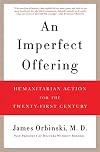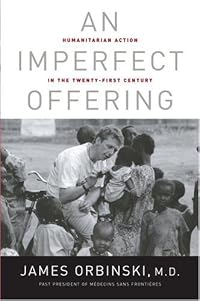
An Imperfect Offering: Humanitarian Action in the Twenty-first Century
by James Orbinski
On This Page
Description
National Bestseller "As Albert Camus wrote, the doctor's role is as a witness-to witness authentically the reality of humanity, and to speak out against the horrors of political inaction. . . . The only crime equaling inhumanity is the crime of indifference, silence, and forgetting." --James Orbinski In 1988, James Orbinski, then a medical student in his twenties, embarked on a year-long research trip to Rwanda, a trip that would change who he would be as a doctor and as a man. Investigating show more the conditions of pediatric AIDS in Rwanda, James confronted widespread pain and suffering, much of it preventable, much of it occasioned by political and economic corruption. Fuelled by the injustice of what he had seen in Rwanda, Orbinski helped establish the Canadian chapter of Médecins Sans Frontières (Doctors Without Borders/MSF). As a member of MSF he travelled to Peru during a cholera epidemic, to Somalia during the famine and civil war, and to Jalalabad, Afghanistan. In April 1994, James answered a call from the MSF Amsterdam office. Rwandan government soldiers and armed militias of extremist Hutus had begun systematically to murder Tutsis. While other foreigners were evacuated from Rwanda, Orbinski agreed to serve as Chef de Mission for MSF in Kigali. As Rwanda descended into a hell of civil war and genocide, he and his team worked tirelessly, tending to thousands upon thousands of casualties. In fourteen weeks 800,000 men, women and children were exterminated. Half a million people were injured, and millions were displaced. The Rwandan genocide was Orbinski's undoing. Confronted by indescribable cruelty, he struggled to regain his footing as a doctor, a humanitarian and a man. In the end he chose not to retreat from the world, but resumed his work with MSF, and was the organization's president when it was awarded the Nobel Peace Prize in 1999. An Imperfect Offering is a deeply personal, deeply political book. With unstinting candor, Orbinski explores the nature of humanitarian action in the twenty-first century, and asserts the fundamental imperative of seeing as human those whose political systems have most brutally failed. He insists that in responding to the suffering of others, we must never lose sight of the dignity of those being helped or deny them the right to act as agents in their own lives. He takes readers on a journey to some of the darkest places of our history but finds there unimaginable acts of courage and empathy. Here he is doctor as witness, recording voices that must be heard around the world; calling on others to meet their responsibility. "Ummera, ummera-sha" is a Rwandan saying that loosely translated means 'Courage, courage, my friend-find your courage and let it live.' It was said to me by a patient at our hospital in Kigali. She was slightly older than middle aged and had been attacked with machetes, her entire body rationally and systematically mutilated. Her face had been so carefully disfigured that a pattern was obvious in the slashes. I could do little more for her at that moment than stop the bleeding with a few sutures. We were completely overwhelmed. She knew and I knew that there were so many others. She said to me in the clearest voice I have ever heard, "Allez, allez. Ummera, ummera-sha"-'Go, go. Courage, courage, my friend-find your courage and let it live.' --From An Imperfect Offering show lessTags
Recommendations










Member Reviews
Passionate, worthwhile, and necessary, this book comes from the perspective of a doctor directly involved with all of the issues he presents.
Orbinski's book is by far the most accessible, intelligent, and nuanced look into Humanitarian Aid that I've come across. The work is without political bias; Orbinski's concern is for those people around the world who need help to simply survive and/or who are treated unfairly (primarily in respect to basic survival needs and medical care). His passion for both humanitarian aid and working For the future beyond simply the present moment is both touching and infective. As a doctor who worked with Doctors without Borders and one of the founders of Dignitas International, a foundation that works for show more the relief of treatable disease in poor populations that have little to no basic medical care or resources, Orbinski's presence in this book is not only central to story and action, but a more intelligent narrator than we could ask for.
Additionally, while I've read quite a few books that overlap in subjectmatter or concern, I haven't come across any book that did such a perfect job of balancing the overwhelming task of mixing narratives, introductory material, hard statistics, and personal voice. Some of the subjects and places Orbinski presents are places I've read quite a bit about, while with others, this was my first exposure--throughout, though, I never felt either lost in the subjectmatter understanding-wise, or bored by what I already knew. For anyone interested in learning more about Humanitarian Aid, this is the first book I would recommend, and without reserve. I would also strongly recommending it all the way through in order, and not simply taking on the chapters that you're interested in---Orbinski's treatment and understanding of his material is unparalleled, and his voice is integral to the experience of reading this book and retaining not simply statistics, but his larger narrative of understanding and humanity in today's world. The chapter on Rwanda is particularly at issue in this regard--while it is, by far, the strongest and most difficult chapter to get through, it is also integral to the larger arch of change and understanding that Orbinski goes through and presents to his reader. If you've read the material up through this mid-way chapter, you'll appreciate it much more than you would otherwise in just taking it on its own.
I cannot recommend this work highly enough. Even if you hesitate to read it, it is a necessary and intelligent book that deserves both time and consideration, without bias. show less
Orbinski's book is by far the most accessible, intelligent, and nuanced look into Humanitarian Aid that I've come across. The work is without political bias; Orbinski's concern is for those people around the world who need help to simply survive and/or who are treated unfairly (primarily in respect to basic survival needs and medical care). His passion for both humanitarian aid and working For the future beyond simply the present moment is both touching and infective. As a doctor who worked with Doctors without Borders and one of the founders of Dignitas International, a foundation that works for show more the relief of treatable disease in poor populations that have little to no basic medical care or resources, Orbinski's presence in this book is not only central to story and action, but a more intelligent narrator than we could ask for.
Additionally, while I've read quite a few books that overlap in subjectmatter or concern, I haven't come across any book that did such a perfect job of balancing the overwhelming task of mixing narratives, introductory material, hard statistics, and personal voice. Some of the subjects and places Orbinski presents are places I've read quite a bit about, while with others, this was my first exposure--throughout, though, I never felt either lost in the subjectmatter understanding-wise, or bored by what I already knew. For anyone interested in learning more about Humanitarian Aid, this is the first book I would recommend, and without reserve. I would also strongly recommending it all the way through in order, and not simply taking on the chapters that you're interested in---Orbinski's treatment and understanding of his material is unparalleled, and his voice is integral to the experience of reading this book and retaining not simply statistics, but his larger narrative of understanding and humanity in today's world. The chapter on Rwanda is particularly at issue in this regard--while it is, by far, the strongest and most difficult chapter to get through, it is also integral to the larger arch of change and understanding that Orbinski goes through and presents to his reader. If you've read the material up through this mid-way chapter, you'll appreciate it much more than you would otherwise in just taking it on its own.
I cannot recommend this work highly enough. Even if you hesitate to read it, it is a necessary and intelligent book that deserves both time and consideration, without bias. show less
James Orbinski renders a painful but in some ways uplifting picture of his personal experiences with attending to individuals catastrophically injured both physically and mentally by the political wars in Africa. Be prepared to experience tertiary trauma. The uplifting part of this book is the fact that he and others like him risk their health and lives to bring care and comfort to individuals caught in the paroxysms of a continent in anguish. We kid ourselves that our world is more civilized than in the past.
An Imperfect Offering is written by Dr. Orbinski, who is the former president of Doctors Without Borders (MSF), a humanitarian relief organization similar to the Red Cross which provides medical care in war zones - in fact MSF's founders were originally with the Red Cross when they broke away and founded MSF in 1970 due to an ethical disagreement about remaining silent (politically neutral) in the face of human rights abuses.
The 400 page book can be seen in three parts - the first is a memoir of Orbinski's early life and how he came to join MSF in the early 1990s. The second and longest (roughly ppgs. 37-300) is a detailed and gripping narrative of Orbinski's field experiences in Somalia, Afghanistan and Rwanda. Rwanda in particular show more makes up the core of this section, and is at the heart of the book. It is some of the best writing about the Rwandan genocide available, really important and amazing stuff. The last section is after Orbinski is elected president of MSF (in large part because of his service in Rwanda), wins the Nobel Peace Prize and is less in the field and more of an international political actor.
I've read 5 humanitarian memoirs, and they all struggle with the contradiction between the apolitical vs political - that is, are doctors simply to help the wounded and needy, or do they also support or oppose one side or the other in a conflict? The answer is yes to all. Orbinski understands this better than most, he knows it's impossible to be involved in a conflict without being a political actor. This is the books core insight. However I think the book is at its best simply as a well told story about a doctor working in third world conditions with limited supplies and support, overwhelming casualties, constant threats and dangers. In this sense it is dry on the edges (beginning and end) and meaty in the middle. It tries to be many things but is best as a vivid war memoir from the perspective of a humanitarian aid worker in some of the most infamous conflicts of the 1990s.
Update: See also the 90-minute film Triage: Dr. James Orbinski's Humanitarian Dilemma which follows the narrative of the book closely and visits many of the locations.
--Review by Stephen Balbach, via CoolReading (c) 2010 cc-by-nd show less
The 400 page book can be seen in three parts - the first is a memoir of Orbinski's early life and how he came to join MSF in the early 1990s. The second and longest (roughly ppgs. 37-300) is a detailed and gripping narrative of Orbinski's field experiences in Somalia, Afghanistan and Rwanda. Rwanda in particular show more makes up the core of this section, and is at the heart of the book. It is some of the best writing about the Rwandan genocide available, really important and amazing stuff. The last section is after Orbinski is elected president of MSF (in large part because of his service in Rwanda), wins the Nobel Peace Prize and is less in the field and more of an international political actor.
I've read 5 humanitarian memoirs, and they all struggle with the contradiction between the apolitical vs political - that is, are doctors simply to help the wounded and needy, or do they also support or oppose one side or the other in a conflict? The answer is yes to all. Orbinski understands this better than most, he knows it's impossible to be involved in a conflict without being a political actor. This is the books core insight. However I think the book is at its best simply as a well told story about a doctor working in third world conditions with limited supplies and support, overwhelming casualties, constant threats and dangers. In this sense it is dry on the edges (beginning and end) and meaty in the middle. It tries to be many things but is best as a vivid war memoir from the perspective of a humanitarian aid worker in some of the most infamous conflicts of the 1990s.
Update: See also the 90-minute film Triage: Dr. James Orbinski's Humanitarian Dilemma which follows the narrative of the book closely and visits many of the locations.
--Review by Stephen Balbach, via CoolReading (c) 2010 cc-by-nd show less
An Imperfect Offering is one of those rare books that not only breaks your heart but puts it back together again and at the same time, inspires you. Dr. James Orbinski has experienced the horrors of war, famine and genocide. Despite that, he writes about the ordinary people he's either treaded or worked with and the compassion and courage they each display. Dr. James Orbinski is a true humanitarian in every sense of the word. This is a tender and beautifully written book that you will never forget.
This book tells the story of Dr. Orbinksi, a Canadian doctor, and his work in war zones and other areas of the world filled with violence and suffering. It shed new light on my understanding of what happened in Somalia and Rwanda. There are also dispatches from other areas. It could also be considered a history of the MSF (Doctors without Borders) organization in the 1990s.
This guys is awesome. A do-gooder! He has a ton of passion and it shows. Willing to take on things that I am too much of a wuss to do. I really admire his disre, and effort, to help others. He is inspiring.
The best book I read in 2008.
Members
- Recently Added By
Author Information

4 Works 235 Members
Awards and Honors
Awards
Distinctions
Notable Lists
Common Knowledge
- Original publication date
- 2008
- People/Characters
- Abdul Aziz; Romeo Dallaire; James Fraser; James Orbinski; Laurent Kabila; Paul Kagame
- Important places
- Calgary, Alberta, Canada; Montréal, Québec, Canada; Nairobi, Kenya; Kigali, Rwanda; Kosovo; Somalia (show all 8); Sudan; Goma, Zaire
- Important events
- Rwandan Genocide
- Epigraph
- We have not yet discovered what it means to be human. And it seems that this ordinary discovery is the most epiphanic that can be made - for when we have learnt what it is to be human, when we have suffered it, and loved it, ... (show all)we will know our true estate, we will know what gulf separates us from the gods, we will know what it means to be free, and we will know that freedom is really the beginning of our mutual destinies. - Ben Okri, A Way of Being Free.
- Dedication
- For my father, Stan. For my mother, Madge. For Vedanand and Uma. For Benedict. For Michael. For my children. And for Rolie.
- First words
- I was having a coffee with Austen Davis, a smart, happy man and the general director of Medecins Sans Frontieres, or Doctors Without Borders, in Holland.
- Last words
- (Click to show. Warning: May contain spoilers.)I know why the struggle is right and good, and why always we can begin again.
Classifications
- Genres
- Nonfiction, General Nonfiction, Biography & Memoir, History
- DDC/MDS
- 610.92 — Applied Science & Technology Medicine & health Medicine and health History, geographic treatment, biography Biography
- LCC
- RA390 .A2 .O73 — Medicine Public aspects of medicine Public aspects of medicine Medicine and the state
- BISAC
Statistics
- Members
- 230
- Popularity
- 140,472
- Reviews
- 7
- Rating
- (4.34)
- Languages
- English
- Media
- Paper, Audiobook, Ebook
- ISBNs
- 8
- ASINs
- 4