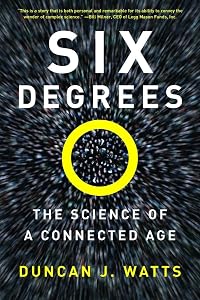
Six Degrees: The Science of a Connected Age
by Duncan J. Watts
On This Page
Description
The pioneering young scientist whose work on the structure of small worlds has triggered an avalanche of interest in networks. In this remarkable book, Duncan Watts, one of the principal architects of network theory, sets out to explain the innovative research that he and other scientists are spearheading to create a blueprint of our connected planet. Whether they bind computers, economies, or terrorist organizations, networks are everywhere in the real world, yet only recently have show more scientists attempted to explain their mysterious workings. From epidemics of disease to outbreaks of market madness, from people searching for information to firms surviving crisis and change, from the structure of personal relationships to the technological and social choices of entire societies, Watts weaves together a network of discoveries across an array of disciplines to tell the story of an explosive new field of knowledge, the people who are building it, and his own peculiar path in forging this new science. show lessTags
Recommendations










Member Reviews
This book is a very good introduction to the fascinating world of networked systems - from social groups to computer networks. Why does success breed success in some systems? What does it look like in measurable terms? How do people find information in a social network? I found this book fascinating and I appreciated that it never oversimplified what is a complex topic. I never got Malcolm Gladwelled.
This is an interesting book about how the world is connected. If you like a mix of math, science, sociology and technology, you'll love this.
A look at the maths behind the idea that there are 'six degreees of separation' and other networking theories. Interesting stuff and I like the fact that the author is not afraid to include plenty of graphs to illustrate his ideas, popular science books that insist on using only words drive me nuts.
A look at the maths behind the idea that there are 'six degreees of separation' and other networking theories. Interesting stuff and I like the fact that the author is not afraid to include plenty of graphs to illustrate his ideas, popular science books that insist on using only words drive me nuts.
His first book (on Small World Networks) was more technical than this one, which was more of a popular-science account of his work and others in the field. Still, a nice introduction for lay readers.
'Six degrees of separation' is a cliche, both of the language and of everyday experience. But it's also an intriguing idea with a long history and some surprising implications. We all live in tightly bonded social networks, yet linked to vast numbers of people more closely than we sometimes think. Scientists have begun to apply insights from the theoretical study of networks to understand forms as superficially different as social networks and electrical networks, computer networks and economical networks, and to show how common principles underlie them all.
Wait, what? I did not realize this was published back in 2004. If I'm going to read something this 'informative' I want it to be truly up-to-date.
Members
- Recently Added By
Published Reviews
ThingScore 75
I would recommend Watts's book to Technology and Culture readers seeking an introduction to this new field for themselves or for their students.
added by Katya0133
Watts's technical descriptions are solid and clear, but the personal narrative feels forced and is generally superfluous.
added by Katya0133
Lists

The Great Courses: How Ideas Spread
4 works; 1 member
Author Information

4 Works 1,662 Members
Duncan J. Watts is associate professor of sociology at Columbia University and an external faculty member of the Santa Fe Institute. He holds a Ph.D. in theoretical and applied mechanics and has published in leading physics and sociology journals. He lives in New York City
Common Knowledge
- Original title
- Six Degrees: The Science of a Connected Age
- Original publication date
- 2003
Classifications
Statistics
- Members
- 845
- Popularity
- 32,620
- Reviews
- 12
- Rating
- (3.84)
- Languages
- 5 — Chinese, English, French, German, Spanish
- Media
- Paper, Ebook
- ISBNs
- 8
- ASINs
- 3