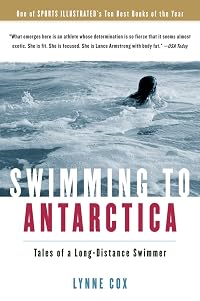
Swimming to Antarctica: Tales of a Long-Distance Swimmer
by Lynne Cox
On This Page
Description
At age fourteen, she swam twenty-six miles from Catalina Island to the California mainland. At ages fifteen and sixteen, she broke the men's and women's world records for swimming the English Channel-a thirty-three-mile crossing in nine hours, thirty-six minutes. At eighteen, she swam the twenty-mile Cook Strait between North and South Islands of New Zealand, was caught on a massive swell, found herself after five hours farther from the finish than when she started, and still completed the show more swim. She was the first to swim the Strait of Magellan, the most treacherous three-mile stretch of water in the world. The first to swim the Bering Strait-the channel that forms the boundary line between the United States and Russia-from Alaska to Siberia, thereby opening the U.S.-Soviet border for the first time in forty-eight years, swimming in thirty-eight-degree water in four-foot waves without a shark cage, wet suit, or lanolin grease. The first to swim the Cape of Good Hope (a shark emerged from the kelp, its jaws wide open, and was shot as it headed straight for her). In this extraordinary book, the world's most extraordinary distance swimmer writes about her emotional and spiritual need to swim and about the almost mystical act of swimming itself. Lynne Cox trained hard from age nine, working with an Olympic coach, swimming five to twelve miles each day in the Pacific. At age eleven, she swam even when hail made the water "like cold tapioca pudding" and was told she would one day swim the English Channel. Four years later-not yet out of high school-she broke the men's and women's world records for the Channel swim. In 1987, she swam the Bering Strait from America to the Soviet Union-a feat that, according to Gorbachev, helped diminish tensions between Russia and the United States. Lynne Cox's relationship with the water is almost mystical: she describes swimming as flying, and remembers swimming at night through flocks of flying fish the size of mockingbirds, remembers being escorted by a pod of dolphins that came to her off New Zealand. She has a photographic memory of her swims. She tells us how she conceived of, planned, and trained for each, and re-creates for us the experience of swimming (almost) unswimmable bodies of water, including her most recent astonishing one-mile swim to Antarctica in thirty-two-degree water without a wet suit. She tells us how, through training and by taking advantage of her naturally plump physique, she is able to create more heat in the water than she loses. Lynne Cox has swum the Mediterranean, the three-mile Strait of Messina, under the ancient bridges of Kunning Lake, below the old summer palace of the emperor of China in Beijing. Breaking records no longer interests her. She writes about the ways in which these swims instead became vehicles for personal goals, how she sees herself as the lone swimmer among the waves, pitting her courage against the odds, drawn to dangerous places and treacherous waters that, since ancient times, have challenged sailors in ships. show lessTags
Recommendations










Member Reviews
Lynne Cox was a long distance swimmer. In the ocean. When she was a teenager in the 1970s, she swam with a group of other teenagers to cross the Catalina Island Channel in California. They were the first teenagers to do so. It only fuelled her desire for bigger, longer, colder swims. She worked for 10 years (meanwhile doing other swims: English Bay, Cook Strait (between the North and South Islands of New Zealand), the Nile River (ugh!) in Egypt, and many more) to be able to cross the Bering Strait (from Alaska to the Soviet Union – this was during the Cold War, which is why it was so difficult to get permission). Ultimately, after all that, she swam in the Antarctic Ocean in 32 F water for a hour.
This was really good. I’m not much show more into sports or swimming, but it was so interesting to learn all the planning and different things they have to think about and arrange when they do such swims. And it was even somewhat suspenseful – the cold! She obviously lived through it all to write this memoir, but to read about what was going through her head (and going on with her body) while she swam in water that was in the 40s F (then later, 30s!). So interesting! show less
This was really good. I’m not much show more into sports or swimming, but it was so interesting to learn all the planning and different things they have to think about and arrange when they do such swims. And it was even somewhat suspenseful – the cold! She obviously lived through it all to write this memoir, but to read about what was going through her head (and going on with her body) while she swam in water that was in the 40s F (then later, 30s!). So interesting! show less
I'd really give this 3.5.
I (finally) finished "Swimming to Antarctica: Tales of a Long-Distance Swimmer" by Lynne Cox. Even though I enjoyed it, for some reason, I feel like it took me a long time to read it.
I was thoroughly swept away reading about Lynne Cox's swims in rivers, lakes, & oceans around the world. Wow. Her swimming feats are totally amazing. I do wish there would have been a few maps in the book to detail some of the bodies of water where she was swimming. Also, there were a few parts where I felt like she 'named too many names' (i.e., all the doctors, cameramen, watchers, etc...) for a few of the swims. I'm sure she wants to thank all those folks, but it gets tedious to read so many names when they're not really major show more players in the book -- more of a once or twice mention in a chapter.
It's interesting to learn about how she preps for such challenging swims in very cold water, the distances she swims, & so on. Last year, I read "The Man Who Swam the Amazon: 3,274 Miles on the World's Deadliest River" by Matthew Mohlke (river guide) & Martin Strel (the swimmer who routinely swam anywhere from 40-70+ miles a DAY for months on end). I think it would be fascinating to hear both of these swimmers get together & 'talk shop'. I didn't plan to read two books about long-distance swimmers, but I'm glad I did, just to see the similarities & differences.
Overall, I'd definitely recommend "Swimming to Antarctica", especially for those who enjoy non-fiction travel/adventure/sports books. show less
I (finally) finished "Swimming to Antarctica: Tales of a Long-Distance Swimmer" by Lynne Cox. Even though I enjoyed it, for some reason, I feel like it took me a long time to read it.
I was thoroughly swept away reading about Lynne Cox's swims in rivers, lakes, & oceans around the world. Wow. Her swimming feats are totally amazing. I do wish there would have been a few maps in the book to detail some of the bodies of water where she was swimming. Also, there were a few parts where I felt like she 'named too many names' (i.e., all the doctors, cameramen, watchers, etc...) for a few of the swims. I'm sure she wants to thank all those folks, but it gets tedious to read so many names when they're not really major show more players in the book -- more of a once or twice mention in a chapter.
It's interesting to learn about how she preps for such challenging swims in very cold water, the distances she swims, & so on. Last year, I read "The Man Who Swam the Amazon: 3,274 Miles on the World's Deadliest River" by Matthew Mohlke (river guide) & Martin Strel (the swimmer who routinely swam anywhere from 40-70+ miles a DAY for months on end). I think it would be fascinating to hear both of these swimmers get together & 'talk shop'. I didn't plan to read two books about long-distance swimmers, but I'm glad I did, just to see the similarities & differences.
Overall, I'd definitely recommend "Swimming to Antarctica", especially for those who enjoy non-fiction travel/adventure/sports books. show less
This is a memoir in the "look at the impressive results of my work ethic" vein. From a literary point of view, this is tiresome, but it's easy to suspend annoyance: Lynne Cox's swimming achievements are amazing. She pushes the bounds of human ability in an arena that brings little to no fame or fortune. She survives, and seems to find joy, in plunging into freezing water, dodging icebergs and sharks, to spend hours pushing through the boundaries that the human body has erected in an attempt not to get killed by hypothermia. It's never quite clear why she feels driven to do this, but there are some convincing scenes of post-swim euphoria, beautiful pods of dolphins and blooms of phosphorescent algae, and pride in the achievement of show more world-class teams. show less
Lynne Cox discovered early that she loved swimming in the elements, and as a very fit swimmer with loads of endurance but not much speed over short swims, she is a natural at swimming for hours in open water. At the age of 14 she began by swimming the Catalina Channel between Catalina Island and Seal Beach just south of Los Angles (26 miles/over 12 hours). She then went looking for more challenges and set world records for the English Channel, was the first woman and one of only 5 people to swim the Cook Strait in New Zealand, and raced in the Nile River. She then set her sights on swimming the Bering Strait between Little Diomede Island and Big Diomede before the end of the cold war on her way to her most extreme swim in the life show more threatening cold of Antarctica. In the mean time swimming around the shark infested Cape of Good Hope, in Alaska’s Glacier Bay, across Russia’s Lake Baikal and in various other spots around the world.
I don’t usually like biography but I was sucked into this book from the first page. Throughout the book Lynne shares her fears, her determination and her triumphs with a humble spirit and with sincere acknowledgment of all the people in her life who have supported and encouraged her to follow her very extreme dreams. A fabulous read! show less
I don’t usually like biography but I was sucked into this book from the first page. Throughout the book Lynne shares her fears, her determination and her triumphs with a humble spirit and with sincere acknowledgment of all the people in her life who have supported and encouraged her to follow her very extreme dreams. A fabulous read! show less
I normally don't go for the inspirational books, let alone the sports memoirs. Lynne Cox is the exception to all of this. Her book is soft spoken, determined, and truly inspirational. The book isn't preaching, nor is it a hearty pat on the back in any way. She acknowledges how difficult all that she did was, and she is thankful every step of the way to those who helped her do it.
Lynne Cox is truly one of the most incredible people I've ever had the joy of reading about. She achieved more in her life than just about anyone else I've read. They should be teaching about this woman in schools. What hope, and what stubborn determination. If everyone had her drive - well, this world would be a far better place.
My hat's off to Ms. Cox. She's show more certainly inspired me. show less
Lynne Cox is truly one of the most incredible people I've ever had the joy of reading about. She achieved more in her life than just about anyone else I've read. They should be teaching about this woman in schools. What hope, and what stubborn determination. If everyone had her drive - well, this world would be a far better place.
My hat's off to Ms. Cox. She's show more certainly inspired me. show less
Gripping read about a woman who does long distance swimming in the world's coldest waters. You'll feel cold reading it (making it the perfect summer read!) and awed by the willpower Lynne Cox demonstrates. If you've ever participated in an endurance sport, you must read this book.
The author is a good writer. The attitude throughout the book is positive, stories are motivating and inspiring. The change of goals in the last third of the book towards being an ambassador of goodwill adds interest and shows that real people often modify their focus after their initial goal has been reached.
The description of dolphin behavior in the New Zealand swim is detailed and better than most descriptions of their behavior in more scientific publications.
My rating would have been slightly higher if the author had finished the side-story of her friend, the young Egyptian athlete, after bringing it into the story and following it for a while.
This book is a good choice for athletes and all who are looking for a way to make a show more difference or just to find their strengths and develop them to a follow a path forward in life. show less
The description of dolphin behavior in the New Zealand swim is detailed and better than most descriptions of their behavior in more scientific publications.
My rating would have been slightly higher if the author had finished the side-story of her friend, the young Egyptian athlete, after bringing it into the story and following it for a while.
This book is a good choice for athletes and all who are looking for a way to make a show more difference or just to find their strengths and develop them to a follow a path forward in life. show less
Members
- Recently Added By
Lists

Adult Books for YA Readers
194 works; 6 members

Books Read in 2007
326 works; 8 members
Author Information

8+ Works 1,845 Members
Lynne Cox has set records all over the world for open-water swimming. She is the author of Swimming to Antarctica and Grayson and lives in Los Alamitos, California.
Awards and Honors
Awards
Distinctions
Notable Lists
Common Knowledge
- Canonical title
- Swimming to Antarctica: Tales of a Long-Distance Swimmer
- Original publication date
- 2004
- Important places
- Antarctica
- Blurbers
- Sachs, Oliver
Classifications
- Genres
- Sports and Leisure, Nonfiction, Biography & Memoir, General Nonfiction
- DDC/MDS
- 797.2 — Arts & recreation Recreation, sports, and performing arts Aquatic and air sports Swimming and diving
- LCC
- GV838 .C69 .A3 — Geography, Anthropology and Recreation Recreation. Leisure Recreation. Leisure Sports Water sports: Canoeing, sailing, yachting, scuba
- BISAC
Statistics
- Members
- 675
- Popularity
- 42,423
- Reviews
- 27
- Rating
- (4.05)
- Languages
- Czech, English
- Media
- Paper, Ebook
- ISBNs
- 12
- ASINs
- 6