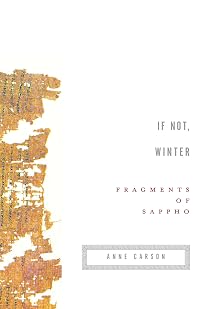
If Not, Winter: Fragments of Sappho
by Sappho
On This Page
Description
"A bilingual edition of the work of the Greek poet Sappho, in a new translation by Anne Carson. Sappho lived on the island of Lesbos from about 630 B.C. She was a musical genius who devoted her life to composing and performing songs. Of the nine books of lyrics Sappho is said to have composed, none of the music is extant and only one poem has survived complete. All the rest are fragments. In If Not, Winter Carson presents all of Sappho's fragments in Greek and in English. Brackets and space show more give the reader a sense of what is absent as well as what is present on the papyrus. Carson's translation illuminates Sappho's reflections on love, desire, marriage, exile, cushions, bees, old age, shame, time, chickpeas and many other aspects of the human situation."--Jacket. show lessTags
Recommendations




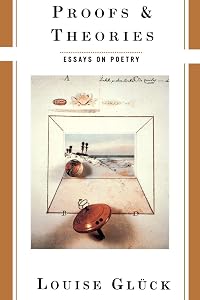
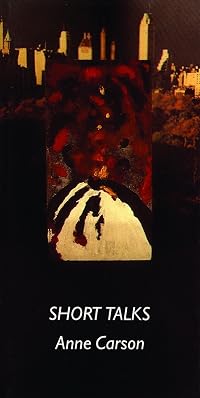
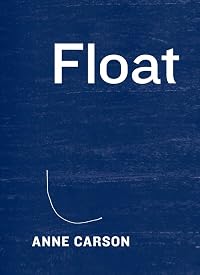
Member Reviews
The omission of so many words (lost from the ancient texts) makes this more rumination than actual reading; some poems have only a line or two extant. Only one remains in its entirety.
Still, Sappho comes through. She exists in vibrant phrases - perhaps more wholly because she is so fractured; imagination fills in - her love for music, for dancing, for her daughter, her pleas to the gods - are desperate in their immediacy, although she's been dust for hundreds of years.
The original Greek is printed on the opposite page. Beautiful.
Still, Sappho comes through. She exists in vibrant phrases - perhaps more wholly because she is so fractured; imagination fills in - her love for music, for dancing, for her daughter, her pleas to the gods - are desperate in their immediacy, although she's been dust for hundreds of years.
The original Greek is printed on the opposite page. Beautiful.
How spellbinding and redolent Sappho's fragments are. In their spaces, incompleteness, and briefness lie the beauty of a thousand interpretations and perceptions. Indeed, it's quite a waste to think that most of her works are lost forever and that we must rely on our imagination in envisioning this stunning arrangement of words ("sweetworded desires", "goldsandaled Dawn", "piercing breezes") sung accompanied by the gentleness of the lyre — wooing, proclaiming, praising. Other than Sappho's indubitable genius as a poet, Anne Carson's translation is not to be missed. Each "]" that designates parts of a papyrus indecipherable / destroyed hints of a much grandeur whole. All is felt and guessed. Moreover, Carson's section for Notes show more provides fascinating insight on some of her literary decisions regarding the translation, some points theorise for what / for whom perhaps a certain fragment is for. I also marvelled on some of the influences included.
"I don't know what to do
two states of mind in me"
— FRAGMENT 51
"you came and I was crazy for you
and you cooled my mind that burned with longing"
— FRAGMENT 48
Throughout the course of reading this, I tend to forget what's missing due to their sheer brilliance alone ("mingled with all kinds of colors", "both you and my servant Eros", "may you sleep on the breast of your delicate friend"). I'd like to think the lost / destroyed papyri have been sieved; a matrimony with the earth. Oh how much more in their wholeness? Currently, this book is resting on my bed and I sleep beside it. All these nights I leaf through it, more so when sleep would not come, comforting myself with pictures they form in my head; an intimate commune I built for Sappho and me. What an experience. show less
"I don't know what to do
two states of mind in me"
— FRAGMENT 51
"you came and I was crazy for you
and you cooled my mind that burned with longing"
— FRAGMENT 48
Throughout the course of reading this, I tend to forget what's missing due to their sheer brilliance alone ("mingled with all kinds of colors", "both you and my servant Eros", "may you sleep on the breast of your delicate friend"). I'd like to think the lost / destroyed papyri have been sieved; a matrimony with the earth. Oh how much more in their wholeness? Currently, this book is resting on my bed and I sleep beside it. All these nights I leaf through it, more so when sleep would not come, comforting myself with pictures they form in my head; an intimate commune I built for Sappho and me. What an experience. show less
Babes, I don't know what to tell you, it's Sappho.
I have been meaning to pick up this collection for a while, and I am so glad that I finally did. I have another small collection of Sappho, but this is ALL of it, and when I mean ALL, I mean it collects fragments so small that only a single word could be deciphered. The introduction provided great context on the condition of the existing Sappho fragments and why translating them can be such a challenge. You all know how I feel about translator notes by now. And there are extensive endnotes as well.
While a lot of the value of this book is certainly academic and contextual, it is also just a joy to let Sappho's words wash over you. Yes, even the tiniest of fragments. I loved poems that show more were more or less complete, and also single lines like "spangled is the earth with her crowns," the line, "if not, winter" which is from a deeply fragmented section of a poem that has a more complete later section.
If you love Sappho (AND YOU SHOULD), this is certainly worth a read. show less
I have been meaning to pick up this collection for a while, and I am so glad that I finally did. I have another small collection of Sappho, but this is ALL of it, and when I mean ALL, I mean it collects fragments so small that only a single word could be deciphered. The introduction provided great context on the condition of the existing Sappho fragments and why translating them can be such a challenge. You all know how I feel about translator notes by now. And there are extensive endnotes as well.
While a lot of the value of this book is certainly academic and contextual, it is also just a joy to let Sappho's words wash over you. Yes, even the tiniest of fragments. I loved poems that show more were more or less complete, and also single lines like "spangled is the earth with her crowns," the line, "if not, winter" which is from a deeply fragmented section of a poem that has a more complete later section.
If you love Sappho (AND YOU SHOULD), this is certainly worth a read. show less
you burn me
Incredible how these words conceived millennia ago can cross that chasm of all these thousands of years, through all those who acted as medium and transcribed, preserved, and translated them, to land with such piercing recognition reading them in this present–already past as I type this–period.
It’s difficult to review this, because how do you review papyrean fragments, bits and parts of what survived the destructive effects of time and remained intact and legible while its accompanying parts that made the whole suffered that complete loss to oblivion? Anne Carson’s method, using brackets to indicate where the lost bits would have been, and thus providing space for them, in her words: “brackets imply a free space of show more imaginal adventure” creates a kind of continuity and connectivity to the work. Providing reverberations to what would have been whole.
The poems themselves are a celebration of life and love. They are rapturous, sensual, and lyrical. When one takes a step back and beholds the whole tapestry: Sappho herself and the splendour of these wonderful fragments of poetry, all that it has survived, the work through the ages to preserve, Carson’s brilliant translation, it’s hard not to be awed.
Some of my favourite parts:
"Eros the melter of limbs (now again) stirs me–
sweet bitter unmanageable creature who steals in"
" Eros shook my
mind like a mountain wind falling on oak trees"
"I don't know what to do
two states of mind in me"
"O beautiful O graceful one"
"may you sleep on the breast of your delicate friend" show less
Incredible how these words conceived millennia ago can cross that chasm of all these thousands of years, through all those who acted as medium and transcribed, preserved, and translated them, to land with such piercing recognition reading them in this present–already past as I type this–period.
It’s difficult to review this, because how do you review papyrean fragments, bits and parts of what survived the destructive effects of time and remained intact and legible while its accompanying parts that made the whole suffered that complete loss to oblivion? Anne Carson’s method, using brackets to indicate where the lost bits would have been, and thus providing space for them, in her words: “brackets imply a free space of show more imaginal adventure” creates a kind of continuity and connectivity to the work. Providing reverberations to what would have been whole.
The poems themselves are a celebration of life and love. They are rapturous, sensual, and lyrical. When one takes a step back and beholds the whole tapestry: Sappho herself and the splendour of these wonderful fragments of poetry, all that it has survived, the work through the ages to preserve, Carson’s brilliant translation, it’s hard not to be awed.
Some of my favourite parts:
"Eros the melter of limbs (now again) stirs me–
sweet bitter unmanageable creature who steals in"
" Eros shook my
mind like a mountain wind falling on oak trees"
"I don't know what to do
two states of mind in me"
"O beautiful O graceful one"
"may you sleep on the breast of your delicate friend" show less
but I am not someone who likes to wound
rather I have a quiet mind
Carson's translations here are brilliant. Sappho comes to life, simply. The fragmentary nature of her catalogue is not as frustrating as one might think. Carson beautifully renders them on the page, and the lacunae become a part of the experience. After reading a handful of other translations, I have to say that Carson's stand alone as something not quite faithful to text, as much as faithful to the spirit.
rather I have a quiet mind
Carson's translations here are brilliant. Sappho comes to life, simply. The fragmentary nature of her catalogue is not as frustrating as one might think. Carson beautifully renders them on the page, and the lacunae become a part of the experience. After reading a handful of other translations, I have to say that Carson's stand alone as something not quite faithful to text, as much as faithful to the spirit.
One of my favorites this year! Anne Carson does a spectacular job at not only conveying the sense of all that was lost— what once was and is now forever a mystery— but, as she says in the introduction, allows Sappho to shine brightly throughout the work.
Though I have always appreciated the legacy of Sappho, I had not read much more than a couple lines of her work before I picked this book up. I didn’t know what to expect and was pleasantly surprised by the rawness, beauty, and poignancy of her words. What is there and what is left to the shadow of millennia past all culminate to a distinct feeling for the spirit of the icon that was and is Sappho.
Here are some lines that stuck out to me:
“..your sweet speaking
and lovely show more laughing—oh it
puts the heart in my chest on wings
for when I look at you, even a moment, no speaking
is left in me
no: tongue breaks and thin
fire is racing under skin
and in no sight and drumming
fills ears
and cold sweat holds me and shaking
grips me all, greener than grass
I am and dead—or almost
I seem to me.
But all is to be dared….”
“Eros shook my
mind like a mountain wind falling on oak trees”
“For the man who is beautiful is beautiful to see
but the good man will at once also beautiful be.”
“I would rather see her lovely step
and the motion of light on her face
than chariots of Lydians or ranks
of footsoldiers in arms.”
“I simply want to be dead.
Weeping she left me
with many tears and said this:
Oh how badly things have turned out for us.
Sappho, I swear, against my will I leave you.”
“as sometimes at sunset
the roseyfingered moon
surpasses all the stars. And her light
stretches over salt sea
equally and flowerdeep fields…..
But she goes back and forth remembering
gentle Atthis and in longing
she bites her tender mind……
]into desire I shall come”
“but me you have forgotten
or you love some man more than me”
“I have a beautiful child who is like golden flowers
in form, darling Kleis
in exchange for whom I would not
all Lydia or lovely”
“Atthis, to you it has become hateful
to think of me and you fly to Andromeda”
“…..that shepherd men
with their feet trample down and on the ground the purple
flower”
“And with sweet oil
costly
you anointed yourself
and on a soft bed
delicate
you would let loose your longing
and neither any [ ] nor any
holy place nor
was there from which we were absent
no grove[ ]no dance
]no sound” show less
Though I have always appreciated the legacy of Sappho, I had not read much more than a couple lines of her work before I picked this book up. I didn’t know what to expect and was pleasantly surprised by the rawness, beauty, and poignancy of her words. What is there and what is left to the shadow of millennia past all culminate to a distinct feeling for the spirit of the icon that was and is Sappho.
Here are some lines that stuck out to me:
“..your sweet speaking
and lovely show more laughing—oh it
puts the heart in my chest on wings
for when I look at you, even a moment, no speaking
is left in me
no: tongue breaks and thin
fire is racing under skin
and in no sight and drumming
fills ears
and cold sweat holds me and shaking
grips me all, greener than grass
I am and dead—or almost
I seem to me.
But all is to be dared….”
“Eros shook my
mind like a mountain wind falling on oak trees”
“For the man who is beautiful is beautiful to see
but the good man will at once also beautiful be.”
“I would rather see her lovely step
and the motion of light on her face
than chariots of Lydians or ranks
of footsoldiers in arms.”
“I simply want to be dead.
Weeping she left me
with many tears and said this:
Oh how badly things have turned out for us.
Sappho, I swear, against my will I leave you.”
“as sometimes at sunset
the roseyfingered moon
surpasses all the stars. And her light
stretches over salt sea
equally and flowerdeep fields…..
But she goes back and forth remembering
gentle Atthis and in longing
she bites her tender mind……
]into desire I shall come”
“but me you have forgotten
or you love some man more than me”
“I have a beautiful child who is like golden flowers
in form, darling Kleis
in exchange for whom I would not
all Lydia or lovely”
“Atthis, to you it has become hateful
to think of me and you fly to Andromeda”
“…..that shepherd men
with their feet trample down and on the ground the purple
flower”
“And with sweet oil
costly
you anointed yourself
and on a soft bed
delicate
you would let loose your longing
and neither any [ ] nor any
holy place nor
was there from which we were absent
no grove[ ]no dance
]no sound” show less
Ms. Carson's Sappho is to my mind very, very brilliant. My reading experience of it was to hear the poems as sung to imaginary lyre accompaniment. What's great about that is that the fragmentary poems (i.e., all but one or two) can be "heard" as if from a distance, say, from across a courtyard or several rooms away, so it's as if because of acoustics you can only pick up a few words. Taking this approach as a reader, I found the resulting experience very natural, musical, and lifelike, and the missing words no problem (it's as if they're not missing at all, but just unable to be made out at present because of distance and/or local acoustic conditions).
I believe Carson has indeed deliberately taken this approach. You see this in her show more refraining from translating every word, i.e., reducing some relatively wordy fragments to one or two simple evocative nouns. Or, to take an extreme case, look at p. 59, where she's thrown all the Greek away but "for ." Carson's saying, in effect, there are no missing words; it's all there in the music. The reader just has to imagine the accompaniment. show less
I believe Carson has indeed deliberately taken this approach. You see this in her show more refraining from translating every word, i.e., reducing some relatively wordy fragments to one or two simple evocative nouns. Or, to take an extreme case, look at p. 59, where she's thrown all the Greek away but "for ." Carson's saying, in effect, there are no missing words; it's all there in the music. The reader just has to imagine the accompaniment. show less
Members
- Recently Added By
Lists

Poetry Corner
187 works; 15 members

Reading list
170 works; 1 member

Literary Witches
86 works; 4 members
A Reading List
100 works; 3 members

Books recommended in the history category on FiveBooks.com
329 works; 4 members
Talk Discussions
Past Discussions
Sappho - If Not, Winter in Folio Society Devotees (January 2024)
Author Information

207+ Works 6,774 Members
Sappho, whom Plato (see Vols. 3 and 4) called "the tenth Muse," was the greatest of the early Greek lyric poets. She was born at Mytilene on Lesbos and was a member---perhaps the head---of a group of women who honored the Muses and Aphrodite. Her family was aristocratic; it is said that she was married and had a daughter. Her brilliant love show more lyrics, marriage songs, and hymns to the gods are written in Aeolic dialect in many meters, one of which is named for her---the Sapphic. Mostly fragments survive of the nine books she is thought to have authored. Her verse is simple and direct, exquisitely passionate and vivid. Catullus, Ovid, and Swinburne (see Vol. 1) were among the many later poets she influenced. (Bowker Author Biography) show less
All Editions
Awards and Honors
Common Knowledge
- Canonical title
- If Not, Winter: Fragments of Sappho
- Original publication date
- 2002
- People/Characters
- Sappho
- Important places
- Lesbos, Greece; Greece; Ancient Greece
- Dedication
- For Emmett Robbins,
Beloved Teacher
/
With Special Thanks to
Dorota Dutsch - First words
- Sappho was a musician. Her poetry was lyric, that is, composed to be sung to the lyre.
- Blurbers
- The New York Times; Time Out New York; Los Angeles Times; Boston Review
- Original language
- Greek
Classifications
Statistics
- Members
- 1,931
- Popularity
- 11,077
- Reviews
- 36
- Rating
- (4.34)
- Languages
- English, Greek (Ancient), Spanish
- Media
- Paper
- ISBNs
- 7
- ASINs
- 3