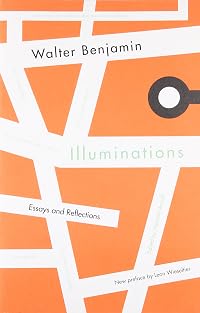
Illuminations: Essays and Reflections
by Walter Benjamin
On This Page
Description
Essays and reflections from one of the twentieth century's most original cultural critics, with an introduction by Hannah Arendt. Walter Benjamin was an icon of criticism, renowned for his insight on art, literature, and philosophy. This volume includes his views on Kafka, with whom he felt a close personal affinity; his studies on Baudelaire and Proust; and his essays on Leskov and Brecht's epic theater. Illuminations also includes his penetrating study "The Work of Art in the Age of show more Mechanical Reproduction," an enlightening discussion of translation as a literary mode; and his theses on the philosophy of history. Hannah Arendt selected the essays for this volume and introduces them with a classic essay about Benjamin's life in a dark historical era. Leon Wieseltier's preface explores Benjamin's continued relevance for our times. Walter Benjamin (1892-1940) was a German-Jewish Marxist literary critic, essayist, translator, and philosopher. He was at times associated with the Frankfurt School of critical theory and was also greatly inspired by the Marxism of Bertolt Brecht and Jewish mysticism as presented by Gershom Scholem. show lessTags
Recommendations














Member Reviews
I'd come across [a:Walter Benjamin|1860|Walter Benjamin|https://images.gr-assets.com/authors/1651512562p2/1860.jpg] mentioned in various non-fiction (e.g [b:In Search of Lost Books: The forgotten stories of eight mythical volumes|37785767|In Search of Lost Books The forgotten stories of eight mythical volumes|Giorgio van Straten|https://i.gr-assets.com/images/S/compressed.photo.goodreads.com/books/1514776378l/37785767._SY75_.jpg|49785515]) and long been fascinated by [b:The Arcades Project|52223|The Arcades Project|Walter Benjamin|https://i.gr-assets.com/images/S/compressed.photo.goodreads.com/books/1649761785l/52223._SY75_.jpg|1034465]. Indeed, I own a copy but haven't yet tackled its immensity. show more [b:Illuminations|52213|Illuminations|Walter Benjamin|https://i.gr-assets.com/images/S/compressed.photo.goodreads.com/books/1348396316l/52213._SY75_.jpg|440208] seemed like a suitable introduction to Benjamin's writing. It was edited and is introduced at length by [a:Hannah Arendt|12806|Hannah Arendt|https://images.gr-assets.com/authors/1608634661p2/12806.jpg]. As a known sceptic of long introductions to books of theory (which put me off Marx's Capital and Lefebvre's [b:Critique of Everyday Life|18310311|Critique of Everyday Life|Henri Lefebvre|https://i.gr-assets.com/images/S/compressed.photo.goodreads.com/books/1398034395l/18310311._SX50_.jpg|87515130] for years), I was pleased to find Arendt's clear, well-structured, and enlightening. Rather than placing a barrier in front of the book, her introduction enhances the reading experience. It provides a succinct synopsis of Benjamin's life, work, and milieu. Inevitably, there is great emphasis on his extraordinary bad luck. Benjamin's timing was, tragically, always wrong. Arendt wonders whether he was born too late to be a man of letters, whereas I found myself thinking that he could also have been a blogger and contemporary writer of cultural commentary. Indeed, he is apparently the progenitor of those popular montage-style tumblr posts:
[b:Illuminations|52213|Illuminations|Walter Benjamin|https://i.gr-assets.com/images/S/compressed.photo.goodreads.com/books/1348396316l/52213._SY75_.jpg|440208] collects writing on books, poetry, theatre, historiography, and art. Benjamin was nothing if not eclectic. This makes general commentary on the collection as a whole difficult. My experiences of each essay varied quite a bit. 'Unpacking My Library' was easy to read but surprisingly unmemorable; 'Franz Kafka' was hard to follow and I cannot say I understood much of it. Conversely, I found 'On Some Motifs in Baudelaire' fascinating and 'The Storyteller' full of insight. I also learned two new words: apodictically (expressing certainty/truth) and banausic (mundane, technical).
I wasn't very surprised that the clear highlight of the collection was an essay I've seen cited repeatedly, 'The Work of Art in the Age of Mechanical Reproduction'. This remains rewarding and thought-provoking in the age of mechanical reinterpretation, when machine learning can be used to remix existing art into seemingly new works (if they can be considered such). Benjamin's analysis of how mechanical reproduction of art changes our relationship with it is of interest both in the historical context when it was written and now, when mechanical reproduction of art has become effectively instant.
He quotes Paul Valéry predicting this very thing: 'Just as water, gas, and electricity are brought into our houses from far off to satisfy our needs in response to a minimal effort, so we shall be supplied with visual or auditory images, which will appear and disappear at a simple movement of the hand, hardly more than a sign.' Just so, a swipe of the finger summons a new algorithmically-chosen selection of static and moving images, with optional sounds. Benjamin's contemplations on film still apply quite neatly to the disorientating, agitating quality of online videos:
The final sentences of this essay seem uncomfortably relevant in a time of neo-fascism: '[Humanity's] self-alienation has reached such a degree that it can experience its own destruction as an aesthetic pleasure of the first order. This is the situation of politics that fascism is rendering aesthetic. Communism responds by politicising art.'
Briefer and more fragmentary but equally memorable, my other favourite in the collection was 'Theses on the Philosophy of History'. It too has notable significance to the present, as well as some beautifully chilling imagery:
Benjamin turned out to be as intriguingly idiosyncratic as I'd heard. Although the essays in [b:Illuminations|52213|Illuminations|Walter Benjamin|https://i.gr-assets.com/images/S/compressed.photo.goodreads.com/books/1348396316l/52213._SY75_.jpg|440208] are a varied bunch, they all exhibit a striking voice and unusual intelligence. I don't pretend to understand or fully appreciate every one of them, but found all distinctive and several really powerful. I feel a little more prepared for [b:The Arcades Project|52223|The Arcades Project|Walter Benjamin|https://i.gr-assets.com/images/S/compressed.photo.goodreads.com/books/1649761785l/52223._SY75_.jpg|1034465] now. show less
The main work consisted in tearing fragments out of their context and arranging them afresh in such a way that they illustrated one another and were able to prove their raison d'être in a free-floating state, as it were. It definitely was a sort of surrealistic montage.
[b:Illuminations|52213|Illuminations|Walter Benjamin|https://i.gr-assets.com/images/S/compressed.photo.goodreads.com/books/1348396316l/52213._SY75_.jpg|440208] collects writing on books, poetry, theatre, historiography, and art. Benjamin was nothing if not eclectic. This makes general commentary on the collection as a whole difficult. My experiences of each essay varied quite a bit. 'Unpacking My Library' was easy to read but surprisingly unmemorable; 'Franz Kafka' was hard to follow and I cannot say I understood much of it. Conversely, I found 'On Some Motifs in Baudelaire' fascinating and 'The Storyteller' full of insight. I also learned two new words: apodictically (expressing certainty/truth) and banausic (mundane, technical).
I wasn't very surprised that the clear highlight of the collection was an essay I've seen cited repeatedly, 'The Work of Art in the Age of Mechanical Reproduction'. This remains rewarding and thought-provoking in the age of mechanical reinterpretation, when machine learning can be used to remix existing art into seemingly new works (if they can be considered such). Benjamin's analysis of how mechanical reproduction of art changes our relationship with it is of interest both in the historical context when it was written and now, when mechanical reproduction of art has become effectively instant.
He quotes Paul Valéry predicting this very thing: 'Just as water, gas, and electricity are brought into our houses from far off to satisfy our needs in response to a minimal effort, so we shall be supplied with visual or auditory images, which will appear and disappear at a simple movement of the hand, hardly more than a sign.' Just so, a swipe of the finger summons a new algorithmically-chosen selection of static and moving images, with optional sounds. Benjamin's contemplations on film still apply quite neatly to the disorientating, agitating quality of online videos:
Let us compare the screen on which a film unfolds with the canvas of a painting. The painting invites the spectator to contemplation; before it the spectator can abandon himself to his associations. Before the movie frame he cannot do so. No sooner has his eye grasped a scene than it has already changed. Duhamel, who detests the film and knows nothing of its significance, though something of its structure, notes this circumstance as follows, 'I can no longer think what I want to think. My thoughts have been replaced by moving images.' The spectator's process of association in view of these images is indeed interrupted by their constant, sudden change.
This constitutes the shock effect of the film, which, like all shocks, should be cushioned bt heightened presence of mind. By means of its technical structure, the film has taken the physical shock effect out of wrappers in which Dadaism had, as it were, kept it inside the moral shock effect.
The final sentences of this essay seem uncomfortably relevant in a time of neo-fascism: '[Humanity's] self-alienation has reached such a degree that it can experience its own destruction as an aesthetic pleasure of the first order. This is the situation of politics that fascism is rendering aesthetic. Communism responds by politicising art.'
Briefer and more fragmentary but equally memorable, my other favourite in the collection was 'Theses on the Philosophy of History'. It too has notable significance to the present, as well as some beautifully chilling imagery:
This is how one pictures the angel of history. His face is turned towards the past. Where we perceive a chain of events, he sees one single catastrophe which keeps piling wreckage upon wreckage and hurls it in front of his feet. The angel would like to stay, awaken the dead, and make whole what has been smashed. But a storm is blowing from Paradise; it has got caught in his wings with such violence that the angel can no longer close them. This storm irresistibly propels him into the future to which his back is turned, while the pile of debris before him grows skyward. This storm is what we call progress.
Benjamin turned out to be as intriguingly idiosyncratic as I'd heard. Although the essays in [b:Illuminations|52213|Illuminations|Walter Benjamin|https://i.gr-assets.com/images/S/compressed.photo.goodreads.com/books/1348396316l/52213._SY75_.jpg|440208] are a varied bunch, they all exhibit a striking voice and unusual intelligence. I don't pretend to understand or fully appreciate every one of them, but found all distinctive and several really powerful. I feel a little more prepared for [b:The Arcades Project|52223|The Arcades Project|Walter Benjamin|https://i.gr-assets.com/images/S/compressed.photo.goodreads.com/books/1649761785l/52223._SY75_.jpg|1034465] now. show less
Of Benjamin, Dwarfs and Angels, August 27, 2006
The depth of Benjamin's pessimism has, I think, been underestimated.
"The story is told of an automation constructed in such a way that it could play a winning game of chess, answering each move of an opponent with a countermove. A puppet in Turkish attire and with a hookah in its mouth sat before a chessboard placed on a large table. A system of mirrors created the illusion that this table was transparent from all sides. Actually, a little hunchback who was an expert chess player sat inside and guided the puppet's hand by means of strings. One can imagine a philosophical counterpart to this device. The puppet called "historical materialism" is to win all the time. It can easily be a match show more for anyone if it enlists the services of theology, which today, as we know, is wizened and has to keep out of sight." Walter Benjamin, First "These on the Philosophy of History", p 253.
One can measure how far the contemporary Marxist (better said, the post or semi-Marxist) left has fallen by how many books have appeared, since the fall of the USSR, enthusing over the radically Universal and allegedly 'Progressive' nature of early Christianity. Walter Benjamin, who was first to place the wise but ugly dwarf (Theology) in the beautiful puppet (Historical Materialism) would be amazed (or perhaps not, see the letters between Benjamin and Scholem) to learn that puppet and dwarf are on the verge of switching places! That is, now the ugly dwarf (historical materialism) wants to hide in (and of course direct) the beautiful puppet of Christian theology. ...Crazy, you say? But even Habermas, the Keeper of the Flame of Critical Theory, has on occasion made somewhat similar noises. The best place, btw, to start reading about this new 'political-theology' probably remains Jacob Taubes.
But perhaps this emergent trend is really not so crazy after all. The only reason the Church became so cozy with Capitalism was its fear of Atheism. The collapse of the Soviet Union ended that fear. Now Christianity faces Capitalism alone. Or not, if the detente being proposed between the left and the Church is actually consummated. But every detente is aimed at some third party. The Church was with Capitalism because it had to defeat atheism. Now it is likely that the Church will join (a moderate) Socialism in trying to contain the ravages of capitalism. This is only another move on the chessboard of History. ...But what did Benjamin think of History?
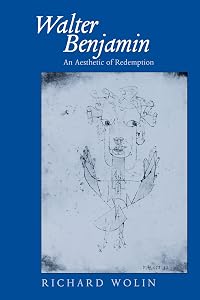
"A Klee painting named "Angelus Novus" shows an angel looking as though he is about to move away from something he is fixedly contemplating. His eyes are staring, his mouth is open, his wings are spread. This is how one pictures the angel of history. His face is turned toward the past. Where we perceive a chain of events, he sees one single catastrophe which keeps piling wreckage upon wreckage and hurls it in front of his feet. The angel would like to stay, awaken the dead, and make whole what has been smashed. But a storm is blowing from Paradise; it has got caught in his wings with such violence that the angel can no longer close them. This storm irresistibly propels him into the future to which his back is turned, while the pile of debris before him grows skyward. This storm is what we call progress." BENJAMIN, Ninth Thesis on History, p 257.
Picture this Angel, wings pinned back by the wind, shoulders forced back because of that - the Angel of History is in the position of the Crucified Christ; except that this crucification does not end. It is this tone of almost ontological despair that was new to the left. This Crucified Angel is the perfect image of the left-wing theoretical pessimism pioneered by not only Benjamin but also Adorno and Horkheimer that split the intellectual left into two camps: the revolutionary and the cultural. And though no one is likely to admit it, the cultural left has quietly come to think of revolution itself as but another 'progressive' force piling up bodies.
It is one of the little ironies of history that this despairing fantasy described contemporary reality exactly. The Angel of History is the image of dialectical knowledge. Rather than seeing disconnected events this Dialectical Knowledge grasps History as One (single catastrophe). Always facing the past ('the owl of Minerva takes flight at night', Hegel said; meaning that dialectical knowledge is retrospective) the 'contemplating' Angel is overwhelmed by historical action - the storm that has been blowing since the expulsion of humanity from paradise - and can never Himself achieve effective action. His knowledge grows in lockstep with the accumulating horror, but each new historical event only results (i,e., gets 'caught in the wings' of our Angel) in more contemplation. So we see how theory (our Angel) is 'irresistibly' propelled into the future. And we also see that the Knowledge dialectical theory gains is precisely equal to the debris the storm hurls at the angel's feet. With an irony equal to the wind blowing from Paradise Benjamin ends this meditation by calling this storm progress.
This is perhaps why Benjamin insisted over 50 years ago that the dwarf Theology must guide the puppet Historical Materialism. Theory can never be equal to action; circumstance piles upon circumstance so rapidly that theory cannot effectively act, and if it does act (presumably) it only adds to the debris. Thus theology (myth) must guide materialism's hand because theoretical knowledge is powerless to help. Benjamin quotes the following remarks of Willy Haas, with approval, in his large Kafka essay;
"'The object of the trial', he writes, 'indeed, the real hero of this incredible book is forgetting, whose main characteristic is the forgetting of itself [...] The most sacred ... act of the ... ritual is the erasing of sins from the book of memory.'
What has been forgotten - and this insight affords us yet another avenue of access to Kafka's work - is never something purely individual." (Benjamin, Franz Kafka, p 131.)
(The last sentence was Benjamin's own.) Theology is a non-individual forgetfulness. Thus myth (theology) is the only forgetfulness worthy of the name. What needs to be forgotten is the unsurpassable fact of the futility of theory...
It is difficult for most to look such despair in the face. show less
The depth of Benjamin's pessimism has, I think, been underestimated.
"The story is told of an automation constructed in such a way that it could play a winning game of chess, answering each move of an opponent with a countermove. A puppet in Turkish attire and with a hookah in its mouth sat before a chessboard placed on a large table. A system of mirrors created the illusion that this table was transparent from all sides. Actually, a little hunchback who was an expert chess player sat inside and guided the puppet's hand by means of strings. One can imagine a philosophical counterpart to this device. The puppet called "historical materialism" is to win all the time. It can easily be a match show more for anyone if it enlists the services of theology, which today, as we know, is wizened and has to keep out of sight." Walter Benjamin, First "These on the Philosophy of History", p 253.
One can measure how far the contemporary Marxist (better said, the post or semi-Marxist) left has fallen by how many books have appeared, since the fall of the USSR, enthusing over the radically Universal and allegedly 'Progressive' nature of early Christianity. Walter Benjamin, who was first to place the wise but ugly dwarf (Theology) in the beautiful puppet (Historical Materialism) would be amazed (or perhaps not, see the letters between Benjamin and Scholem) to learn that puppet and dwarf are on the verge of switching places! That is, now the ugly dwarf (historical materialism) wants to hide in (and of course direct) the beautiful puppet of Christian theology. ...Crazy, you say? But even Habermas, the Keeper of the Flame of Critical Theory, has on occasion made somewhat similar noises. The best place, btw, to start reading about this new 'political-theology' probably remains Jacob Taubes.
But perhaps this emergent trend is really not so crazy after all. The only reason the Church became so cozy with Capitalism was its fear of Atheism. The collapse of the Soviet Union ended that fear. Now Christianity faces Capitalism alone. Or not, if the detente being proposed between the left and the Church is actually consummated. But every detente is aimed at some third party. The Church was with Capitalism because it had to defeat atheism. Now it is likely that the Church will join (a moderate) Socialism in trying to contain the ravages of capitalism. This is only another move on the chessboard of History. ...But what did Benjamin think of History?
"A Klee painting named "Angelus Novus" shows an angel looking as though he is about to move away from something he is fixedly contemplating. His eyes are staring, his mouth is open, his wings are spread. This is how one pictures the angel of history. His face is turned toward the past. Where we perceive a chain of events, he sees one single catastrophe which keeps piling wreckage upon wreckage and hurls it in front of his feet. The angel would like to stay, awaken the dead, and make whole what has been smashed. But a storm is blowing from Paradise; it has got caught in his wings with such violence that the angel can no longer close them. This storm irresistibly propels him into the future to which his back is turned, while the pile of debris before him grows skyward. This storm is what we call progress." BENJAMIN, Ninth Thesis on History, p 257.
Picture this Angel, wings pinned back by the wind, shoulders forced back because of that - the Angel of History is in the position of the Crucified Christ; except that this crucification does not end. It is this tone of almost ontological despair that was new to the left. This Crucified Angel is the perfect image of the left-wing theoretical pessimism pioneered by not only Benjamin but also Adorno and Horkheimer that split the intellectual left into two camps: the revolutionary and the cultural. And though no one is likely to admit it, the cultural left has quietly come to think of revolution itself as but another 'progressive' force piling up bodies.
It is one of the little ironies of history that this despairing fantasy described contemporary reality exactly. The Angel of History is the image of dialectical knowledge. Rather than seeing disconnected events this Dialectical Knowledge grasps History as One (single catastrophe). Always facing the past ('the owl of Minerva takes flight at night', Hegel said; meaning that dialectical knowledge is retrospective) the 'contemplating' Angel is overwhelmed by historical action - the storm that has been blowing since the expulsion of humanity from paradise - and can never Himself achieve effective action. His knowledge grows in lockstep with the accumulating horror, but each new historical event only results (i,e., gets 'caught in the wings' of our Angel) in more contemplation. So we see how theory (our Angel) is 'irresistibly' propelled into the future. And we also see that the Knowledge dialectical theory gains is precisely equal to the debris the storm hurls at the angel's feet. With an irony equal to the wind blowing from Paradise Benjamin ends this meditation by calling this storm progress.
This is perhaps why Benjamin insisted over 50 years ago that the dwarf Theology must guide the puppet Historical Materialism. Theory can never be equal to action; circumstance piles upon circumstance so rapidly that theory cannot effectively act, and if it does act (presumably) it only adds to the debris. Thus theology (myth) must guide materialism's hand because theoretical knowledge is powerless to help. Benjamin quotes the following remarks of Willy Haas, with approval, in his large Kafka essay;
"'The object of the trial', he writes, 'indeed, the real hero of this incredible book is forgetting, whose main characteristic is the forgetting of itself [...] The most sacred ... act of the ... ritual is the erasing of sins from the book of memory.'
What has been forgotten - and this insight affords us yet another avenue of access to Kafka's work - is never something purely individual." (Benjamin, Franz Kafka, p 131.)
(The last sentence was Benjamin's own.) Theology is a non-individual forgetfulness. Thus myth (theology) is the only forgetfulness worthy of the name. What needs to be forgotten is the unsurpassable fact of the futility of theory...
It is difficult for most to look such despair in the face. show less
For every second of time was the strait gate through which the Messiah might enter.
There are hardly enough superlatives for this amazing collection of essays concerning Baudelaire, Proust, Kafka, messianism and the aesthetic tension between the cultic and the exhibitional. I had read Unpacking My Library a half dozen times previously and it still forces me to catch my breath. The thoughts on Kafka explore the mystical as well as the shock of the modern. The shock of the urban and industrial is a recurring theme in these pieces. Likewise is the dearth of actual experience and the onslaught of involuntary memory. It was a strange juxtaposition that this very morning I put down Illuminations and was enjoying my breakfast. Before me in the show more recent Bookforum was an article by Geoff Dyer about August Sander's People of the Twentieth Century https://www.goodreads.com/book/show/473219.August_Sander_1876_1964. Benjamin's idea of aura has likely morphed into something strange over the intervening 70 odd years. show less
There are hardly enough superlatives for this amazing collection of essays concerning Baudelaire, Proust, Kafka, messianism and the aesthetic tension between the cultic and the exhibitional. I had read Unpacking My Library a half dozen times previously and it still forces me to catch my breath. The thoughts on Kafka explore the mystical as well as the shock of the modern. The shock of the urban and industrial is a recurring theme in these pieces. Likewise is the dearth of actual experience and the onslaught of involuntary memory. It was a strange juxtaposition that this very morning I put down Illuminations and was enjoying my breakfast. Before me in the show more recent Bookforum was an article by Geoff Dyer about August Sander's People of the Twentieth Century https://www.goodreads.com/book/show/473219.August_Sander_1876_1964. Benjamin's idea of aura has likely morphed into something strange over the intervening 70 odd years. show less
Benjamin (pronounced BEN-ya-mean) is one of those writers you just can't help loving in a sort of "oh poor Walter" way. His longing for an "aura" even as it seems to be dissolving before his very eyes is so likable and so tragic that you just want to give the guy a hug.
Certainly his life's tragedy leans over the edge of the reader's shoulder and one really can't separate the ideas in these essays from the idea of Walter Benjamin: a guy who's been dealt none of the right cards, can't figure himself to be an employee, who just wants to be left alone to read great books, write great essays, and to lead the life of an homme de lettres, and of course, the final tragedy of his bad luck, when he's off by a single day. I can relate to his show more frustrations, as well as to the seeming impossibility of leading the life he wanted.
Poor, poor Benjamin. show less
Certainly his life's tragedy leans over the edge of the reader's shoulder and one really can't separate the ideas in these essays from the idea of Walter Benjamin: a guy who's been dealt none of the right cards, can't figure himself to be an employee, who just wants to be left alone to read great books, write great essays, and to lead the life of an homme de lettres, and of course, the final tragedy of his bad luck, when he's off by a single day. I can relate to his show more frustrations, as well as to the seeming impossibility of leading the life he wanted.
Poor, poor Benjamin. show less
I suspected some of my trouble this time around was the fault of a horrible translation--the Benjamin I'd read elsewhere was dense but not opaque. Now readers' comments are confirming it. Still, it couldn't mangle all his insight; it's scattered through these essays; he's the only critic I know who could cross the mined landscape between mysticism and materialism and make you believe literature is the high wire that connects the two.
Benjamin (pronounced BEN-ya-mean) is one of those writers you just can't help loving in a sort of "oh poor Walter" way. His longing for an "aura" even as it seems to be dissolving before his very eyes is so likable and so tragic that you just want to give the guy a hug.
Certainly his life's tragedy leans over the edge of the reader's shoulder and one really can't separate the ideas in these essays from the idea of Walter Benjamin: a guy who's been dealt none of the right cards, can't figure himself to be an employee, who just wants to be left alone to read great books, write great essays, and to lead the life of an homme de lettres, and of course, the final tragedy of his bad luck, when he's off by a single day. I can relate to his show more frustrations, as well as to the seeming impossibility of leading the life he wanted.
Poor, poor Benjamin. show less
Certainly his life's tragedy leans over the edge of the reader's shoulder and one really can't separate the ideas in these essays from the idea of Walter Benjamin: a guy who's been dealt none of the right cards, can't figure himself to be an employee, who just wants to be left alone to read great books, write great essays, and to lead the life of an homme de lettres, and of course, the final tragedy of his bad luck, when he's off by a single day. I can relate to his show more frustrations, as well as to the seeming impossibility of leading the life he wanted.
Poor, poor Benjamin. show less
Walter Benjamin is a name, a thinker that I've encountered over and over throughout my years of reading--yet, I've never read his work directly. This, then, was my first experience with the German polymath. Hannah Arendt's 51-page introduction is one of the finest introductions I've ever read-scholarly, compassionate, engaging; it is not to be skipped, though I suggest that it be read after the compendium of Benjamin's essays. Arendt sheds light on the crucial fact that Benjamin was nearly unclassifiable, especially in his lifetime. He did literary criticism but was not a literary critic; he engaged in theological discourse, but was not a theologian, etc. This (or perhaps Harry Zohn's translation) could account for what I feel to be a show more lack of congruence in these essays. Out of all 10 essays, I felt that I was in a jungle of thoughts, only to happen upon shining treasure once in a while. I've included some examples below. Overall, his thoughts were stimulating, though they may not last. The best of the lot were his essay on Proust and the essay on art during the age of mass-production, the latter of which I will be returning to when I concentrate on William Gaddis's [b:The Recognitions|11786836|The Recognitions|William Gaddis|https://d2arxad8u2l0g7.cloudfront.net/books/1348605197s/11786836.jpg|1299804] for my dissertation.
Examples:
Unpacking My Library
- "...the mild boredom of order" (59).
- "Every passion borders on the chaotic, but the [book] collector's passion borders on the chaos of memories" (60).
- "Writers are really people who write books...because they are dissatisfied with the books which they...do not like" (61).
- A theme in this essay, as in others, is that the collector exists inside the collection; the collection possesses the collector.
The Task of the Translator
- "Languages are not strangers to one another, but are, a priori and apart from all historical relationships, interrelated in what they want to express" (72).
- "Where a text is identical with truth or dogma, where it is supposed to be the 'true language' in all its literalness and without the mediation of meaning, this text is unconditionally translatable. In such case translations are called for only because of the plurality of languages" (82).
The Image of Proust
- "...from the honeycombs of memory he built a house for the swarm of his thoughts" (203).
The Work of Art in the Age of Mechanical Reproduction
- "A man who concentrates before a work of art is absorbed by it...the distracted mass absorbs the work of art" (239). show less
Examples:
Unpacking My Library
- "...the mild boredom of order" (59).
- "Every passion borders on the chaotic, but the [book] collector's passion borders on the chaos of memories" (60).
- "Writers are really people who write books...because they are dissatisfied with the books which they...do not like" (61).
- A theme in this essay, as in others, is that the collector exists inside the collection; the collection possesses the collector.
The Task of the Translator
- "Languages are not strangers to one another, but are, a priori and apart from all historical relationships, interrelated in what they want to express" (72).
- "Where a text is identical with truth or dogma, where it is supposed to be the 'true language' in all its literalness and without the mediation of meaning, this text is unconditionally translatable. In such case translations are called for only because of the plurality of languages" (82).
The Image of Proust
- "...from the honeycombs of memory he built a house for the swarm of his thoughts" (203).
The Work of Art in the Age of Mechanical Reproduction
- "A man who concentrates before a work of art is absorbed by it...the distracted mass absorbs the work of art" (239). show less
Members
- Recently Added By
Lists

Best Essay Collections
61 works; 24 members

Filosofía - Clásicos
217 works; 1 member

Top-Rated Books on LibraryThing
272 works; 118 members

SantaThing 2014 Gifts
299 works; 17 members

Harold Bloom - The Western Canon: D. The Chaotic Age
833 works; 24 members

1950s
340 works; 22 members

Books Read in 2023
5,638 works; 147 members

Books Cited in Wasteland by W. Scott Poole
120 works; 1 member

In Our Time books
4,934 works; 2 members

Books cited in The Artificial Kingdom: A Treasury of the Kitsch Experience
114 works; 1 member
Author Information

523+ Works 16,396 Members
Walter Benjamin (1892-1940) was a German-Jewish Marxist literary critic, essayist, translator and philosopher associated with the Frankfurt School of critical theory.
Some Editions
Awards and Honors
Series
Belongs to Publisher Series
Work Relationships
Common Knowledge
- Canonical title*
- Озарения
- Original publication date
- 1968
- People/Characters
- Franz Kafka; Walter Benjamin; Charles Baudelaire; Marcel Proust
- Blurbers
- Toynbee, Philip; Kermode, Frank; Eagleton, Terry
- Original language
- German
*Some information comes from Common Knowledge in other languages. Click "Edit" for more information.
Classifications
- Genres
- Literature Studies and Criticism, Nonfiction, Philosophy, Art & Design
- DDC/MDS
- 809 — Literature & rhetoric Literature, rhetoric & criticism History, description, critical appraisal of more than two literatures
- LCC
- PN37 .B4413 — Language and Literature Literature (General) Literature (General)
- BISAC
Statistics
- Members
- 3,576
- Popularity
- 4,606
- Reviews
- 25
- Rating
- (4.26)
- Languages
- 7 — Dutch, English, German, Latvian, Russian, Slovak, Spanish
- Media
- Paper, Audiobook, Ebook
- ISBNs
- 25
- ASINs
- 18