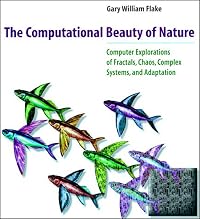
The Computational Beauty of Nature: Computer Explorations of Fractals, Chaos, Complex Systems, and Adaptation
by Gary William Flake
On This Page
Description
In this book, Gary William Flake develops in depth the simple idea that recurrent rules can produce rich and complicated behaviors. Distinguishing "agents" (e.g., molecules, cells, animals, and species) from their interactions (e.g., chemical reactions, immune system responses, sexual reproduction, and evolution), Flake argues that it is the computational properties of interactions that account for much of what we think of as "beautiful" and "interesting." From this basic thesis, Flake show more explores what he considers to be today's four most interesting computational topics: fractals, chaos, complex systems, and adaptation. show lessTags
Recommendations






Member Reviews
I feel a strange draw towards two poles. I love the highly technial man-made achievements and I love the completely unspoiled "nature of nature". This book sythesizes the two extremes beautifully. As our computers push the envelope of mathematics, we are better able to sythesize and understand the structure and appearance of natural things. This book added to my appreciation of nature by showing me the level of computation required to simulate it. At the same time, it added to my appreciation of science by tying it to the emotional response that I feel when I see beauty in nature.
Very little of this is really share-able in a high school classroom. The kids love the fractals and this book helps explain the practical applications of show more fractals. But fractals weren't even in the CA teaching standards in the first place, so it's all kindof extra-curricular.
But, it's a beautiful book. Beautiful in the way that "Eternal Golden Braid" was beautiful. And much more concise. show less
Very little of this is really share-able in a high school classroom. The kids love the fractals and this book helps explain the practical applications of show more fractals. But fractals weren't even in the CA teaching standards in the first place, so it's all kindof extra-curricular.
But, it's a beautiful book. Beautiful in the way that "Eternal Golden Braid" was beautiful. And much more concise. show less
I believe I thumbed through this book in the 1990s, enjoyed the diagrams, and took it back to the library, satisfied that now I knew something about fractals..
difficult, but excellent publication
Dec 30, 2006French
Ratings
Members
- Recently Added By
Lists

University Presses
155 works; 1 member
Author Information

1 Work 298 Members
Gary William Flake is a scientist at the NEC Research Institute in Princeton, New Jersey.
Common Knowledge
- Epigraph
- The scientist does not study nature because it is useful; he studies it because he delights in it, and he delights in it because it is beautiful. If nature were not beautiful, it would not be worth knowing, and if nature wer... (show all)e not worth knowing, life would not be worth living. Of course I do not here speak of that beauty that strikes the senses, the beauty of qualitiesand appearances; not that I undervalue such beauty, far from it, but it has nothing to do with science; I mean that profounder beauty which comes from the harmonious order of the parts, and which a pure intelligence can grasp.
—Henri Poincaré - Dedication
- For my parents
- First words
- A variation on an old joke goes as follows:Engineers study interesting real-world problems but fudge their results. Mathematicians get exact results but study only toy problems. But computer scientists, being neither engine... (show all)ers nor mathematicans, study toy problems and fudge their results.
Reductionism is the idea that a system can be understood by examining its individual parts. - Last words
- (Click to show. Warning: May contain spoilers.)If all natural phenomena were either perfectly describable or absolutely indescribable, not only would they be uninteresting, but life would be impossible.
(Click to show. Warning: May contain spoilers.)Output units can be linear or sigmoidal, allowing you to model both discrete and continuous output target values.
(Click to show. Warning: May contain spoilers.)The author gratefully thanks and acknowledges the community of hackers who have made such excellent software available for free; without it producing this book would have been impossible.
Classifications
- Genres
- Technology, Nonfiction, Science & Nature, General Nonfiction
- DDC/MDS
- 005 — Computer science, information & general works Computer science, knowledge & systems Artificial Intelligence/Virtual Reality
- LCC
- QA76.6 .F557 — Science Mathematics Mathematics Instruments and machines Calculating machines Electronic computers. Computer science
- BISAC
Statistics
- Members
- 298
- Popularity
- 107,765
- Reviews
- 4
- Rating
- (4.14)
- Languages
- English
- Media
- Paper, Ebook
- ISBNs
- 5
- UPCs
- 1
- ASINs
- 2