In Small Things Forgotten: An Archaeology of Early American Life
by James Deetz
On This Page
Description
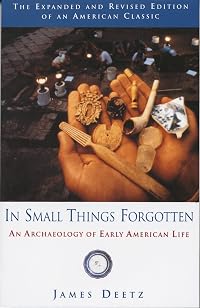
History is recorded in many ways. According to author James Deetz, the past is given new dimensions by studying the small things so often forgotten. Doorways, gravestones, musical instruments, and shards of pottery (objects so plain they would never be displayed in a museum) depict the intricacies of daily life. In this completely revised and expanded edition of In Small Things Forgotten, Deetz has added a chapter addressing the influence of African culture - a culture so strong it survived show more the Middle Passage and the oppression of slavery - on America in the years following the settler's arrival in Jamestown, Virginia. Simultaneously a study of American life and an explanation of how American life is studied, In Small Things Forgotten colorfully depicts a world hundreds of years in the past through the details of ordinary living. show lessTags
Recommendations


















Member Reviews
"If we could find in some way find a way to understand the significance of artifacts as they were thought of and used by Americans in the past, we might gain new insight into the history of our nation." Such is the purview of the historical archaeologist. In this small book, James Deetz, gives us a short, very readable and intriguing overview of some of the interesting work done by historical archaeologists, including himself, in New England (he does occasionally reference work done in Virginia and other early colonies). He begins by noting that there are certain factors that favor the survival of some objects and not others, and those surviving objects are 'not necessarily representative of their period.' So, as not to rely solely on show more museum collections, historical archaeologists do digs.
Deitz shows us how such objects found reveal how people lived and thought in early times. He discusses three early periods in our cultural history and his chapters explore such topics as gravestones, buildings, ceramics, but also the changes in tools, food preparation, the disposal of refuse, furniture (lack of chairs!) and music. Intriguingly, He also discusses a dig of the once small community of African Americans near Plymouth, Massachusetts, called “Parting Ways” which show ties back to African roots. There are so many interesting bits in this book.
At the end of the book Deitz implores us NOT to forget the little, seemingly insignificant things "for in the seemingly little and insignificant existence is captured. We must remember these bits and pieces, and we must use them in new and imaginative ways so that a different appreciation for what life is today, and was in the past, can be achieved. The written document has its proper and important place, but there is also a time when we should set aside of perusal of diaries, court records, and inventories, and listen to another voice… "Don’t read what we have written; look at what we have done."
The reader will probably not look at his or her fork quite the same again. show less
Deitz shows us how such objects found reveal how people lived and thought in early times. He discusses three early periods in our cultural history and his chapters explore such topics as gravestones, buildings, ceramics, but also the changes in tools, food preparation, the disposal of refuse, furniture (lack of chairs!) and music. Intriguingly, He also discusses a dig of the once small community of African Americans near Plymouth, Massachusetts, called “Parting Ways” which show ties back to African roots. There are so many interesting bits in this book.
At the end of the book Deitz implores us NOT to forget the little, seemingly insignificant things "for in the seemingly little and insignificant existence is captured. We must remember these bits and pieces, and we must use them in new and imaginative ways so that a different appreciation for what life is today, and was in the past, can be achieved. The written document has its proper and important place, but there is also a time when we should set aside of perusal of diaries, court records, and inventories, and listen to another voice… "Don’t read what we have written; look at what we have done."
The reader will probably not look at his or her fork quite the same again. show less
This is one of my favourite books, even though it inspires historical archaeology envy in me. It is a very readable melding of documentary research with archaeological evidence. The mundane becomes important, and sheds light onto ordinary lives. This is history almost lierally, from the bottom up. Deetz brings humanity into archaeology, and discusses everything from why Americans eat with forks in the right hand and Europeans in the left, to foodways in various classes of colonial American society to the life cycle of crockery and stylistic changes in gravestone carving.
Excellent book on historical archaeology, which is the part of archaeology that makes use of the written historical record as well as excavation and more traditional archaeological techniques. The author restricts the field to "the spread of European cultures since the 15th century and their impact and interaction with the cultures of indigenous people." I think that's a little TOO restrictive (surely other cultures had their own written records for that time period?), but I'm not an archaeologist so maybe there are reasons for the definition that I'm not aware of.
In any case, Deetz discusses New England archaeology in detail, which is why I'm re-reading the book. I've been systematically walking the Massachusetts coastline taking show more pictures of the first and second period houses. You can really see the transition he discusses from the asymmetric houses common in the 17th century to the highly symmetric Georgian houses of the 18th — it's dramatic. Essex and Duxbury MA in particular are like a case study. Deetz says the 17th century designs were meant to conform to nature (a medieval point of view) while the 18th century designs challenged it with their rigid symmetry.
It makes me wonder whether we're at the start of a fourth period, where we'll still embrace technology but will also try to make it work with nature in the name of not destroying our species. I'm starting to see signs of it, notably in the number of solar panels and windmills dotting the Massachusetts landscape. There's also a great deal of online discussion of "green" design, which includes things like orienting houses to take advantage of the sunshine and insulation techniques that reduce the need for heating and air conditioning. An eventual "fourth period house" might end up looking a lot like a first period one, but with 21st century materials and techniques.
--
Having finished the book, I think Deetz makes a strong case for historical archaeology overall, but I have one nit to pick. Deetz claims as part of his thesis (as I interpreted it) that artifacts are a less biased source of information than the historical record. In some ways it's true (potsherds can't lie) but the weak point of that argument is that artifacts require interpretation and proper context or they can be misleading. Deetz himself says so! He discusses the case of "Colono ware", a type of African American pottery initially misidentified as "Colono Indian ware" because of the false supposition that it was produced by Native Americans. Clearly Deetz knows that the archaeologists sometimes goof outrageously, yet in the very next chapter he's back to claiming that artifacts are a more objective record. It seems to me that in trusting the historical record versus the archaeological record, one is simply trading off the biases of the contemporary people versus the biases of the modern excavators. show less
In any case, Deetz discusses New England archaeology in detail, which is why I'm re-reading the book. I've been systematically walking the Massachusetts coastline taking show more pictures of the first and second period houses. You can really see the transition he discusses from the asymmetric houses common in the 17th century to the highly symmetric Georgian houses of the 18th — it's dramatic. Essex and Duxbury MA in particular are like a case study. Deetz says the 17th century designs were meant to conform to nature (a medieval point of view) while the 18th century designs challenged it with their rigid symmetry.
It makes me wonder whether we're at the start of a fourth period, where we'll still embrace technology but will also try to make it work with nature in the name of not destroying our species. I'm starting to see signs of it, notably in the number of solar panels and windmills dotting the Massachusetts landscape. There's also a great deal of online discussion of "green" design, which includes things like orienting houses to take advantage of the sunshine and insulation techniques that reduce the need for heating and air conditioning. An eventual "fourth period house" might end up looking a lot like a first period one, but with 21st century materials and techniques.
--
Having finished the book, I think Deetz makes a strong case for historical archaeology overall, but I have one nit to pick. Deetz claims as part of his thesis (as I interpreted it) that artifacts are a less biased source of information than the historical record. In some ways it's true (potsherds can't lie) but the weak point of that argument is that artifacts require interpretation and proper context or they can be misleading. Deetz himself says so! He discusses the case of "Colono ware", a type of African American pottery initially misidentified as "Colono Indian ware" because of the false supposition that it was produced by Native Americans. Clearly Deetz knows that the archaeologists sometimes goof outrageously, yet in the very next chapter he's back to claiming that artifacts are a more objective record. It seems to me that in trusting the historical record versus the archaeological record, one is simply trading off the biases of the contemporary people versus the biases of the modern excavators. show less
I did not know what to expect from this little book. I originally thought that James Deetz’s title, “In Small Things Forgotten: The Archeology of Early American Life” was borrowed from a poem. In fact it was borrowed from a probate inventory. I have had some exposure to archaeology and was at first concerned that the book was simply an introduction to the science. Deetz explains stratification (the stuff on the bottom is the oldest) and that pottery is fragile in the home but nearly immortal in the ground. But he also goes deeper and his focus is on the United States, not a dead civilization I have little interest in.
His examination of gravestones, illustrated with very informative drawings, is the best explanation I have seen of show more how styles evolve and how cultural evolution spreads out from urban centers to the countryside. As Deetz continues to explain archaeological methods he also explores a major cultural shift that could easily have escaped the notice of history drawn entirely from documentary evidence, the change in focus from communal to the individual. After covering the basics while showing us how the English culture was brought over and adapted to the realities of the colonies Deetz shows us how even our involuntary African immigrants brought their culture, food, music, styles of homes, and even grammar with them to the New World.
Originally written in 1977 “In Small Things Forgotten” is still a fun and educational read that I think anyone with an interest in American history would enjoy. show less
His examination of gravestones, illustrated with very informative drawings, is the best explanation I have seen of show more how styles evolve and how cultural evolution spreads out from urban centers to the countryside. As Deetz continues to explain archaeological methods he also explores a major cultural shift that could easily have escaped the notice of history drawn entirely from documentary evidence, the change in focus from communal to the individual. After covering the basics while showing us how the English culture was brought over and adapted to the realities of the colonies Deetz shows us how even our involuntary African immigrants brought their culture, food, music, styles of homes, and even grammar with them to the New World.
Originally written in 1977 “In Small Things Forgotten” is still a fun and educational read that I think anyone with an interest in American history would enjoy. show less
A mildly interesting book - unusually for me, I found the details rather dull but his sweeping conclusions quite interesting. I suspect it was the author's PhD dissertation - that style. It's about historical archaeology, specifically in the area of the East Coast of the US, mostly New England; there's a lot about how what can be determined with historical (written) evidence can bolster or contradict physical (dug-up) evidence, and how awareness of those contradictions can be useful in pre-historic archaeology as well. Specifically, most of the book was a sketch of how American culture changed from the 17th to the 19th century, as evidenced by...dishes, houses, gravestones, music... various evidence. Then it ended with a dig of a small show more African-American settlement, which looked (from surviving pictures, and historical evidence) very like all the other settlements of the time - but the dig came up with some serious differences (size and style of houses, locations of hearths, food waste - bones and the like). His sweeping conclusion was something along the lines of "just because you're within an area of a culture, don't assume that everything there reflects that one culture". Hmmm - I don't know if I read the revised edition or the original - probably the original, I didn't see anything about revision. I'm glad I read it, but I don't intend to reread. show less
This book is an absolute classic of historical archaeology literature. Deetz examines what small, seemingly insignificant artifacts can tell us about the lives of people of the past and complement -- or even contradict -- what is missing from the written historical record. My favorite chapter on the evolution of headstones in New England cemeteries and how their evolution reflects changes in religious belief.
I attempted to read this revision too soon after reading the much shorter first edition. This is too much 'same but different' for me. I do say, be aware, this is almost revised & expanded enough to be a whole different book. The first was focused on New England, this includes more of Virginia and the Chesapeake. This also has more of the African and African-American experience.
Members
- Recently Added By
Lists

School Made Us Read It
380 works; 196 members
Author Information

12 Works 1,602 Members
Classifications
- Genres
- Anthropology, History, Nonfiction, General Nonfiction
- DDC/MDS
- 974.01 — History & geography History of North America Northeastern United States (New England and Middle Atlantic states)
- LCC
- F6 .D43 — Local History of the United States, Canada and Latin America United States local history New England
- BISAC
Statistics
- Members
- 837
- Popularity
- 32,938
- Reviews
- 8
- Rating
- (4.08)
- Languages
- English
- Media
- Paper, Audiobook, Ebook
- ISBNs
- 4
- ASINs
- 8