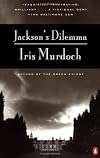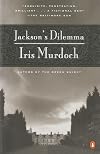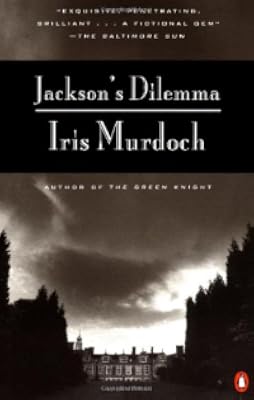
Jackson's Dilemma
by Iris Murdoch 
On This Page
Description
Edward Lannion is to marry the lovely Marian Fox. But on the eve of the wedding, Marian's note leaves everyone in a tizzy and full of questions: Where is Marian? And who is Jackson? In this intricately plotted novel, a mysterious, charismatic English butler derails the marriage of his master, a young aristocrat, and his fiancé, sending them both off on strange, dark, and amusing paths.Tags
Recommendations















Member Reviews
Murdoch's 26th and final novel, written as the dementia, still undiagnosed, was beginning to impinge on her mind, is strange, bittersweet, and mysterious. In some ways it's a redux of her preoccupying themes and motifs: Shakespeare, philosophy and its intersection with mysticism and religion, impulsiveness, fate, the unknowability of the self. It's shorter than most of her novels, but not less rich or complicated. It's a swirl of misguided, very obviously Shakespearian lovers disarranging each other and being re-arranged by an ineffable external force, the titular manservant who is introduced gradually, seemingly insidiously, by Murdoch into the book as he introduces himself into the lives of the other characters. At first Jackson show more reminded me of the malevolent, dependency-inducing butler in Robert Maugham's The Servant. But I should have known better. Instead he's a Prospero, a metaphor for the artist at the end of his (actually her) career, setting her artistic affairs in some sort of order and preparing to depart the stage. The book's poignancy comes from this, and it should probably be read after the other 25 Murdoch novels (it's my ninth). But it's still a cleverer and more beguiling novel in its own right than most writers produce in a lifetime. show less
Iris Murdoch's rather puzzling last novel. The plot reads like a bizarre parody of Victorian melodrama, with the heroine being carried off by her Australian lover on the eve of the wedding. Nonetheless, everyone pairs off without the slightest trouble in the last act. The setting is oddly divorced from historical realities - various clues set us firmly in England in the second half of the 20th century, but two of the main characters are landowners who seem to have inherited their country houses without any irritating little worries about death duties and the like, and each manage to support two or three houses, a few servants, and the odd Titian without any obvious source of revenue. We're clearly not meant to take it as a realistic show more novel: it's a fable of some kind, but it's hard to tell what. Certainly, most of the characters are on some sort of quest for spiritual redemption.
The eponymous Jackson is an enigma: other characters compare him to Kim and to Caliban, but he also seems to have significant parts of Jeeves and Figaro, and there's a suggestion that he's on a mission that is outside his own control - is the late Uncle Tim acting as Prospero from beyond the grave? Is Jackson some kind of angel? And where does the elderly horse Spencer fit in? Sadly, we'll never know for sure. This is probably a book one reads more out of loyalty to a great writer than for its own sake, really. show less
The eponymous Jackson is an enigma: other characters compare him to Kim and to Caliban, but he also seems to have significant parts of Jeeves and Figaro, and there's a suggestion that he's on a mission that is outside his own control - is the late Uncle Tim acting as Prospero from beyond the grave? Is Jackson some kind of angel? And where does the elderly horse Spencer fit in? Sadly, we'll never know for sure. This is probably a book one reads more out of loyalty to a great writer than for its own sake, really. show less
At the end it is Jackson's Dilemma to decide whether his mission is over once those within his orbit have sorted out their superficial and petty lives. Jackson has a mysterious and beneficial influence on the batty characters that play out their parts in a typical Murdoch plot. Jackson verges on the mystical. He magically appears to instil an insight that sets in train for the cast of characters, a less frivolous, deeper apprehension of life.
In an ominous penultimate paragraph, Jackson seriously considers that his earthly work may be over and that he has reached " the end of what is necessary, I have come to a place where there is no road."
In an ominous penultimate paragraph, Jackson seriously considers that his earthly work may be over and that he has reached " the end of what is necessary, I have come to a place where there is no road."
I hate it when I read a review that influences my way of thinking, my way of reading a book. This happened innocently enough. I was looking for more information about Jackson's Dilemma. Was it ever made into a movie? Adapted for the stage? A musical? As a result of my searching I discovered Jackson's Dilemma was Murdock's last book. Not only that, but she was diagnosed with Alzheimer's right around the time of publication. Inadvertently, I read two reviews that seemed to blame the disease for the demise of Murdoch's craft. In other words, Jackson's Dilemma bombed. Because of the reviews I found myself wondering about the words. I will admit, the beginning was slow and the characters, curious, but in the end I didn't think it was all show more that bad.
It starts off on the eve of Edward and Marian's wedding. Edward is enjoying dinner with friends when he discovers a note under the door: an "I can't marry you" letter from Marian. There is no explanation but the following day there is much hoopla about making sure people are "barred" from the church and from attending a wedding that won't happen. All of Edward's friends are absurdly devastated by this turn of events, so much so that I started to really question their sanity. Meanwhile, both Edward and Marian disappear (separately, of course). Enter Jackson (Just Jackson, no last name). Even his arrival is peculiar.
In the end the plot becomes a garbled mess. Everyone is trying to be in love with someone else, exclaiming undying devotion left and right. Even Owen (male) and Tuan (also male) have some kind of odd, unexplained relationship going on. Despite all this, I did have two favorite lines: "The moon was not present, being elsewhere" (p 22). Who actually knows where the moon was, but I thought that was funny. The other line: "After all, as Randall said, it's the sea that matters" (p 100). Too bad Randall would lose his life to the very thing that mattered. show less
It starts off on the eve of Edward and Marian's wedding. Edward is enjoying dinner with friends when he discovers a note under the door: an "I can't marry you" letter from Marian. There is no explanation but the following day there is much hoopla about making sure people are "barred" from the church and from attending a wedding that won't happen. All of Edward's friends are absurdly devastated by this turn of events, so much so that I started to really question their sanity. Meanwhile, both Edward and Marian disappear (separately, of course). Enter Jackson (Just Jackson, no last name). Even his arrival is peculiar.
In the end the plot becomes a garbled mess. Everyone is trying to be in love with someone else, exclaiming undying devotion left and right. Even Owen (male) and Tuan (also male) have some kind of odd, unexplained relationship going on. Despite all this, I did have two favorite lines: "The moon was not present, being elsewhere" (p 22). Who actually knows where the moon was, but I thought that was funny. The other line: "After all, as Randall said, it's the sea that matters" (p 100). Too bad Randall would lose his life to the very thing that mattered. show less
I almost gave this up but am happy I persisted. As it was published in 1995 and written by someone born in 1919, it's free of all modern phone/computer technology. It felt like a 19th or even 18th century novel. Once I embraced the fairytale aspect I did enjoy the book.
Bought 1996
And so we reach the end of the Iris Murdoch A Month project with the much-dreaded Jackson's Dilemma. I remember reading this when it came out in paperback, only really then realising there was something very wrong. And I haven't read it since, where I have revisited old favourites.
Actually, it wasn't as bad as I feared. Although it was obviously weaker than the other novels, it was more Murdoch-Lite than a failure. The huge lapses in continuity (which could surely have been fixed by a kind person somewhere within the publishing process (and yes, I know she had refused to be edited since many books previously)) notwithstanding, Murdoch's themes and characters were there, and the story was Murdochian and engaging enough, if show more very short compared to the last few. Very upsetting at the end, though, where you can read Jackson's soliloquy as echoing Murdoch's own thoughts.
Goodby, Iris - and goodbye IM a month project, although both live on in our discussions of Jackson's Dilemma and my research project! show less
And so we reach the end of the Iris Murdoch A Month project with the much-dreaded Jackson's Dilemma. I remember reading this when it came out in paperback, only really then realising there was something very wrong. And I haven't read it since, where I have revisited old favourites.
Actually, it wasn't as bad as I feared. Although it was obviously weaker than the other novels, it was more Murdoch-Lite than a failure. The huge lapses in continuity (which could surely have been fixed by a kind person somewhere within the publishing process (and yes, I know she had refused to be edited since many books previously)) notwithstanding, Murdoch's themes and characters were there, and the story was Murdochian and engaging enough, if show more very short compared to the last few. Very upsetting at the end, though, where you can read Jackson's soliloquy as echoing Murdoch's own thoughts.
Goodby, Iris - and goodbye IM a month project, although both live on in our discussions of Jackson's Dilemma and my research project! show less
Despite a surfeit of explanation marks and italics to show emotion, this book enchants in its depiction of wealthy people deciding what to do about life and love. You feel for the main character, Benet, because you see his thoughts, which are tormented despite the triviality of the topic (the relationships of others, friends and family).
Members
- Recently Added By
Published Reviews
Iris Murdoch's last novel, Jackson's Dilemma, was about a mysterious disappearance. But it tells another story, according to neuroscientists today. It subtly reveals the onset of Alzheimer's disease before the author herself could have known.... her vocabulary had dwindled and her language become simpler.... An analysis of 30 sentences found on average fewer words per sentence, and fewer show more r clauses per sentence, in the last novel. show less
added by KayCliff
Author Information

80+ Works 29,386 Members
Iris Murdoch was one of the twentieth century's most prominent novelists, winner of the Booker Prize for The Sea. She died in 1999. (Publisher Provided) Iris Murdoch was born in Dublin, Ireland on July 15, 1919. She was educated at Badminton School in Bristol and Oxford University, where she read classics, ancient history, and philosophy. After show more several government jobs, she returned to academic life, studying philosophy at Newnham College, Cambridge. In 1948, she became a fellow and tutor at St. Anne's College, Oxford. She also taught at the Royal College of Art in London. A professional philosopher, she began writing novels as a hobby, but quickly established herself as a genuine literary talent. She wrote over 25 novels during her lifetime including Under the Net, A Severed Head, The Unicorn, and Of the Nice and the Good. She won several awards including the James Tait Black Memorial Prize for The Black Prince in 1973 and the Booker Prize for The Sea, The Sea in 1978. She died on February 8, 1999 at the age of 79. (Bowker Author Biography) show less
Iris Murdoch has a Legacy Library. Legacy libraries are the personal libraries of famous readers, entered by LibraryThing members from the Legacy Libraries group.
Common Knowledge
- Original title
- Jackson's Dilemma
- Original publication date
- 1995
- Quotations
- Owen had laid out a little table with whisky and red wine and orange
juice and ham sandwiches and olives and plums and cherry cake.
Classifications
Statistics
- Members
- 514
- Popularity
- 58,564
- Reviews
- 16
- Rating
- (2.88)
- Languages
- 5 — English, French, Romanian, Russian, Turkish
- Media
- Paper, Audiobook, Ebook
- ISBNs
- 20
- UPCs
- 1
- ASINs
- 6