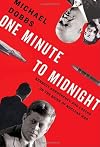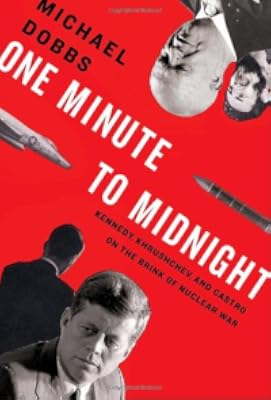
One Minute to Midnight: Kennedy, Khrushchev, and Castro on the Brink of Nuclear War
by Michael Dobbs
Cold War Trilogy (2)
On This Page
Description
In October 1962, at the height of the Cold War, the United States and the Soviet Union were sliding inexorably toward a nuclear conflict over the placement of missiles in Cuba. Veteran journalist Michael Dobbs has used previously untapped American, Soviet, and Cuban sources to produce the most authoritative book yet on the Cuban missile crisis. In his hour-by-hour chronicle, he takes us onto the decks of American ships patrolling Cuba; inside sweltering Soviet submarines and missile units as show more they ready their warheads; and inside the White House and the Kremlin as Kennedy and Khrushchev--rational, intelligent men separated by an ocean of ideological suspicion--agonize over the possibility of war. He shows how these two leaders recognized the terrifying realities of the nuclear age while Castro--never swayed by conventional political considerations--demonstrated the messianic ambition of a man selected by history for a unique mission.--From publisher description. show lessTags
Recommendations












Member Reviews
An excellent and absorbing piece of work. And although we all know the outcome there is palpable tension and menace in the air as the events unfold. Although I knew the basic facts of the Cuban Missile Crisis, there were a number of elements that I wasn't aware of and that really surprised me. Firstly, the hungriness for preemptive nuclear strikes from so many of the Excomm - a point of view that seems madness to us with the benefit of hindsight. Whether this was replicated in Moscow we don't know - Dobbs spends more time on the US and even Cuban response, presumably because it is better documented. The second is the potential for random human error to trigger a chain reaction - the world might expect its leaders such as Kennedy and show more Khrushchev to act responsibility but you can't legislate for Soviet air crews to decide to shoot down an American U2 over Cuba or for another U2 to wander off course over Soviet territory in the Arctic. And the third is how much of the crisis was caused, and resolved by poor communications. The US and Soviet leaders constantly misinterpret each others actions and communiques take hours to be delivered - and yet this leads to a happy conclusion. Its interesting to consider how the crisis might have played out in a modern world of much better communications and less room for creative interpretation
I also thought that Dobbs conclusions about how the "success" of the Cuban Missile Crisis informed less successful actions in Vietnam and the Persian Gulf were very well thought through . Highly recommended all round show less
I also thought that Dobbs conclusions about how the "success" of the Cuban Missile Crisis informed less successful actions in Vietnam and the Persian Gulf were very well thought through . Highly recommended all round show less
I've been listening to this for a few months and I learned a lot. But the thing that struck me is how very, very close we were to the end of the world. At one point, I called up my sister to explain to her exactly just how amazed I was that we were still alive. The reader, Bob Walter, was not great, but he was very good. He conveyed, at least to me, the emotions that Dobbs wrote into the text. I'm glad I read this book, but holy crap. There was a lot I didn't know about the Cuban Missile Crisis. And, finally, this isn't a book just about that event, it's about the built up and aftermath, as well as views from the Russians and the Cubans. Dobbs leaves no stone unturned and for that I applaud him.
This is a systematic account of the Cuban missile crisis from the American, Soviet and Cuban points of view. It is hard for those of us born after this time (the 50th anniversary of which is almost upon us) to understand how close the world came to nuclear destruction, especially on so called Black Saturday, 27 October 1962. Leading figures seriously wondered whether they would live to see another dawn. What emerges clearly, despite their faults and weaknesses, is the essential humanity and statesmanship of both Jack Kennedy and Nikita Khrushchov. Both had seen warfare at first hand and were ultimately determined that they would not destroy future generations by allowing nuclear weapons to be used first by their respective countries and show more thereby condemn the rest of the world as well as their opponents. Kennedy was held back by the belligerence of many of the top military echelon, especially Curtis LeMay and Thomas Power, who openly advocated as a matter of general policy a nuclear first strike against the Soviet Union; while Khrushchov was held back by the adventurism and rashness of Castro, who saw no reason why nuclear holocaust should not be risked if it meant destruction of American imperialism and who advocated a nuclear first strike by the Soviets to achieve this. Both Kennedy and Khrushchov were held back more generally by the mad logic of nuclear deterrence and international diplomacy which permitted no admission of weakness or public backing down. On Black Saturday, a US plane accidentally entered Soviet airspace without Kennedy's knowledge, while a US reconnaissance plane was shot down over Cuba without Khrushchov's knowledge, either of which incidents could have triggered off nuclear armageddon.
Some of the statistics of the weapons of mass destruction here are astonishingly sobering and horrible - just one Soviet ship (the Aleksandrovsk) heading for Cuba had on it nuclear weapons with the destructive capacity of some 1700 Hiroshima bombs - over three times the total amount of explosive ever detonated in all the wars in human history put together. This book combines horrific details like this together with the personal stories of low level participants on all three sides, in a day by day, hour by hour, minute by minute account that truly brings across the horror of those days when we came closer than ever before or since to the End of the World. 5/5 show less
Some of the statistics of the weapons of mass destruction here are astonishingly sobering and horrible - just one Soviet ship (the Aleksandrovsk) heading for Cuba had on it nuclear weapons with the destructive capacity of some 1700 Hiroshima bombs - over three times the total amount of explosive ever detonated in all the wars in human history put together. This book combines horrific details like this together with the personal stories of low level participants on all three sides, in a day by day, hour by hour, minute by minute account that truly brings across the horror of those days when we came closer than ever before or since to the End of the World. 5/5 show less
I picked this book up because I had very little knowledge of the events that comprised the Cuban Missile Crisis. I really was only expecting a well-written history lesson. What I got was an emotionally engaging and dramatic re-enactment of those thirteen days. Michael Dobbs does an excellent job of creating and maintaining suspense while conveying fact after fact after fact. Sometimes the facts alone sufficed to establish drama, especially where, for example, Dobbs described the amount of firepower available to the United States on the second Sunday of the standoff. "By midday Sunday, [the U.S. Strategic Air Command] would have a 'cocked'--meaning 'ready to fire'--nuclear strike force of 162 missiles and 1,200 airplanes carrying 2,858 show more nuclear warheads." Add to this the fact that a single warhead carried by a B-52 bomber had a destructive power that was seventy times that of the bomb dropped on Hiroshima and the drama is set.
The most valuable aspect of the book, and clearly the author's purpose in writing it, was the frequent portrayal of both Krushchev and Kennedy as seeking a peaceful resolution, but clearly and knowingly dealing with problems beyond their immediate control. The description of the hugely inflated times that it took messages to travel through diplomatic channels (many, many hours) demonstrated the point. How were Krushchev and Kennedy going to avoid nuclear war when diplomatic messages took so long to be received, yet missiles were on 15 minute alert? The smallest screw-up by anyone, even down to a soldier or pilot, could ignite the flame that began World War III.
The "Afterword" alone is worth reading. In it, Dobbs persuasively argues that many American military decisions since the Cuban Missile Crisis have been premised on a mis-reading of its lessons. According to conventional wisdom, Kennedy's cool, clear decision-making strategy and strong showing of military might forced Krushchev to back down. As the book demonstrates, however, nothing was further from the truth. Yet, we can see remnants of that popular belief in the Vietnam War and even in Iraq.
While One Minute to Midnight is not perfect (at times the level of detail is overwhelming and a bit gratuitous), it is an entertaining and eye-opening read about a series of events that brought us one small accident away from nuclear devastation. show less
The most valuable aspect of the book, and clearly the author's purpose in writing it, was the frequent portrayal of both Krushchev and Kennedy as seeking a peaceful resolution, but clearly and knowingly dealing with problems beyond their immediate control. The description of the hugely inflated times that it took messages to travel through diplomatic channels (many, many hours) demonstrated the point. How were Krushchev and Kennedy going to avoid nuclear war when diplomatic messages took so long to be received, yet missiles were on 15 minute alert? The smallest screw-up by anyone, even down to a soldier or pilot, could ignite the flame that began World War III.
The "Afterword" alone is worth reading. In it, Dobbs persuasively argues that many American military decisions since the Cuban Missile Crisis have been premised on a mis-reading of its lessons. According to conventional wisdom, Kennedy's cool, clear decision-making strategy and strong showing of military might forced Krushchev to back down. As the book demonstrates, however, nothing was further from the truth. Yet, we can see remnants of that popular belief in the Vietnam War and even in Iraq.
While One Minute to Midnight is not perfect (at times the level of detail is overwhelming and a bit gratuitous), it is an entertaining and eye-opening read about a series of events that brought us one small accident away from nuclear devastation. show less
One Minute to Midnight is an hour by hour reconstruction of the Cuban Missile Crisis. Dobbs has done original archival research and brings to the page new facts never before published. His main thesis is that there was no "eyeball to eyeball and the Soviets blinked", that was propaganda by the Kennedy team. Rather he shows that both sides came closer to war than they realized, were in less control of events then they thought. It's a great lesson of history and instructive about the complexity of events. It leads to the pessimistic conclusion that an accidental nuclear detonation or war was (and still is) very possible.
I was born in 1961, so was only a small child when the Cuban Missile Crisis occurred. I was only passingly familiar with both the Bay of Pigs fiasco and the Missile Crisis prior to reading this book and therefore learned many new and interesting facts. After reading this account, I can only say that it must have been terrifying to have lived through the Crisis, the more you knew, the more frightening it must have been. The world was literally on the door step of a large scale nuclear exchange.
Kennedy was a young, inexperienced President, fresh off the Bay of Pigs disaster and having been completely dominated by Khrushchev at their summit in Vienna. He was surrounded by an eclectic crew of advisors, from those equally as naïve and show more inexperienced as himself (namely his brother Bobby), egghead bureaucrats (such as Robert McNamara) and aging Cold Warriors (LeMay) who were eager for a showdown with the Soviets.
Most troubling was the “chain of command” and delegation of authority as a result of which the lowest level bureaucrat or member of the armed forces (on either side) could have triggered a sequence of events leading to ultimate launching of missiles. When a national leader such as Castro and top level U. S. military advisors can be so adamantly in favor of a nuclear exchange, it certainly causes one to reflect upon our current world situation in which unstable democracies such as Pakistan and aspiring nuclear club members such as the theocracy governing Iran and the dysfunctional regime in Pyongyang virtually hold the world hostage through their possession of nuclear material and the devices to deliver them.
This book should be required reading for anyone aspiring to leadership of a “nuclear club” member, and anyone dealing with such a member. After reading this book, and reflecting upon the impending nuclear proliferation, I must admit to a high degree of pessimism as it relates to the world’s ability to avoid a nuclear exchange. show less
Kennedy was a young, inexperienced President, fresh off the Bay of Pigs disaster and having been completely dominated by Khrushchev at their summit in Vienna. He was surrounded by an eclectic crew of advisors, from those equally as naïve and show more inexperienced as himself (namely his brother Bobby), egghead bureaucrats (such as Robert McNamara) and aging Cold Warriors (LeMay) who were eager for a showdown with the Soviets.
Most troubling was the “chain of command” and delegation of authority as a result of which the lowest level bureaucrat or member of the armed forces (on either side) could have triggered a sequence of events leading to ultimate launching of missiles. When a national leader such as Castro and top level U. S. military advisors can be so adamantly in favor of a nuclear exchange, it certainly causes one to reflect upon our current world situation in which unstable democracies such as Pakistan and aspiring nuclear club members such as the theocracy governing Iran and the dysfunctional regime in Pyongyang virtually hold the world hostage through their possession of nuclear material and the devices to deliver them.
This book should be required reading for anyone aspiring to leadership of a “nuclear club” member, and anyone dealing with such a member. After reading this book, and reflecting upon the impending nuclear proliferation, I must admit to a high degree of pessimism as it relates to the world’s ability to avoid a nuclear exchange. show less
A well researched book that brings new light to a crisis that was mythologized in the immediate aftermath and in the decades following. It gives a very balanced view of events from the three main perspectives: American, Russian, and Cuban. With the addition of declassified US and Soviet records of military activities as well as conversations among senior leadership, we see Kennedy and Kruschchev as the cooler heads who prevailed over institutions that had a lot of inertia moving them towards war. It wasn't the macro level brinksmanship of placing the missiles in Cuba nor the American blockade that brought the world to the brink, but rather several small events beyond anyone's real control that could have triggered a tumble into a show more nuclear exchange; from a Soviet sub skipper ordering the "lock and load" of a nuclear torpedo to a US U-2 pilot inadvertently straying 300 miles into the USSR at just the wrong time, things could've gone very badly. A final chapter on lessons-learned for the US and USSR would have been interesting, in terms of improved protocols for military encounters at sea, airspace incursions, and direct communications between the heads of state. show less
Members
- Recently Added By
Lists

Non-Fiction Worth Reading
1,015 works; 254 members

Mind Expanding Books by hackerkid
581 works; 8 members
Author Information

9+ Works 1,753 Members
Born in 1948 Michael Dobb was Chief of Staff and later Deputy Chairman of the Conservative Party. He has a doctorate in nuclear defense studies. Dobbs has also been Deputy Chairman of Saatchi & Saatchi, he presented the BBC TV current affairs program Despatch Box and was a columnist for The Mail on Sunday. Dobbs recently penned the hugely show more acclaimed theatre play, 'The Turning Point'. He is also the author of the Harry Jones Thrillers, Churchill Novels, and the Parliamentary Novels Series. The immensely popular Netflix series House of Cards is based on book 1 of the Parliamentary Novels by the same name. Michael became Lord Dobbs of Wylye in December 2010 after a long career in and around politics. (Bowker Author Biography) show less
Some Editions
Awards and Honors
Awards
Distinctions
Series

Common Knowledge
- Canonical title
- One Minute to Midnight: Kennedy, Khrushchev, and Castro on the Brink of Nuclear War
- Original publication date
- 2008
- People/Characters
- Fidel Castro; John F. Kennedy; Nikita Khrushchev; Robert F. Kennedy; Robert S. McNamara
- Important places
- Cuba
- Important events
- Cuban Missile Crisis (1962); Cold War
Classifications
- Genres
- History, Nonfiction, General Nonfiction
- DDC/MDS
- 973.922 — History & geography History of North America United States 1901- Cold War, Vietnam War, Digital Age (1953-2001) Dwight D. Eisenhower, 2nd Term (1953-1961) Sputnik Crisis, Little Rock Crisis, National Aeronautics and Space Act
- LCC
- E841 .D573 — History of the United States United States Later twentieth century, 1961-2000 Kennedy's administration, 1961-November 22, 1963
- BISAC
Statistics
- Members
- 869
- Popularity
- 31,228
- Reviews
- 19
- Rating
- (4.19)
- Languages
- 7 — Danish, English, Norwegian (Bokmål), Norwegian, Polish, Portuguese, Swedish
- Media
- Paper, Audiobook, Ebook
- ISBNs
- 18
- ASINs
- 12