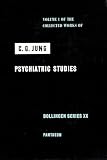
Psychiatric Studies
by C. G. Jung
On This Page
Description
At the turn of the last century C. G. Jung began his career as a psychiatrist. During the next decade three men whose names are famous in the annals of medical psychology influenced his professional development: Pierre Janet, under whom he studied at the Salpetriere Hospital in Paris; Eugen Bleuler, his chief at the Burgholzli Hospital in Zurich; and Sigmund Freud, with whom Jung began corresponding in 1906. It is Bleuler, and to a lesser extent Janet, whose influence bears on the studies in show more descriptive and experimental psychiatry composing Volume 1 of the Collected Works. This first volume of Jung's Collected Works contains papers that appeared between 1902 and 1905. It opens with Jung's dissertation for the medical degree: "On the Psychology and Pathology of So-called Occult Phenomena," a detailed analysis of the case of an hysterical adolescent girl who professed to be a medium. This study foreshadows much of his later work and is indispensable to all serious students of his psychiatric career. The volume also includes papers on cryptomnesia, hysterical parapraxes in reading, manic mood disorder, simulated insanity, and other topics. show lessTags
Recommendations



















Member Reviews
Review: At the turn of the last century C.G. Jung began his career as a psychiatrist. During the next decade, three men whose names are famous in the annals of medical psychology influenced his professional development: Pierre Janet, under whom he studied at the Sappetriere Hospital in Paris; Eugen Bleuler, his chief at the Burgholzli Mental Hospital in Zurick; and Sigmund Frued, whom Jung met in 1907. It is Bleuler, and to a lesser extent Janet, whose influence is to be found in the descriptive experimental psychiatry composing Volume I of the Collected Works. These papers appeared between 1902 and 1905l most of them are now being published in English for the first time.
The volume opens with Jung's dissertation for the medical degree: show more 'On the Psychology and Pathology of So-Called Occult Phenomena', a study that foreshadows much of his later work, and as such is indispensable to all serious students of his work. It is the detailed analysis of the case of an hysterical adolescent girl who professed to be a medium. The volume also includes papers on cryptomnesia, hysterical parapraxes in reading, manic mood disorder, simulated insanity, and other subjects.
Source: Taylor & Francis December 18, 2014 edition show less
The volume opens with Jung's dissertation for the medical degree: show more 'On the Psychology and Pathology of So-Called Occult Phenomena', a study that foreshadows much of his later work, and as such is indispensable to all serious students of his work. It is the detailed analysis of the case of an hysterical adolescent girl who professed to be a medium. The volume also includes papers on cryptomnesia, hysterical parapraxes in reading, manic mood disorder, simulated insanity, and other subjects.
Source: Taylor & Francis December 18, 2014 edition show less
Acerca de la psicología y patología de los llamados fenómenos ocultos Sobre la paralexia histérica Criptomnesia Sobre la distimia maniaca Un caso de estupor histérico en una mujer en prisión preventiva Sobre simulación de trastorno mental Peritaje médico sobre un caso de simulación de trastorno mental Peritaje arbitral sobre dos peritajes psiquiátricos contradictorios Acerca del diagnóstico psicológico forense
Feb 4, 2026Spanish
Ratings
Members
- Recently Added By
Author Information

881+ Works 42,526 Members
Carl Gustav Jung was born in Switzerland on July 26, 1875. He originally set out to study archaeology, but switched to medicine and began practicing psychiatry in Basel after receiving his degree from the University of Basel in 1902. He became one of the most famous of modern psychologists and psychiatrists. Jung first met Sigmund Freud in 1907 show more when he became his foremost associate and disciple. The break came with the publication of Jung's Psychology of the Unconscious (1912), which did not follow Freud's theories of the libido and the unconscious. Jung eventually rejected Freud's system of psychoanalysis for his own "analytic psychology." This emphasizes present conflicts rather than those from childhood; it also takes into account the conflict arising from what Jung called the "collective unconscious"---evolutionary and cultural factors determining individual development. Jung invented the association word test and contributed the word complex to psychology, and first described the "introvert" and "extrovert" types. His interest in the human psyche, past and present, led him to study mythology, alchemy, oriental religions and philosophies, and traditional peoples. Later he became interested in parapsychology and the occult. He thought that unidentified flying objects (UFOs) might be a psychological projection of modern people's anxieties. He wrote several books including Studies in Word Association, Flying Saucers: A Modern Myth of Things Seen in the Skies, and Psychology and Alchemy. He died on June 6, 1961 after a short illness. (Bowker Author Biography) show less
Some Editions
Series
Belongs to Publisher Series
Common Knowledge
- Canonical title
- Psychiatric Studies
- Original title
- Psychiatrische Studien
- Original publication date
- 1957
- Original language
- German
Classifications
Statistics
- Members
- 212
- Popularity
- 153,509
- Reviews
- 2
- Rating
- (4.38)
- Languages
- 5 — English, German, Italian, Serbian, Spanish
- Media
- Paper, Ebook
- ISBNs
- 16
- ASINs
- 3