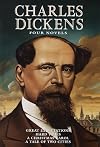
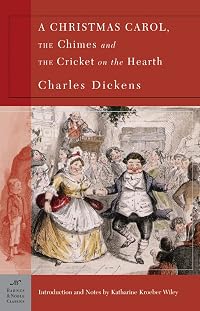
Great Expectations / Hard Times / A Christmas Carol / A Tale of Two Cities
by Charles Dickens
On This Page
Description
This audiobook contains the greatest works of Charles Dickens such as "Oliver Twist", "A Christmas Carol", "David Copperfield", "Bleak House", "A Tale of Two Cities" and "Great Expectations".Tags
Recommendations




















Member Reviews
For A Tale of Two Cities -
I remember now, the first time I read this I could see the ending a mile off. Carten was the answer to all. Dickens’ foreshadowed it by his saving Darnet in the trial for treason at the beginning. I always remember Wodehouse having one of his female characters refer to Bertie as a Sid someone and Jeeves having to come to the rescue with Sidney Carten’s name.
The hysterical bloodshed in this novel sounds so real. The revenge got out of hand and the peasants began to treat the aristocracy the exact same way they themselves were treated. Locking up people on little or now charge. Mass executions of the innocent as well as the guilty. In a way it’s too bad that the Marquis didn’t end up at the end of the show more “country’s razor” for a close shave. His attitude and behavior when he ran down that child in the street, made me want to strangle him myself. To think they could get away with that. Now if you so much as look at a child cross-eyed, you get into trouble. Then when I heard of his involvement in getting Mr. Manette imprisoned, I really wished he could have felt the dread and powerlessness before the people and the guillotine. The reference to the fact that the servant didn’t open the door quickly enough, and the Marquis and his brother both struck him like a dog, and the dogs were struck less actually. When he hit the child he asked about the horses! Unreal.
Therese deFarge was a character. Alternately I praised and despised her. Her and her knitting. That was an ominous device. You could see and hear the sharp needles flashing in the smoky candlelight. Brrr.
Dickens’ plot was so intricate and well sewn up, I loved it. Mme. DeFarge’s sister was the one who was so abused at the hand of the Marquis. It’s no wonder she felt such a blind rage for that family. Unbelievable that the story M. Manette wrote during his imprisonment should be the telling point against his son in law, so recently saved by himself. I loved seeing the working out of Carten’s plot, with Pross’ horrid brother being the prison “sheep”. Luckily Jerry was a “resurrection man” and could be sure there was no one in the grave. The “sheep” used to prove he couldn’t have another close contact in Paris. Cool. I wish all novels could tie up so well.
Carten. Such a figure he was at the guillotine. If he had existed, I’m sure Darnet descendents would be still telling the tale. show less
I remember now, the first time I read this I could see the ending a mile off. Carten was the answer to all. Dickens’ foreshadowed it by his saving Darnet in the trial for treason at the beginning. I always remember Wodehouse having one of his female characters refer to Bertie as a Sid someone and Jeeves having to come to the rescue with Sidney Carten’s name.
The hysterical bloodshed in this novel sounds so real. The revenge got out of hand and the peasants began to treat the aristocracy the exact same way they themselves were treated. Locking up people on little or now charge. Mass executions of the innocent as well as the guilty. In a way it’s too bad that the Marquis didn’t end up at the end of the show more “country’s razor” for a close shave. His attitude and behavior when he ran down that child in the street, made me want to strangle him myself. To think they could get away with that. Now if you so much as look at a child cross-eyed, you get into trouble. Then when I heard of his involvement in getting Mr. Manette imprisoned, I really wished he could have felt the dread and powerlessness before the people and the guillotine. The reference to the fact that the servant didn’t open the door quickly enough, and the Marquis and his brother both struck him like a dog, and the dogs were struck less actually. When he hit the child he asked about the horses! Unreal.
Therese deFarge was a character. Alternately I praised and despised her. Her and her knitting. That was an ominous device. You could see and hear the sharp needles flashing in the smoky candlelight. Brrr.
Dickens’ plot was so intricate and well sewn up, I loved it. Mme. DeFarge’s sister was the one who was so abused at the hand of the Marquis. It’s no wonder she felt such a blind rage for that family. Unbelievable that the story M. Manette wrote during his imprisonment should be the telling point against his son in law, so recently saved by himself. I loved seeing the working out of Carten’s plot, with Pross’ horrid brother being the prison “sheep”. Luckily Jerry was a “resurrection man” and could be sure there was no one in the grave. The “sheep” used to prove he couldn’t have another close contact in Paris. Cool. I wish all novels could tie up so well.
Carten. Such a figure he was at the guillotine. If he had existed, I’m sure Darnet descendents would be still telling the tale. show less
Great Expectations, Hard Times, A Christmas Carol, A Tale of Two Cities
Ratings
Members
- Recently Added By
Author Information

2,578+ Works 313,139 Members
Charles Dickens, perhaps the best British novelist of the Victorian era, was born in Portsmouth, Hampshire, England on February 7, 1812. His happy early childhood was interrupted when his father was sent to debtors' prison, and young Dickens had to go to work in a factory at age twelve. Later, he took jobs as an office boy and journalist before show more publishing essays and stories in the 1830s. His first novel, The Pickwick Papers, made him a famous and popular author at the age of twenty-five. Subsequent works were published serially in periodicals and cemented his reputation as a master of colorful characterization, and as a harsh critic of social evils and corrupt institutions. His many books include Oliver Twist, David Copperfield, Bleak House, Great Expectations, Little Dorrit, A Christmas Carol, and A Tale of Two Cities. Dickens married Catherine Hogarth in 1836, and the couple had nine children before separating in 1858 when he began a long affair with Ellen Ternan, a young actress. Despite the scandal, Dickens remained a public figure, appearing often to read his fiction. He died in 1870, leaving his final novel, The Mystery of Edwin Drood, unfinished. (Bowker Author Biography) show less
Series
Belongs to Publisher Series
Work Relationships
Contains
Common Knowledge
- Canonical title
- Great Expectations / Hard Times / A Christmas Carol / A Tale of Two Cities
- Original publication date
- 1861; 1854; 1843; 1859
- Disambiguation notice
- This omnibus work contains the following 4 works by Charles Dickens, and should not be combined with any of the individual works, or with any work containing additional works:
- A Christmas Carol
- Gr... (show all)eat Expectations
- Hard Times
- A Tale of Two Cities
Classifications
Statistics
- Members
- 697
- Popularity
- 40,767
- Reviews
- 2
- Rating
- (4.23)
- Languages
- English, German
- Media
- Paper, Audiobook, Ebook
- ISBNs
- 23
- ASINs
- 6