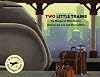
Two Little Trains
by Margaret Wise Brown
On This Page
Description
Two little trains, one streamlined, the other old-fashioned, puff, puff, puff, and chug, chug, chug, on their way West.Tags
Recommendations


















Member Reviews
My 4 year old picked this up from the library. I thought it might be too old fashioned for him, but (though he's into super-heroes like his big brother, he hasn't learned yet what is accepted as cool, and what's uncool!) he loved it and asked for it to be read over and over again. Of course, it doesn't hurt that he loves playing with trains.
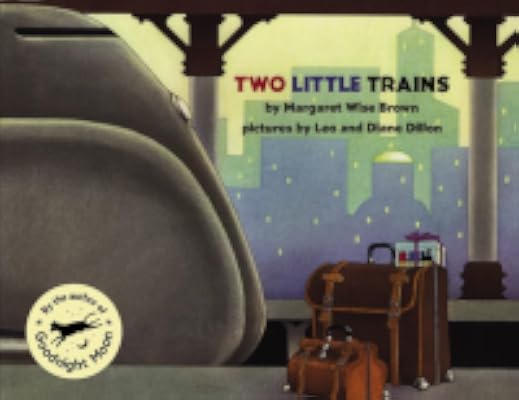
It's a short, simple book (by the author of [Goodnight Moon], which we own) about (you guessed it!) two trains. One is a not-so-little Art Deco-style liner waiting patiently at the terminal, and the other is a little wooden, boxed train, sitting on a suitcase on the platform; this is the story of their journeys to the west.
I think what caught his attention were the simple, repetitive lines, the show more almost-rhyme, and the clacketty-clack rhythm that Wise Brown has captured. Each page has a full page illustration of the 'real' train as the story follows it on its journey from the terminal (presumably on the east coast of the USA) to the sunny, palm tree-lined beaches of the west coast. Each facing page has a full page illustration of the toy train as it mimics the same journey in its bed-time routine.
I liked the way that the toy train did everything that the real train did; when the big train went through a tunnel through a hill, the little train went through a tunnel created from a book titled "Hills", for instance. Or the big train climbed a mountain while the little train rode up the bannister. I think my son's favourite was when the big train crossed a deep river while the toy train travelled around the bath.
I'm rating it for it's age range : simple but captivating classic.
ETA : I notice from other reviews that the original version of this book was about two 'real' trains, one a fast, new train and the other a slow, old train. show less
It's a short, simple book (by the author of [Goodnight Moon], which we own) about (you guessed it!) two trains. One is a not-so-little Art Deco-style liner waiting patiently at the terminal, and the other is a little wooden, boxed train, sitting on a suitcase on the platform; this is the story of their journeys to the west.
I think what caught his attention were the simple, repetitive lines, the show more almost-rhyme, and the clacketty-clack rhythm that Wise Brown has captured. Each page has a full page illustration of the 'real' train as the story follows it on its journey from the terminal (presumably on the east coast of the USA) to the sunny, palm tree-lined beaches of the west coast. Each facing page has a full page illustration of the toy train as it mimics the same journey in its bed-time routine.
I liked the way that the toy train did everything that the real train did; when the big train went through a tunnel through a hill, the little train went through a tunnel created from a book titled "Hills", for instance. Or the big train climbed a mountain while the little train rode up the bannister. I think my son's favourite was when the big train crossed a deep river while the toy train travelled around the bath.
I'm rating it for it's age range : simple but captivating classic.
ETA : I notice from other reviews that the original version of this book was about two 'real' trains, one a fast, new train and the other a slow, old train. show less
This is a re-illustrated version of a largely forgotten Margaret Wise Brown book. If you google you can find one or two of the original images floating around, if you're curious.
In THIS version, the second little train (as you can see on the cover) is a toy train. The writing is simply repetitive, just right for little children, and the connection between what the real train is doing and what the toy train is doing is sweet and imaginative.
Two things bugged me, one very minor and one a little more seriously.
Firstly, although the trains are going "to the west", if you were to look at a map, with North at the top (as is typical), west is to the left... not the right. Never Eat Shredded Wheat, as I taught my nieces, and the compass rose show more says "WE". Not, heaven forbid, "EW!" So I keep looking at the pictures thinking "But... surely that's EAST!"
I'm aware that this is a stupid thing to complain about, I know it's silly, and I haven't taken off any stars for it or anything. It just bugged me and I had to let it out. Please forgive me :)
The other, slightly more serious bit, is in this line: "The moon shone down on a gleaming track / And the two little trains going West; / And they hurried along and heard the song / Of a black man singing in the West."
The illustration is of the toy train resting by a radio, and opposite it is an image of the (black) man in the moon singing.
Now, you see the bit of the problem? Nowadays it's a bit... awkward to just randomly mention somebody's race unless it's, well, necessary. "Which one of those guys in the picture is Bob, your boyfriend?" "Oh... well, the black one, everybody else is white." It's just kinda weird... it's not like I'd randomly say "The red-haired man singing" or anything like that.
As it happens, I have a few different thoughts about this, and they don't all agree.
1. The text of this book was written in a different era. While I normally find the argument "We can't judge books by our modern standards" to be tiresome (unless you have a time machine, you're not giving the book to a child 50 years ago, so why is it wrong to take modern standards and sensibilities into account when purchasing?), but the text and (modern) illustration here aren't especially offensive. They mention the man's race, they don't demonize or mock it in any way.
2. I'm very interested in the research which says that children pick up racist attitudes more quickly if we do NOT talk about it.
Apparently, since children aren't actually stupid, when they see that other people have skin a different color than their own, they wonder about it. But when their questions are met with embarrassment and attempts to quiet them, and when no explanation is ever given, they come to their own conclusions about skin color... often conclusions we'd rather they hadn't reached. We try not to talk about race in order to be polite, but instead we may send the message that there's something shameful or wrong about being not-like-us... especially if we have few friends outside our own ethnic group. There have actually been a few compelling studies among this line suggesting that the best thing to do IS to talk about race, but in a matter-of-fact way that's not, well, racist.
Which doesn't mean going around pointing to people and going "Look! She's BLACK! Wow!", but it does mean that maybe skipping over that one word and hoping your kid doesn't learn to read quicker than they can ask you why you skip that one word is the best bet.
3. On the third hand... it's just kinda weird to mention randomly that somebody is black! Perhaps in the context it was understood that he was singing a type of music that was primarily part of black culture? I don't know.
So, as you see, I'm mostly on the side of "In this particular instance, it's no big deal", but I appreciate that some people will have reservations about it, and I understand that. show less
In THIS version, the second little train (as you can see on the cover) is a toy train. The writing is simply repetitive, just right for little children, and the connection between what the real train is doing and what the toy train is doing is sweet and imaginative.
Two things bugged me, one very minor and one a little more seriously.
Firstly, although the trains are going "to the west", if you were to look at a map, with North at the top (as is typical), west is to the left... not the right. Never Eat Shredded Wheat, as I taught my nieces, and the compass rose show more says "WE". Not, heaven forbid, "EW!" So I keep looking at the pictures thinking "But... surely that's EAST!"
I'm aware that this is a stupid thing to complain about, I know it's silly, and I haven't taken off any stars for it or anything. It just bugged me and I had to let it out. Please forgive me :)
The other, slightly more serious bit, is in this line: "The moon shone down on a gleaming track / And the two little trains going West; / And they hurried along and heard the song / Of a black man singing in the West."
The illustration is of the toy train resting by a radio, and opposite it is an image of the (black) man in the moon singing.
Now, you see the bit of the problem? Nowadays it's a bit... awkward to just randomly mention somebody's race unless it's, well, necessary. "Which one of those guys in the picture is Bob, your boyfriend?" "Oh... well, the black one, everybody else is white." It's just kinda weird... it's not like I'd randomly say "The red-haired man singing" or anything like that.
As it happens, I have a few different thoughts about this, and they don't all agree.
1. The text of this book was written in a different era. While I normally find the argument "We can't judge books by our modern standards" to be tiresome (unless you have a time machine, you're not giving the book to a child 50 years ago, so why is it wrong to take modern standards and sensibilities into account when purchasing?), but the text and (modern) illustration here aren't especially offensive. They mention the man's race, they don't demonize or mock it in any way.
2. I'm very interested in the research which says that children pick up racist attitudes more quickly if we do NOT talk about it.
Apparently, since children aren't actually stupid, when they see that other people have skin a different color than their own, they wonder about it. But when their questions are met with embarrassment and attempts to quiet them, and when no explanation is ever given, they come to their own conclusions about skin color... often conclusions we'd rather they hadn't reached. We try not to talk about race in order to be polite, but instead we may send the message that there's something shameful or wrong about being not-like-us... especially if we have few friends outside our own ethnic group. There have actually been a few compelling studies among this line suggesting that the best thing to do IS to talk about race, but in a matter-of-fact way that's not, well, racist.
Which doesn't mean going around pointing to people and going "Look! She's BLACK! Wow!", but it does mean that maybe skipping over that one word and hoping your kid doesn't learn to read quicker than they can ask you why you skip that one word is the best bet.
3. On the third hand... it's just kinda weird to mention randomly that somebody is black! Perhaps in the context it was understood that he was singing a type of music that was primarily part of black culture? I don't know.
So, as you see, I'm mostly on the side of "In this particular instance, it's no big deal", but I appreciate that some people will have reservations about it, and I understand that. show less
This is a new rendering of this rather obscure story by [a:Margaret Wise Brown|18479|Margaret Wise Brown|http://photo.goodreads.com/authors/1208465845p2/18479.jpg]. The new illustrations tell most of the story, and while breathing something of a classic feel, make the story more modern and - I suspect - drastically better. I myself loved it, and the juxtaposition of the two trains really tickled my son's imagination. Absolutely delightful!
Personally, I'm not a big fan of trains and don't think we need new books, or new editions of older books, about them. The text of this is rhythmic, and what stands in for a plot if appropriate, but it doesn't engage me. However, the Dillons did the art, and therefore a strong full star just for that.
Of course anything by Margaret Wise Brown is wonderful, but train lovers will especially appreciate this book. The big stream lined train and the little toy wooden train are both heading west on a trip to the ocean. Lovely illustrations.
Two little trains are heading West. One is a shiny, streamlined train, moving fast. The other is a little old train, moving not so fast. Both will travel through long dark tunnels, through snow and dust. What else can they have in common? Much more than you think!
This story is about two trains, one being real and one a toy wooden train, both heading west. They are traveling through hills, across bridges, rain, snow, moonlight, dusty sand, mountains and finally reach the ocean. The real train and scenery is mirrored by the toy train pretending to travel west throughout a home with books, a bathtub and other things imitating the scenery the train is traveling through.
I liked the book, I think my preschool son would enjoy it because it is about trains. It encourages pretend play, and that imagination can take your train throughout nature inside of your own home. The illustrations were pretty, they have an art deco influence.
In the classroom, I would introduce this maybe when we are learning about show more trains and traveling. I also would make a chart and ask the children to list the different things you can use in your home to make nature and use it in pretend play. show less
I liked the book, I think my preschool son would enjoy it because it is about trains. It encourages pretend play, and that imagination can take your train throughout nature inside of your own home. The illustrations were pretty, they have an art deco influence.
In the classroom, I would introduce this maybe when we are learning about show more trains and traveling. I also would make a chart and ask the children to list the different things you can use in your home to make nature and use it in pretend play. show less
Members
- Recently Added By
Lists

Honey For a Child's Heart
1,152 works; 25 members
Author Information

265+ Works 79,942 Members
Margaret Wise Brown was born on May 10, 1910 in Greenpoint, Brooklyn, New York, to Robert Brown, a Vice President at American Manufacturing Company and Maud Brown, a housewife. She attended school in Lausanne, Switzerland for three years, before attending Dana Hall in Wellesley, Massachusetts for two years. In 1928, she began taking classes at show more Hollis College in Virginia. In 1935, Brown began working at the Bank Street Cooperative School for student teachers. Two years later, her writing career took off with the publication of "When the Wind Blows." Over the course of fourteen years, Brown wrote over one hundred picture books for children. Some of her best known titles include Goodnight Moon, Big Red Barn and Runaway Bunny. Margaret Wise Brown died on November 13, 1952 of an embolism following an operation in Nice, France. (Bowker Author Biography) show less
Some Editions
Awards and Honors
Notable Lists
Common Knowledge
- Original publication date
- 1949; 2001 Reissue
- Dedication
- To Antonia Markiet, Albert Cetta, and John Vitale
--Leo and Diane Dillon - First words
- Two little trains went down the track,
Two little trains went West. - Last words
- (Click to show. Warning: May contain spoilers.)They had come to the edge of the West.
Classifications
Statistics
- Members
- 994
- Popularity
- 26,326
- Reviews
- 17
- Rating
- (3.75)
- Languages
- English
- Media
- Paper, Audiobook
- ISBNs
- 14
- ASINs
- 3