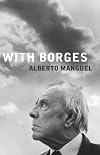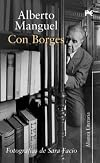
With Borges
by Alberto Manguel
On This Page
Description
"In Buenos Aires, 1964, a blind writer approaches a sixteen-year-old bookstore clerk asking if he would be interested in a part-time job reading aloud. The writer was Jorge Luis Borges, one of the world's finest literary minds; the boy was Alberto Manguel, who was later to become an internationally acclaimed author and bibliophile. The young Manguel spent several years reading aloud and transcribing for the enigmatic Borges. Here he recalls this time with integrity and warmth, offering us an show more intimate and moving portrait of one of the great literary luminaries."--Page 4 of cover. show lessTags
Recommendations








Member Reviews
‘With Borges’ is a tiny gem of a book by my favourite non-fiction writer on the subject of my favourite short story writer (although that is a wholly inadequate characterisation of Borges). Alberto Manguel was one of many to read to Borges, who went gradually blind between the age of 30 and 58. This extended essay recalls that experience, as well as Borges the man and the writer. Manguel reveres Borges without claiming he was flawless. Both are writers of extraordinary accomplishment, adept at selecting just the right words with nothing either wasted or unnecessary. It is an enduring disappointment to me that I can’t read either in the original because I never learned Spanish. (There’s still time, I intend to take it up one show more day.)
In this book I found some wonderful new insights. For instance, that Borges didn’t live in a home stuffed with books. His shelves were tidy and selective, containing only the books that truly mattered to him. Why would he have needed more? After all, he was director of the National Public Library of Buenos Aires! Manguel describes his relationship with books in this lovely passage:
And on his style:
Both Borges and Manguel share my fascination with dreams. Manguel quotes Borges as saying, “I would like to write a story that had the quality of a dream. I’ve tried. I don’t think I’ve succeeded.” On the contrary, I consider Borges one of only a handful of writers to actually manage this. The other two I can recall are [a:Paul Auster|296961|Paul Auster|https://images.gr-assets.com/authors/1554662932p2/296961.jpg] and [a:Kazuo Ishiguro|4280|Kazuo Ishiguro|https://images.gr-assets.com/authors/1424906625p2/4280.jpg], both of whom can only reproduce the quality of an anxiety dream. Borges evokes a much wider palette of dreams. [EDIT: As does Mervyn Peake! How could I forget the dreamlike atmosphere of Gormenghast?]
Manguel’s book is essentially an extended epitaph for Borges. It doesn’t have a tone of mourning, however, as Borges lives on in his writing. I found the whole thing uplifting, both as an insight into two of my favourite writers and as an affirmation that we, the readers, take up their baton and continue the endless thought, discussion, and interpretation of books: an endless, joyful task to which every reader brings their own experience and associations. Manguel concludes with the following, which sums up my own belief in the importance of reading:
In this book I found some wonderful new insights. For instance, that Borges didn’t live in a home stuffed with books. His shelves were tidy and selective, containing only the books that truly mattered to him. Why would he have needed more? After all, he was director of the National Public Library of Buenos Aires! Manguel describes his relationship with books in this lovely passage:
For Borges, the core of reality lay in books; reading books, writing books, talking about books. In a visceral way, he was conscious of continuing a dialogue begun thousands of years before and which he believed would never end. Books restored the past. “In time,” he said to me, “every poem becomes an elegy.”
And on his style:
His language (and the style in which he wrote that language) came largely from reading, and from translating into Spanish authors such as Chesterton and Schwob. Partly it came from everyday conversation, from the civilised habit of sitting at a cafe table or over dinner with friends and discussing the great eternal questions with humour and ingenuity. He had a gift for paradox, the quiet and illuminating turn of phrase, for elegant nonsense such as this admonition to his nephew aged five or six: “If you behave, I’ll give you permission to think of a bear.”
Both Borges and Manguel share my fascination with dreams. Manguel quotes Borges as saying, “I would like to write a story that had the quality of a dream. I’ve tried. I don’t think I’ve succeeded.” On the contrary, I consider Borges one of only a handful of writers to actually manage this. The other two I can recall are [a:Paul Auster|296961|Paul Auster|https://images.gr-assets.com/authors/1554662932p2/296961.jpg] and [a:Kazuo Ishiguro|4280|Kazuo Ishiguro|https://images.gr-assets.com/authors/1424906625p2/4280.jpg], both of whom can only reproduce the quality of an anxiety dream. Borges evokes a much wider palette of dreams. [EDIT: As does Mervyn Peake! How could I forget the dreamlike atmosphere of Gormenghast?]
Manguel’s book is essentially an extended epitaph for Borges. It doesn’t have a tone of mourning, however, as Borges lives on in his writing. I found the whole thing uplifting, both as an insight into two of my favourite writers and as an affirmation that we, the readers, take up their baton and continue the endless thought, discussion, and interpretation of books: an endless, joyful task to which every reader brings their own experience and associations. Manguel concludes with the following, which sums up my own belief in the importance of reading:
There are writers who attempt to put the world in a book. There are others, rarer, for whom the world is a book, a book that they attempt to read for themselves and for others. Borges was one of these writers. He believed, against all odds, that our moral duty was to be happy, and he believed that happiness could be found in books, even though he was unable to explain exactly why this was so. “I don’t know exactly why I believe that a book bring us the possibility of happiness,” he said. “But I am truly grateful for that modest miracle.” He trusted the written word in all its fragility, and through his example he granted us, his readers, access to that infinite library which others call the Universe.show less
3.5 stars. Haven't read Borges in a long time, but this reminded me of paging through my older brother's copy of [b:A Personal Anthology|526929|A Personal Anthology|Jorge Luis Borges|https://i.gr-assets.com/images/S/compressed.photo.goodreads.com/books/1294392635l/526929._SY75_.jpg|19255] and, though I can't say I really grasped it all, knowing that I had found another person who loved books as much as I did and believed that "a book brings us the possibility of happiness." Magical.
Only the pen of the one and only Alberto Manguel could create such a singular portrait of Borges. A glimpse into the writing lives of two remarkable writers.
An extended essay that will probably only satisfy those who, like me, revere Borges.
Exceedingly boring
La sabbia del Sahara o l'acqua del Nilo, la costa dell'Islanda, le rovine della Grecia e di Roma, cose a cui si accostava con godimento e venerazione, non facevano che confermare il ricordo di una pagina delle Mille e una notte e della Bibbia, della Saga di Njall o di Omero e Virgilio. (18)
Per Borges, il nocciolo della realta' stava nei libri: nel leggere libri, scrivere libri, parlare di libri. (33)
Ammirava l'uso metaforico dei simboli cristiani fatto da Agostino, di cui si compiaceva di citare la frase: "La croce di Cristo ci ha salvato dal labirinto circolare degli stoici", aggiungendo peraltro: "Ma io continuo a preferire il labirinto circolare". (61)
Per Borges, il nocciolo della realta' stava nei libri: nel leggere libri, scrivere libri, parlare di libri. (33)
Ammirava l'uso metaforico dei simboli cristiani fatto da Agostino, di cui si compiaceva di citare la frase: "La croce di Cristo ci ha salvato dal labirinto circolare degli stoici", aggiungendo peraltro: "Ma io continuo a preferire il labirinto circolare". (61)
Intéressant, Borgès est un personnage étonnant
Members
- Recently Added By
Author Information

130+ Works 16,403 Members
Alberto Manguel is a Canadian writer, translator, editor, and critic. Born in Buenos Aires, he has since resided in Israel, Argentina, Europe, the South Pacific, and Canada.
Series
Belongs to Publisher Series
Common Knowledge
- Canonical title
- With Borges
- Original publication date
- 2003 (Spanish) (Spanish); 2004 (English translation) (English translation)
- People/Characters
- Jorge Luis Borges
Classifications
- Genres
- Nonfiction, Biography & Memoir, General Nonfiction, Literature Studies and Criticism
- DDC/MDS
- 920 — History & geography Biographies, Genealogy, Heraldry Biographies
- LCC
- PQ7797 .B635 .Z77445 — Language and Literature French, Italian, Spanish and Portuguese literatures Spanish literature Provincial, local, colonial, etc. Spanish America
- BISAC
Statistics
- Members
- 267
- Popularity
- 121,674
- Reviews
- 10
- Rating
- (3.96)
- Languages
- 7 — English, Estonian, French, Italian, Portuguese, Spanish, Swedish
- Media
- Paper, Ebook
- ISBNs
- 17
- ASINs
- 4