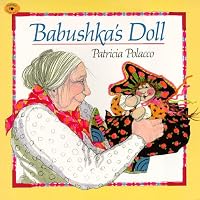
Babushka's Doll
by Patricia Polacco
On This Page
Description
A little girl gets a doll that turns out to be twice as rambunctious as her owner.Tags
Recommendations

Member Reviews
Well this was a surprise! I don't think I've ever encountered a Patricia Polacco title with such an overtly didactic purpose before, and I've now read thirty-five of her books! The story of an impatient little girl named Natasha, who never understood why her Babushka couldn't drop everything, and do just what she (Natasha) wanted her to, Babushka's Doll is a picture-book exploration of the theme of getting a taste of one's own medicine, as Natasha becomes the beleaguered one, when her grandmother's unusual doll comes to life.
I had mixed feelings about this one. On the one hand, I think young readers might enjoy the madcap sense of humor in Natash'a adventures, as she chases after Babushka's doll. On the other hand, while I do approve of show more the message - that sometimes we can't have what we want right away, and that it isn't very considerate to make a pest of ourselves - somehow the very presence of a "moral" in a Polacco book was jarring to me. show less
I had mixed feelings about this one. On the one hand, I think young readers might enjoy the madcap sense of humor in Natash'a adventures, as she chases after Babushka's doll. On the other hand, while I do approve of show more the message - that sometimes we can't have what we want right away, and that it isn't very considerate to make a pest of ourselves - somehow the very presence of a "moral" in a Polacco book was jarring to me. show less
Ironically, I read this the day before Mother’s Day. Having a little person learn what the demands of a littler person are is an interesting read.
I don’t think I’d call this a nice book. But it is an interesting one. YMMV because you could consider this a shared imagination but could also consider this witchcraft or possession of a doll by a spirit or something like that.
I don’t think I’d call this a nice book. But it is an interesting one. YMMV because you could consider this a shared imagination but could also consider this witchcraft or possession of a doll by a spirit or something like that.
Impatient, bratty and impulsive Natasha notices a doll high up on the shelf in her grandmother's house. Asking to play with the doll, her grandmother mentions that she only ever played with this item once.
After leaving the house, leaving Natasha with the doll, a great lesson is learned. The doll, a mirror image of behavior of Natasha demands rudely to hurry, hurry, hurry to flit from one thing to another. When Natasha is tired from the demands, she places the doll back on the shelf.
Increasingly, I find joy in the books of this author. The illustrations, the stories, and the importance of role models create wonderful reading.
After leaving the house, leaving Natasha with the doll, a great lesson is learned. The doll, a mirror image of behavior of Natasha demands rudely to hurry, hurry, hurry to flit from one thing to another. When Natasha is tired from the demands, she places the doll back on the shelf.
Increasingly, I find joy in the books of this author. The illustrations, the stories, and the importance of role models create wonderful reading.
Although the cover of this Scholastic reprint is shiny, the paper inside isn't and the pictures feel washed out and dull. They are also too hurried for my taste. But my primary complaint is with the blatant lesson that Natasha learns when a doll comes to life and behaves the way Natasha has. I don't mind subtle measure for measure, but I ended up feeling sorry for Natasha and I don't think I was supposed to.
Summary: Natasha can be a rather demanding girl, always asking her dear Babushka to tend to what she wants right away. But when Babushka lets her play with a magic doll, Natasha learns how heard it can be to let someone have their way all the time.
Review: A very sweet, true to life book, Babushka's Doll shows a side of childhood we've all either seen or taken part of firsthand. I think it's a great book to read with young children to help them understand the value of patience and appreciating the things others do for them.
Craft Elements/Lesson: Do you think Natasha is going to be as demanding to Babushka after playing with the doll? How is the doll like Natasha?
Review: A very sweet, true to life book, Babushka's Doll shows a side of childhood we've all either seen or taken part of firsthand. I think it's a great book to read with young children to help them understand the value of patience and appreciating the things others do for them.
Craft Elements/Lesson: Do you think Natasha is going to be as demanding to Babushka after playing with the doll? How is the doll like Natasha?
Polacco's very engaging illustrations, brightly colored, are a wonderful combination of the organic with the geometric. But really, you read this story if you have a four year old daughter. You hear a lot about the terrible twos, but nobody tells you about the f***ing fours, when kids often get demanding and try on selfishness for size. Not that I'm speaking from experience, or anything.
Sit down with that girl and read Babushka's Doll. Her eyes will be opened.
Sit down with that girl and read Babushka's Doll. Her eyes will be opened.
In this wonderful book by Patricia Polacco, a big lesson is learned. Natasha, the little girl, is very demanding and impatient. She keeps asking her grandmother for things while her grandma is busy. Finally the grandma asks to play with a doll on her grandma's shelf. The grandmother tells Natasha that she only played with it once when she was little. The grandmother lets Natasha play with the doll while she leaves the house. Once Natasha is alone with the doll, the doll comes to life. She starts bossing Natasha around. She eventually wears Natasha out with all of her demands. Natasha is upset and cries that she is just a little girl. When the grandmother arrives and hears Natasha's story, she tells Natasha she must have had a bad show more dream.She goes to sleep and the grandmother tells the doll that she heard she had a busy day, the doll then winks.
This teaches a lesson that patience is a virtue. It would be a good lesson in a classroom when teaching children manners. show less
This teaches a lesson that patience is a virtue. It would be a good lesson in a classroom when teaching children manners. show less
Members
- Recently Added By
Lists

A Child's Book Tour of Russia
45 works; 4 members
Author Information

81+ Works 56,705 Members
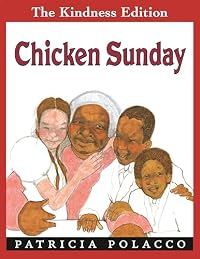
Patricia Polacco was born in Lansing, Michigan on July 11, 1944. She attended Oakland Tech High School in Oakland, California before heading off to the California College of Arts and Crafts in Oakland, then Laney Community College in Oakland. She then set off for Monash University, Mulgrave, Australia and the Royal Melbourne Institute of show more Technology, Melbourne, Australia where she received a Ph.D in Art History, Emphasis on Iconography. After college, she restored ancient pieces of art for museums. She didn't start writing children's books until she was 41 years old. She began writing down the stories that were in her head, and was then encouraged to join the Society of Children's Book Writers and Illustrators. There she learned how to put together a dummy and get a story into the form of a children's picture book. Her mother paid for a trip to New York, where the two visited 16 publishers in one week. She submitted everything she had to more than one house. By the time she returned home the following week, she had sold just about everything. Polacco has won the 1988 Sydney Taylor Book Award for The Keeping Quilt, and the 1989 International Reading Association Award for Rechenka's Eggs. She was inducted into the Author's Hall of Fame by the Santa Clara Reading Council in 1990, and received the Commonwealth Club of California's Recognition of Excellence that same year for Babushka's Doll, and again in 1992 for Chicken Sunday. She also won the Golden Kite Award for Illustration from the Society of Children's Book Writers and Illustrators for Chicken Sunday in 1992, as well as the Boston Area Educators for Social Responsibility Children's Literature and Social Responsibility Award. In 1993, she won the Jane Adams Peace Assoc. and Women's Intl. League for Peace and Freedom Honor award for Mrs. Katz and Tush for its effective contribution to peace and social justice. She has won Parent's Choice Honors for Some Birthday in 1991, the video Dream Keeper in 1997 and Thank You Mr. Falker in 1998. In 1996, she won the Jo Osborne Award for Humor in Children's Literature. Her titles The Art of Miss. Chew and The Blessing Cup made The New York Times Best Seller List. (Bowker Author Biography) show less
Awards and Honors
Work Relationships
Common Knowledge
- Canonical title
- Babushka's Doll
- Original publication date
- 1990
- Important places
- Russia
- Dedication
- To Lauen Estelle Washington
- First words
- It wasn't that Natasha was a truly naughty girl. She just never understood why she had to wait for things.
- Last words
- (Click to show. Warning: May contain spoilers.)The little doll gave Babushka a wink and went back to being just a doll. And Natasha turned out to be quite nice after all.
Classifications
- Genres
- Picture Books, Children's Books
- DDC/MDS
- 398.8 — Society, Government, and Culture Customs, etiquette & folklore Folklore & Folktales Rhymes and rhyming games
- LCC
- PZ7 .P75186 .P — Language and Literature Fiction and juvenile belles lettres Fiction and juvenile belles lettres Juvenile belles lettres
- BISAC
Statistics
- Members
- 1,846
- Popularity
- 11,654
- Reviews
- 54
- Rating
- (4.16)
- Languages
- English
- Media
- Paper, Audiobook, Ebook
- ISBNs
- 18
- ASINs
- 7