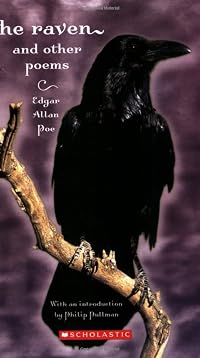
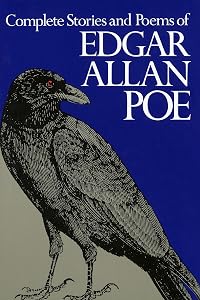
The Raven and Other Poems
by Edgar Allan Poe
On This Page
Description
A collection of twenty-six poems by nineteenth-century American poet Edgar Allen Poe.Tags
Recommendations












Member Reviews
I still think that Edgar Allan Poe is an insufferable sap, but when one of my favourite artists illustrates his work I have to add the book to my collection anyways. Dulac’s take on Poe may be one of the darkest I’ve seen, since his ever-moody palette of jewel tones evokes a sensuality that is otherwise absent in some of the other versions I’ve seen. Even out of context (since, let’s be honest, I stopped trying to deal with Poe’s melodramatic poetics), the images set the scene for some wondrous stories, even if they retain a melancholic undertone. Dulac generally doesn’t seem to be one for frivolity in his artwork, so in this sense he is well-suited to illustrating Poe’s terse characters and their sad lives, completely show more ignoring the softly magical and happier moods that do occasionally appear. Yet, I don’t know if I would count Dulac’s version of these poems as one of my top favourites, since the characters are missing the majesty of his other work and come off more stilted than expected. Though maybe that’s just how he saw Poe: moody and emotional, but a bit too uptight to fall into romanticism. show less
What a joy to revisit the poems of Edgar Allan Poe with a group of readers who brought to them thoughts and ideas that enhanced the reading. I love Poe's grasp of mythology, his use of rhyme and rhythm, alliteration, and, yes, even his morose musings. He seems to me to lay a tortured soul in front of us and ask, "What would you do with this? What could you do with it, but mourn?"
I have written individual reviews for The Raven, The Bells and Annabel Lee. I will not revisit them here, but I would like to speak to some of the lesser known poems that touched a chord with me.
To Annie:
And the fever called "Living"
Is conquered at last.
Poe sees life as so much torture and death as a release. And, death is portrayed as an illusion. The show more onlookers think he is "dead", but he is really in the arms of the woman he loved and lost. And...
And ah! let it never
Be foolishly said
That my room it is gloomy
And narrow my bed;
For man never slept
In a different bed—
And, to sleep, you must slumber
In just such a bed.
So, death is inevitable and there is no rest in life...to slumber you must die. It will come to all of us, and he seems to say that while it might look gloomy or confining or sad, it is not. It is simply a release from this world's toil and it is not just his lot, but that of every man.
Alone:
And all I lov'd--I lov'd alone.
I thought this one of the most moving of the poems. There is a real sense of angst in his recognition that he sees the world differently than others and that they cannot understand what is beneath his surface, in his mind. Even his loves cannot be shared or understood by others. They see fluffy clouds, he sees demons in the sky. He cannot explain why the world is darker to him, but he knows that his view separates him from humanity at large.
To Science:
I took this to be more about reality vs. creativity (imagination) than science literally. He cannot help reality imposing itself upon him, and truth destroys the comfort of myth. With science, he must face death as a reality; with myth, he can imagine that he is still able to hold and share the world of his beloved. I thought about Eden--after all, we humans lost Eden because Adam and Eve ate from the Tree of Knowledge.
And finally,
Dream Within a Dream
Yet if hope has flown away
In a night, or in a day,
In a vision, or in none,
Is it therefore the less gone?
All that we see or seem
Is but a dream within a dream.
The ultimate question (especially for Poe), "what is reality?" If hope has flown in a dream or vision is it less gone? Good question. If we feel something deeply, is it not real for us? How do we distinguish between what is and what was and what might be? If we wake on the morning after the loss of someone we love and believe we feel the weight of their body in the bed, can they have been there for that moment? Are there two worlds, ours and theirs, and can we bridge the two? And if there are two worlds, which of them is real...are they the dream, or are we?
There were several of the poems that just left me flat and did not speak to me at all, but for the most part I love his ability to tap into his sorrow and isolation and see his poems as an attempt to connect and reveal himself. He challenges our intellect, makes us ask questions, and what more can a poem do than that? I hope in death he was indeed folded into the arms of his Virginia or granted the gentle sleep that eluded him in life. There is no writer ever whose life and work were more intertwined. show less
I have written individual reviews for The Raven, The Bells and Annabel Lee. I will not revisit them here, but I would like to speak to some of the lesser known poems that touched a chord with me.
To Annie:
And the fever called "Living"
Is conquered at last.
Poe sees life as so much torture and death as a release. And, death is portrayed as an illusion. The show more onlookers think he is "dead", but he is really in the arms of the woman he loved and lost. And...
And ah! let it never
Be foolishly said
That my room it is gloomy
And narrow my bed;
For man never slept
In a different bed—
And, to sleep, you must slumber
In just such a bed.
So, death is inevitable and there is no rest in life...to slumber you must die. It will come to all of us, and he seems to say that while it might look gloomy or confining or sad, it is not. It is simply a release from this world's toil and it is not just his lot, but that of every man.
Alone:
And all I lov'd--I lov'd alone.
I thought this one of the most moving of the poems. There is a real sense of angst in his recognition that he sees the world differently than others and that they cannot understand what is beneath his surface, in his mind. Even his loves cannot be shared or understood by others. They see fluffy clouds, he sees demons in the sky. He cannot explain why the world is darker to him, but he knows that his view separates him from humanity at large.
To Science:
I took this to be more about reality vs. creativity (imagination) than science literally. He cannot help reality imposing itself upon him, and truth destroys the comfort of myth. With science, he must face death as a reality; with myth, he can imagine that he is still able to hold and share the world of his beloved. I thought about Eden--after all, we humans lost Eden because Adam and Eve ate from the Tree of Knowledge.
And finally,
Dream Within a Dream
Yet if hope has flown away
In a night, or in a day,
In a vision, or in none,
Is it therefore the less gone?
All that we see or seem
Is but a dream within a dream.
The ultimate question (especially for Poe), "what is reality?" If hope has flown in a dream or vision is it less gone? Good question. If we feel something deeply, is it not real for us? How do we distinguish between what is and what was and what might be? If we wake on the morning after the loss of someone we love and believe we feel the weight of their body in the bed, can they have been there for that moment? Are there two worlds, ours and theirs, and can we bridge the two? And if there are two worlds, which of them is real...are they the dream, or are we?
There were several of the poems that just left me flat and did not speak to me at all, but for the most part I love his ability to tap into his sorrow and isolation and see his poems as an attempt to connect and reveal himself. He challenges our intellect, makes us ask questions, and what more can a poem do than that? I hope in death he was indeed folded into the arms of his Virginia or granted the gentle sleep that eluded him in life. There is no writer ever whose life and work were more intertwined. show less
Who knew that Poe was such a sap? Almost all of the poems in this collection had the narrator whinging on about some lady love or other, whether she was dead or not, so I was pretty bored the whole time. I most certainly will not be bothering to pick up any more of his poetry.
2020 Review (Hardcover edition)
I'm honestly still not a fan of Edgar Allan Poe and his melodramatic proto-emo aesthetic, but I did enjoy Gustav Doré's accompanying illustrations to The Raven and Other Poems. Doré's stark black and white woodcuts capture the melancholy setting of many of the poes, placing them solidly in the Victorian era and setting a timeless tone for readers. In some ways, Doré's expressive characterization paris perfectly with Poe's overly show more emotional protagonist and brings out his sadness at losing his love and his anger at the raven; unfortunately for those of us who think he's a rather goofy sap, this only feeds our dislike of him. The other poems in the collection were much more loosely illustrated, as they each stand alone without a larger narrative, and while they were well done they didn't stand out that much. Ironically, the one poem that I did enjoy ("Dream-land") is scarcely illustrated, with only one small and faded landscape to show for all its lush imagery. Overall, I have to sat the book isn't very successful, for all of Doré's skill, but mostly because I can't really engage with most of the literary contents from Poe. show less
2020 Review (Hardcover edition)
I'm honestly still not a fan of Edgar Allan Poe and his melodramatic proto-emo aesthetic, but I did enjoy Gustav Doré's accompanying illustrations to The Raven and Other Poems. Doré's stark black and white woodcuts capture the melancholy setting of many of the poes, placing them solidly in the Victorian era and setting a timeless tone for readers. In some ways, Doré's expressive characterization paris perfectly with Poe's overly show more emotional protagonist and brings out his sadness at losing his love and his anger at the raven; unfortunately for those of us who think he's a rather goofy sap, this only feeds our dislike of him. The other poems in the collection were much more loosely illustrated, as they each stand alone without a larger narrative, and while they were well done they didn't stand out that much. Ironically, the one poem that I did enjoy ("Dream-land") is scarcely illustrated, with only one small and faded landscape to show for all its lush imagery. Overall, I have to sat the book isn't very successful, for all of Doré's skill, but mostly because I can't really engage with most of the literary contents from Poe. show less
Who knew that Poe was such a sap? Almost all of the poems in this collection had the narrator whinging on about some lady love or other, whether she was dead or not, so I was pretty bored the whole time. I most certainly will not be bothering to pick up any more of his poetry.
I liked some poems more than others. They average out quite close to three. Phillip Pullman's introduction was perfect.
not the biggest fan of this style of poetry, but i respect poe’s legacy, and i liked ‘For Annie.’
It was very slow and calm in the beginning not to much excitement. It didn’t have my attention but I read it to see if I would understand it a little more then what I thought about it. I had given up on this book because I wasn’t finding any interest and I didn’t really understand its way of explaining things or what they were doing. Yea, there were some good parts in the book I am not going to lie but not to the point where I wanted to read more about it. It’s a good book for those who are into like poem type readers or those who know how to read in the way they talked back then as like in ‘Romeo and Juliet.’ It has some mystery that is quit interesting. In some moments when I wasn’t reading the book I read the poems in show more the back of the book to see what they were about. They were long and not to the point. I had to read it a few times before I actually got what he was talking about. show less
Members
- Recently Added By
Lists

Poetry Collections
79 works; 6 members

Books Read in 2016
4,666 works; 197 members

Favourite Books
1,819 works; 308 members

19th Century
190 works; 16 members

Books Read in 2023
5,547 works; 145 members
Author Information

3,808+ Works 107,491 Members
Edgar Allan Poe was born in Boston, Massachusetts on January 19, 1809. In 1827, he enlisted in the United States Army and his first collection of poems, Tamerlane and Other Poems, was published. In 1835, he became the editor of the Southern Literary Messenger. Over the next ten years, Poe would edit a number of literary journals including the show more Burton's Gentleman's Magazine and Graham's Magazine in Philadelphia and the Broadway Journal in New York City. It was during these years that he established himself as a poet, a short story writer, and an editor. His works include The Fall of the House of Usher, The Tell-Tale Heart, The Murders in the Rue Morgue, The Mystery of Marie Roget, A Descent into the Maelstrom, The Masque of the Red Death, and The Raven. He struggle with depression and alcoholism his entire life and died on October 7, 1849 at the age of 40. (Bowker Author Biography) show less
Some Editions
Work Relationships
Is contained in
Contains
Common Knowledge
- Canonical title
- The Raven and Other Poems
- Original title
- The Raven and Other Poems
- Original publication date
- 1845 (The Raven) (The Raven)
- First words
- Once upon a midnight dreary, while I pondered weak and weary,
Over many a quaint and curious volume of forgotten lore,
While I nodded, nearly napping, suddenly there came a tapping,
As of some one gently rapping, rap... (show all)ping at my chamber door. - Quotations
- Nevermore.
- Last words
- (Click to show. Warning: May contain spoilers.)Ah, Psyche, from the regions which
Are Holy-land!
Classifications
Statistics
- Members
- 2,014
- Popularity
- 10,118
- Reviews
- 14
- Rating
- (4.13)
- Languages
- 9 — Czech, English, Estonian, French, German, Italian, Portuguese, Spanish, Swedish
- Media
- Paper, Audiobook, Ebook
- ISBNs
- 53
- ASINs
- 14