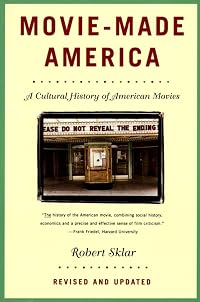
Movie-Made America: A Cultural History of American Movies
by Robert Sklar
On This Page
Description
This vastly readable and richly illustrated volume examines film as art form, technological innovation, big business, and cultural bellwether. It takes in stars from Douglas Fairbanks to Sly Stallone; auteurs from D. W. Griffith to Martin Scorsese and Spike Lee; and genres from the screwball comedy of the 1930s to the "hard body" movies of the 1980s to the independent films of the 1990s. Combining panoramic sweep with detailed commentaries on hundreds of individual films, Movie-Made America show more is a must for any motion picture enthusiast. show lessTags
Recommendations




















Member Reviews
I enjoyed reading this, but I'm sorry to say I don't remember much...about how the movies reflected the changing culture of the US
A classic by the man who directly inspired the creation of fantasy baseball, for better or for worse.
In Movie-Made America: A Cultural History of American Movies, Robert Sklar writes of film’s cultural power, “In the case of movies, the ability to exercise cultural power was shaped not only by the possession of economic, social or political power but also by such factors as national origin or religious affiliation, not to speak of far more elusive elements, such as celebrity or personal magnetism” (pg. vi). Sklar’s survey of film history is largely based on how the motion picture business responded to and drove issues of class in the United States. Sklar argues, “The urban workers, the immigrants and the poor had discovered a new medium of entertainment without the aid, and indeed beneath the notice, of the custodians and show more arbiters of middle-class culture. The struggle for control of the movies was the begin soon thereafter, and it continues to the present day. But movies have never lost their original character as a medium of mass popular culture” (pg. 5).
Sklar writes, “As a business, and as a social phenomenon, the motion pictures came to life in the United States when the made contact with working-class needs and desires” (pg. 16). Further, “It was not what movies were but what they might become that attracted the spokesmen for middle-class culture. They were fascinated by the audience that movies had won over and could command” (pg. 32). Sklar continues, “There is no way to show a cause-and-effect relation between Hollywood’s pleasure principles and the gradual unloosening of sexual restraints in American life; perhaps the two go together as symptoms of social change which affects them both. But Hollywood’s sexual behavior was the most publicized frontier of a new morality – or lack of one – during the 1920s, and there is reason to believe that the Aquarians of Hollywood were a vanguard of the increasingly larger role sexual openness has played in American public behavior during the past half-century” (pg. 81-82).
According to Sklar, “The movies appealed to a large audience untouched by the established media of entertainment; moreover, they provided visual techniques ideally suited to a new and expanded expression of the old comic violence, exaggeration and grotesque imagination. In the movies, audience taste and media form came together in what may have been the one genuine expression of popular feelings in the history of American commercial humor” (pg. 105). Returning to his thesis, Sklar writes, “The struggle over movies, in short, was an aspect of the struggle between the classes” (pg. 123). Turning to the Great Depression, Sklar writes, “The form that movie culture assumed grew out of interrelations with other social and economic institutions and with the state. Behind the dream world on the screen loomed the very real world of the American economy and society” (pg. 161). Of the public discussion, he writes, “Among academics and in literary circles, however, and in the principal newspapers and magazines, the moviemakers were regarded with considerably more respect, awe and even envy, as the possessors of the power to create the nation’s myths and dreams” (pg. 195).
After World War II, the class issue changed. Sklar writes, “The postwar attack on Hollywood could not have got off the ground had it been merely a renewal of old enmities. The familiar charges against moviemakers, although couched in moral terms, had never fully succeeded in masking ethnic, religious and class antagonisms. In the aftermath of a war against Nazism, these traditional complaints began to appear base and repugnant” (pg. 256). show less
Sklar writes, “As a business, and as a social phenomenon, the motion pictures came to life in the United States when the made contact with working-class needs and desires” (pg. 16). Further, “It was not what movies were but what they might become that attracted the spokesmen for middle-class culture. They were fascinated by the audience that movies had won over and could command” (pg. 32). Sklar continues, “There is no way to show a cause-and-effect relation between Hollywood’s pleasure principles and the gradual unloosening of sexual restraints in American life; perhaps the two go together as symptoms of social change which affects them both. But Hollywood’s sexual behavior was the most publicized frontier of a new morality – or lack of one – during the 1920s, and there is reason to believe that the Aquarians of Hollywood were a vanguard of the increasingly larger role sexual openness has played in American public behavior during the past half-century” (pg. 81-82).
According to Sklar, “The movies appealed to a large audience untouched by the established media of entertainment; moreover, they provided visual techniques ideally suited to a new and expanded expression of the old comic violence, exaggeration and grotesque imagination. In the movies, audience taste and media form came together in what may have been the one genuine expression of popular feelings in the history of American commercial humor” (pg. 105). Returning to his thesis, Sklar writes, “The struggle over movies, in short, was an aspect of the struggle between the classes” (pg. 123). Turning to the Great Depression, Sklar writes, “The form that movie culture assumed grew out of interrelations with other social and economic institutions and with the state. Behind the dream world on the screen loomed the very real world of the American economy and society” (pg. 161). Of the public discussion, he writes, “Among academics and in literary circles, however, and in the principal newspapers and magazines, the moviemakers were regarded with considerably more respect, awe and even envy, as the possessors of the power to create the nation’s myths and dreams” (pg. 195).
After World War II, the class issue changed. Sklar writes, “The postwar attack on Hollywood could not have got off the ground had it been merely a renewal of old enmities. The familiar charges against moviemakers, although couched in moral terms, had never fully succeeded in masking ethnic, religious and class antagonisms. In the aftermath of a war against Nazism, these traditional complaints began to appear base and repugnant” (pg. 256). show less
(Mine's the 1975 paperback, via used bookstore. Checking to see if I have the newer edition too.)
Poorly indexed.
Ratings
Members
- Recently Added By
Lists

Best Books on Film
46 works; 12 members
Author Information

Robert Sklar received his undergraduate degree from Princeton University and his Ph.D. from Harvard University. Currently Professor of Cinema Studies at New York University, he has been chairman of the Department of Cinema Studies there and has also taught in New Zealand and Japan. He is the author of several books on film, Dr. Sklar is a member show more of the National Society of Film Critics, as well as the National Film Preservation Board show less
Some Editions
Awards and Honors
Awards
Common Knowledge
- Original title
- Movie-made America. A Cultural History of American Movies
- Original publication date
- 1975
- Blurbers
- Postman, Neil
Classifications
- Genres
- Nonfiction, History, General Nonfiction
- DDC/MDS
- 791.430973 — Arts & recreation Recreation, sports, and performing arts Public performances Motion pictures, radio, television, podcasting Motion pictures Standard subdivisions History, geographic treatment, biography; description, critical appraisal of specific companies and studios {for specific films see 791.437} North America
- LCC
- PN1993.5 .U6 .S53 — Language and Literature Literature (General) Literature (General) Drama Motion pictures
- BISAC
Statistics
- Members
- 432
- Popularity
- 71,545
- Reviews
- 5
- Rating
- (3.77)
- Languages
- English, Italian
- Media
- Paper, Ebook
- ISBNs
- 5
- ASINs
- 7