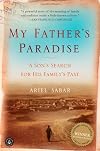
My Father's Paradise: A Son's Search for His Jewish Past in Kurdish Iraq
by Ariel Sabar
On This Page
Description
In a remote corner of the world, forgotten for nearly three thousand years, lived an enclave of Kurdish Jews so isolated that they still spoke Aramaic, the language of Jesus. Mostly illiterate, they were self-made mystics and gifted storytellers and humble peddlers who dwelt in harmony with their Muslim and Christian neighbors in the mountains of northern Iraq. To these descendants of the Lost Tribes of Israel, Yona Sabar was born. Yona's son Ariel grew up in Los Angeles, where Yona had show more become an esteemed professor, dedicating his career to preserving his people's traditions. Ariel wanted nothing to do with his father's strange immigrant heritage-until he had a son of his own. Ariel Sabar brings to life the ancient town of Zakho, discovering his family's place in the sweeping saga of Middle-Eastern history. This powerful book is an improbable story of tolerance and hope set in what today is the very center of the world's attention. Ariel Sabar is an award-winning former staff writer for the Baltimore Sun and the Providence (RI) Journal. His work has also appeared in the New York Times, the Christian Science Monitor, the Washington Monthly, Moment, Mother Jones magazine, and other publications. He lives with his wife and two children in Washington, D.C. show lessTags
Recommendations
















Member Recommendations
labfs39 Reading My Father’s Paradise brings to mind Daniel Mendelsohn’s book The Lost (published by HarperCollins in 2006). Both books are personal journeys of discovery into their families’ pasts: Sabar’s search for Zakho’s Jews and his father’s past, and Mendelsohn’s search for six members of his family lost in the Holocaust. Both are compelling stories with broad appeal. What is different, however, is Mendelsohn’s inclusion of the impact of each discovery on his own understanding: understanding of himself and his family, on the nature of history and memory, and on the interaction of truth and storytelling.

cransell A different look at the emigrant experience of a lesser known community of Jews.
Member Reviews
A compelling narrative that serves both to illuminate the world and experience of Iraqi Kurdish Jews, and the journey of one particular one (the author's father) from Kurdistan to Israel to Los Angeles, where he becomes an authority on the disappearing language of his boyhood. Ariel Sabar writes clearly and evocatively, whether it's outlining the complicated history of the region or reenacting scenes from his grandparents' and parents' lives. One only wishes that all sons and daughters could do as well with capturing the stories of the generations that came before.
A wonderful book. Ariel Sabar tells the story of his Jewish family from their origins in isolated Kurdistan where their ancestors had been settled for thousands of years to their forced emigration - first to Israel, and then, through his father's prowess in Aramaic, to America. A story of the immigrant struggle, it is also, and more deeply, a story told simultaneously at two more levels - that of Ariel's overcoming of his long dissatisfaction with his father's backward looking person and discipline, and that of the language itself.
By the quality of Sabar's observations and writing he is able to present honest assessments of all the players, including himself, in ways constantly touching and revealing. In the end he is able to reassess show more the meaning and value of his father's long and arduous labour at what was, for him, a mother tongue, but, for nearly all others, a language in its final death throes. No matter that it is called neo-Aramaic, it is the end of the ancient language of empires whose spread and dominance could be compared for westerners to ancient Greek or modern English, but to which both must as yet bow the knee of longevity and endurance.
For its human insight alone, the book is worth reading. As a student of the Bible, I was further fascinated by the thought of the Kurdish Jews as long survivors of the lost tribes of Israel, thrilled to think of Aramaic, once spoken by Jesus (albeit in an older form) still being used by ordinary people within my lifetime, and horrified at the low esteem of such survivors in the modern world.
My copy was a kind gift from a thoughtful friend, and I am glad to have received it. show less
By the quality of Sabar's observations and writing he is able to present honest assessments of all the players, including himself, in ways constantly touching and revealing. In the end he is able to reassess show more the meaning and value of his father's long and arduous labour at what was, for him, a mother tongue, but, for nearly all others, a language in its final death throes. No matter that it is called neo-Aramaic, it is the end of the ancient language of empires whose spread and dominance could be compared for westerners to ancient Greek or modern English, but to which both must as yet bow the knee of longevity and endurance.
For its human insight alone, the book is worth reading. As a student of the Bible, I was further fascinated by the thought of the Kurdish Jews as long survivors of the lost tribes of Israel, thrilled to think of Aramaic, once spoken by Jesus (albeit in an older form) still being used by ordinary people within my lifetime, and horrified at the low esteem of such survivors in the modern world.
My copy was a kind gift from a thoughtful friend, and I am glad to have received it. show less
Incredibly well written, moving and compelling book about the author's father- Yona Sabar, a linguistic professor at UCLA, whose roots and early life were in Kurdistan. Uprooted from Iraq in the early 1950's the family then settles in Israel, where prejudice and hard times prevail. Yona, through much, much hard work and study, is able to secure an education and winds up at Yale in the 1960's. The son, a skateboarding teenager, who was raised in Los Angeles and appeared ashamed of his immigrant father throughtout his teen years, begins to have a change of heart as an adult, and begins an incredible journey to document his father's life and those of his ancestors. A joy of a book and totally worthy of the awards and praise the author has won.
In 1985 I was 25 years old and living at 25 Rehov Antigones in the Katamon Vav neighborhood of Jerusalem, surrounded by Israelis from Kurdistan and their grown children and grandchildren. The neighborhood of the Katomonim was working class and Jewish Kurdish. Not Moroccan, or Yemenite, or Iraqi, but distinctly and undeniably Kurdish. I didn't know at the time that the Kurds were considered to be at the bottom of the Israeli social hierarchy. I didn't then know that the language the older folks were speaking was actually neo-Aramaic, the surviving remnant of the language of the ancient land of Israel, found in Books of Ezra and Daniel and in the Talmud. I thought of them only as ordinary working class Mizrahim, "Sephardic" Jews from Arab show more lands.
We young Americans in Katamon Vav, for our part, were real oddities. We were from the golden medina (how do you say "golden land" in Kurdish Aramaic?), but poor, living on student stipends and minimum wage jobs. They must have wondered what the hell we were doing in their world. In some global sense I was on the top of the heap - I had a college degree and an American passport! But in another sense, with my broken Hebrew and lack of money, living on white cheese, lehem chai, lemon juice syrup and cucumbers with three other bachelors, I was below these Israeli Kurdish natives in social status. I may have had a fine American life waiting for me if I left, but I was a miserably incompetent Israeli in their world. We did not interact much with our Kurdish neighbors. They didn't invite us into their lives. I was curious about them, but busy with my studies at Hebrew University. It was just a rental situation in a poor neighborhood.
Ariel Sabar's "My Father's Paradise: A Son's Search for his Jewish Past in Kurdish Iraq" puts everything I experienced in Kurdish Jerusalem in context. Through his eyes I understand better what Iraqi Kurdistan once was, what my neighbors must have experienced in making the vast cultural jump to Israel, and who they were in a deep sense. Reading Sabar a new affection for them replaces what was largely an experience of curiosity mixed with non-communication and misunderstandings, mostly of the ordinary landlord-tenant kind, but exacerbated by cross-cultural miscues.
Sabar's narrative is a two level story, personal and historical. At the personal level, it is the story of his own struggles in America with his immigrant father, a double immigrant, from both Kurdistan and the Jerusalem Katamonim where I had lived. By the time of Sabar's birth in 1971, Sabar's father had left the Katamonim and Israel to become a world renowned academic scholar of neo-Aramaic. He was ensconced at UCLA and Sabar would be raised in Los Angeles of the 1970s and 1980s. Their relationship was difficult and the book is the story of Sabar's effort as an American to understand his father, so culturally alien in manner and perspective. It is an old immigrant story, a father from the old country and a son in the new who do not understand each other, and it is beautifully told in a modern manifestation here.
But beyond the personal the book is also an historical narrative of the entire Kurdish immigration and settlement, describing the deep history of the Jewish settlement in Kurdistan, beginning with the original Babylonia exile in 500 BCE, and then moving forward across hundreds of years of little recorded history in a mountainous back country, using fragments of historical texts and family history to tell the story of the entire Kurdish Jewish situation, culminating in the mass exodus of the Kurdish Jewish community to Israel in 1951.
Anyone who has lived in Israel or has relatives (like I do) who were immigrants from the lands of e'dote ha'mizrach (the eastern communities) is familiar with the 1950s ma'aborot (transit camps) and the stories of the struggle, bigotry and discrimination that Middle Eastern Jews experienced at the hands of the Ashkenazi Israeli establishment of the era. Sabar's narrative brings that experience to life. As his family (grandparents, aunts, uncles, cousins) and friends make clear, the dislocation and the poverty were profound, and the 1950s era bigotry was cutting. When Sabar's father received a scholarship at Yale in 1965 it is no surprise that he leaped for the life it promised as an American academic. His siblings however remained in Israel and their stories, explored here in some detail, are more typical of Kurdish immigrants to Israel like my former neighbors in the Katamonim.
But beyond my year in Katamon Vav, the personal parallels between my own life and Sabar's make this book feel intimately familiar to me. He and I share Los Angeles. Ariel Sabar grew up in Los Angeles in the 1970s and 1980s. I was some ten years older and grew up there in the 1970s. His father was a professor, the son of immigrant parents, who found freedom and professional renown in faraway Los Angeles. My father was also a professor, the son of immigrants (Russian Jews living in the Bronx, New York 1930s) who found freedom and professional renown in faraway Los Angeles. Ariel Sabar struggled more overtly with his father than I did with mine, but in the end we both developed a sense that the thing we were missing in the cultural break created by our parents' movement to the sun-baked sterility of Southern California had something to do with the obscure past our parents left behind. Sabar's need to discover a past seems to have its roots in the dystopian eternal now of West Los Angeles. There is a special ahistorical madness that develops in that California sun. It got to me, and it got to him. In a world without a past, sometimes you have to write one yourself.
Twenty seven years have passed since I lived in Katamon in 1985, a full generation. That's as much time as had already passed since the Kurds had first come to Israel and moved into the Katamon neighborhood when I was there in the mid-1980s. When I returned in 2009 the neighborhood looked perhaps slightly improved in the intervening quarter century. I thought I recognized the house I lived in. (See GoogleMaps link below.) I didn't knock. I couldn't remember the landlord's name. You can't go back. At least, you can't go back in any simple sense. Sabar does a lot of going back in his book, and discovers what remains and what has been washed away forever.
Ariel Sabar's story of searching for his father's past, and thus his own present, is marvelous as journalism, memoir, family history, Jewish and Middle Eastern history, and a beautiful exploration of an uneasy relationship between a father and a son. He does not wrap it up for us in a bow, or pretend that all the differences and breaks are reconciled. He saves the biggest disappointment for the end, and discovers the people who can never be reunited and the breaks that can never be repaired. But he does show us how it is possible to come to terms with the personal and cultural breaks that emerge as people grow into new cultural situations and migrate apart. It's a broken world he seems to say, but it can still all hang together in a new way if we weave the right web of words.
The web of words will bind us together and a livable coherence will emerge, and yet there will be story lines whose conclusions will be forever lost and questions that can never be resolved.
---
Postscript: I lived in one of these low buildings at 25 Antigonus (see GoogleMaps link below, in Katamon Vav (Katamon Six), Jerusalem, Israel, a Kurdish neighborhood. Many of the surrounding buildings have been added on to considerably, growing upward and toward the street, but it appears that my exact address has changed little. Image from circa 2012.
https://maps.google.com/maps?q=25 Rehov Antigones Katamon Vav jerusalem israel&hl=en&ll=31.756441,35.206943&spn=0.003809,0.006968&sll=31.756443,35.206944&sspn=0.003827,0.006968&t=h&hnear=Antigonus 25, Jerusalem, Israel&z=18&layer=c&cbll=31.756441,35.206943&panoid=7PDckq4cv_zGdmVR9sXcaA&cbp=12,127.45,,0,2.15 show less
We young Americans in Katamon Vav, for our part, were real oddities. We were from the golden medina (how do you say "golden land" in Kurdish Aramaic?), but poor, living on student stipends and minimum wage jobs. They must have wondered what the hell we were doing in their world. In some global sense I was on the top of the heap - I had a college degree and an American passport! But in another sense, with my broken Hebrew and lack of money, living on white cheese, lehem chai, lemon juice syrup and cucumbers with three other bachelors, I was below these Israeli Kurdish natives in social status. I may have had a fine American life waiting for me if I left, but I was a miserably incompetent Israeli in their world. We did not interact much with our Kurdish neighbors. They didn't invite us into their lives. I was curious about them, but busy with my studies at Hebrew University. It was just a rental situation in a poor neighborhood.
Ariel Sabar's "My Father's Paradise: A Son's Search for his Jewish Past in Kurdish Iraq" puts everything I experienced in Kurdish Jerusalem in context. Through his eyes I understand better what Iraqi Kurdistan once was, what my neighbors must have experienced in making the vast cultural jump to Israel, and who they were in a deep sense. Reading Sabar a new affection for them replaces what was largely an experience of curiosity mixed with non-communication and misunderstandings, mostly of the ordinary landlord-tenant kind, but exacerbated by cross-cultural miscues.
Sabar's narrative is a two level story, personal and historical. At the personal level, it is the story of his own struggles in America with his immigrant father, a double immigrant, from both Kurdistan and the Jerusalem Katamonim where I had lived. By the time of Sabar's birth in 1971, Sabar's father had left the Katamonim and Israel to become a world renowned academic scholar of neo-Aramaic. He was ensconced at UCLA and Sabar would be raised in Los Angeles of the 1970s and 1980s. Their relationship was difficult and the book is the story of Sabar's effort as an American to understand his father, so culturally alien in manner and perspective. It is an old immigrant story, a father from the old country and a son in the new who do not understand each other, and it is beautifully told in a modern manifestation here.
But beyond the personal the book is also an historical narrative of the entire Kurdish immigration and settlement, describing the deep history of the Jewish settlement in Kurdistan, beginning with the original Babylonia exile in 500 BCE, and then moving forward across hundreds of years of little recorded history in a mountainous back country, using fragments of historical texts and family history to tell the story of the entire Kurdish Jewish situation, culminating in the mass exodus of the Kurdish Jewish community to Israel in 1951.
Anyone who has lived in Israel or has relatives (like I do) who were immigrants from the lands of e'dote ha'mizrach (the eastern communities) is familiar with the 1950s ma'aborot (transit camps) and the stories of the struggle, bigotry and discrimination that Middle Eastern Jews experienced at the hands of the Ashkenazi Israeli establishment of the era. Sabar's narrative brings that experience to life. As his family (grandparents, aunts, uncles, cousins) and friends make clear, the dislocation and the poverty were profound, and the 1950s era bigotry was cutting. When Sabar's father received a scholarship at Yale in 1965 it is no surprise that he leaped for the life it promised as an American academic. His siblings however remained in Israel and their stories, explored here in some detail, are more typical of Kurdish immigrants to Israel like my former neighbors in the Katamonim.
But beyond my year in Katamon Vav, the personal parallels between my own life and Sabar's make this book feel intimately familiar to me. He and I share Los Angeles. Ariel Sabar grew up in Los Angeles in the 1970s and 1980s. I was some ten years older and grew up there in the 1970s. His father was a professor, the son of immigrant parents, who found freedom and professional renown in faraway Los Angeles. My father was also a professor, the son of immigrants (Russian Jews living in the Bronx, New York 1930s) who found freedom and professional renown in faraway Los Angeles. Ariel Sabar struggled more overtly with his father than I did with mine, but in the end we both developed a sense that the thing we were missing in the cultural break created by our parents' movement to the sun-baked sterility of Southern California had something to do with the obscure past our parents left behind. Sabar's need to discover a past seems to have its roots in the dystopian eternal now of West Los Angeles. There is a special ahistorical madness that develops in that California sun. It got to me, and it got to him. In a world without a past, sometimes you have to write one yourself.
Twenty seven years have passed since I lived in Katamon in 1985, a full generation. That's as much time as had already passed since the Kurds had first come to Israel and moved into the Katamon neighborhood when I was there in the mid-1980s. When I returned in 2009 the neighborhood looked perhaps slightly improved in the intervening quarter century. I thought I recognized the house I lived in. (See GoogleMaps link below.) I didn't knock. I couldn't remember the landlord's name. You can't go back. At least, you can't go back in any simple sense. Sabar does a lot of going back in his book, and discovers what remains and what has been washed away forever.
Ariel Sabar's story of searching for his father's past, and thus his own present, is marvelous as journalism, memoir, family history, Jewish and Middle Eastern history, and a beautiful exploration of an uneasy relationship between a father and a son. He does not wrap it up for us in a bow, or pretend that all the differences and breaks are reconciled. He saves the biggest disappointment for the end, and discovers the people who can never be reunited and the breaks that can never be repaired. But he does show us how it is possible to come to terms with the personal and cultural breaks that emerge as people grow into new cultural situations and migrate apart. It's a broken world he seems to say, but it can still all hang together in a new way if we weave the right web of words.
The web of words will bind us together and a livable coherence will emerge, and yet there will be story lines whose conclusions will be forever lost and questions that can never be resolved.
---
Postscript: I lived in one of these low buildings at 25 Antigonus (see GoogleMaps link below, in Katamon Vav (Katamon Six), Jerusalem, Israel, a Kurdish neighborhood. Many of the surrounding buildings have been added on to considerably, growing upward and toward the street, but it appears that my exact address has changed little. Image from circa 2012.
https://maps.google.com/maps?q=25 Rehov Antigones Katamon Vav jerusalem israel&hl=en&ll=31.756441,35.206943&spn=0.003809,0.006968&sll=31.756443,35.206944&sspn=0.003827,0.006968&t=h&hnear=Antigonus 25, Jerusalem, Israel&z=18&layer=c&cbll=31.756441,35.206943&panoid=7PDckq4cv_zGdmVR9sXcaA&cbp=12,127.45,,0,2.15 show less
This book is a gem. I turn each page feeling slightly elated. I want to save it and not read it quickly but I can't resist just a few more pages at a time. What its about is the Sabar family, the father is a professor in UCLA but spent his early years on a tiny river island in Kurdistan, the same river with the exact same name as mentioned in the bible as when the Jews went out to Mesopotamia (Iraq) 2,700 years ago and where they still spoke Aramaic which was, for a thousand years, the lingua franca of the Middle East, before the Arabs conquered it and imposed Arabic, a daughter language of Aramaic itself. Fascinating characters, a wonderful journey and marvellous, story-spinning writing.
What child has not been embarrassed by his parent at some point during his adolescence? A parent’s accent, love for country music, or penchant for Hawaiian shirts in December seem like flashing neon badges of distinction to a teenager’s desire for conformity. So it is with author Ariel Sabar, a product of Southern California cool, and his desire to disassociate himself with his decidedly un-cool father. Yona Sabar is a world expert on neo-Aramaic, an almost dead language, the driver of a Tercel, and his own barber. He is also the product of a lost world, a Jewish enclave in Kurdish Iraq. As an adult, Ariel’s slow-growing appreciation of his father’s accomplishments, and the birth of his own son, leads him on a journey of family show more exploration which ends where it began, the town of Zakho, in Northern Iraq.
Growing up in Southern California, Ariel Sabar understood little of the burden his father felt as the link between a world that was nearly extinct and the twenty-first century. Writing this book, Ariel’s first, is an attempt to reach out to his father and to discover his own place in his family’s history. Despite the personal nature of his purpose, most of the book is written as a rather impersonal but fascinating story. With a plot that touches on current events in Iraq, the struggles of the Kurdish people, and the success of a modern-day immigrant to America, the reader is drawn into a unique and compelling story. Ariel’s background in journalism is apparent in his brief masterful sketches of place and character. The mind’s eye can picture each scene: Yona as a boy jumping from rooftop to rooftop; his mother, sitting unnoticed in the corner as her children eat at the table; the confusion of a new immigrant as he searches for his American welcoming committee. What was harder to see was the effect on the author of each new discovery about his family.
In the last chapters of My Father’s Paradise, Sabar touches on his motivations for writing the book, his reconciliation with failing to get the ultimate “Oprah” moment in his search for his missing aunt, and the role his young son plays in bring Ariel and his father together. But one is left with the feeling that the author’s adolescent bitterness is still coloring his relationship with his father and that from his “home” in Maine, he is still searching for his place in the world.
Overall, I found the depiction of the characters to be touching and real, the history to be compelling, and the glimpses into the study of linguistics to be illuminating. I wish the author had included more introspection about what these discoveries mean to him, but I suspect he is still learning that himself.
[Ariel Sabar is now living in Washington, DC with his wife and two children and is covering the 2008 presidential campaign for the Christian Science Monitor.] show less
Growing up in Southern California, Ariel Sabar understood little of the burden his father felt as the link between a world that was nearly extinct and the twenty-first century. Writing this book, Ariel’s first, is an attempt to reach out to his father and to discover his own place in his family’s history. Despite the personal nature of his purpose, most of the book is written as a rather impersonal but fascinating story. With a plot that touches on current events in Iraq, the struggles of the Kurdish people, and the success of a modern-day immigrant to America, the reader is drawn into a unique and compelling story. Ariel’s background in journalism is apparent in his brief masterful sketches of place and character. The mind’s eye can picture each scene: Yona as a boy jumping from rooftop to rooftop; his mother, sitting unnoticed in the corner as her children eat at the table; the confusion of a new immigrant as he searches for his American welcoming committee. What was harder to see was the effect on the author of each new discovery about his family.
In the last chapters of My Father’s Paradise, Sabar touches on his motivations for writing the book, his reconciliation with failing to get the ultimate “Oprah” moment in his search for his missing aunt, and the role his young son plays in bring Ariel and his father together. But one is left with the feeling that the author’s adolescent bitterness is still coloring his relationship with his father and that from his “home” in Maine, he is still searching for his place in the world.
Overall, I found the depiction of the characters to be touching and real, the history to be compelling, and the glimpses into the study of linguistics to be illuminating. I wish the author had included more introspection about what these discoveries mean to him, but I suspect he is still learning that himself.
[Ariel Sabar is now living in Washington, DC with his wife and two children and is covering the 2008 presidential campaign for the Christian Science Monitor.] show less
 This review was written for LibraryThing Early Reviewers.
"My Father's Paradise" by Ariel Sabar is really two books in one.
The first story is the author 's attempt to understand his family (especially his father Yona) by investigating their shared history. While I enjoyed this part of the book, this portion covered very familiar themes like reconcilation, personal discovery and assimilation. I seem to have read many books on these topics recently.
The second story, however, was new to me. It told of the mass relocation of Kurdish Jews from Iraq to Israel. This portion of the book was fascinating and unfamiliar. Sabar uses his skill as a reporter to increase the reader's understanding of a very important event in history, the creation of the Jewish state. While I have read previously on this show more subject, it has never been from the perspective of a non-European Jew. I will continue to look for other books like this to read, as Mr. Sabar has really sparked an interest in me to learn more about this time and place in history.
I would recommend this book wholeheartedly to anyone whose interests include Middle Eastern history or Judaism. I am very thankful I had the opportunity to read and review this book. show less
The first story is the author 's attempt to understand his family (especially his father Yona) by investigating their shared history. While I enjoyed this part of the book, this portion covered very familiar themes like reconcilation, personal discovery and assimilation. I seem to have read many books on these topics recently.
The second story, however, was new to me. It told of the mass relocation of Kurdish Jews from Iraq to Israel. This portion of the book was fascinating and unfamiliar. Sabar uses his skill as a reporter to increase the reader's understanding of a very important event in history, the creation of the Jewish state. While I have read previously on this show more subject, it has never been from the perspective of a non-European Jew. I will continue to look for other books like this to read, as Mr. Sabar has really sparked an interest in me to learn more about this time and place in history.
I would recommend this book wholeheartedly to anyone whose interests include Middle Eastern history or Judaism. I am very thankful I had the opportunity to read and review this book. show less
This review was written for LibraryThing Early Reviewers.Members
- Recently Added By
Published Reviews
ThingScore 75
As long as the focus stays on Yona Sabar, a last of the Mohicans for Kurdish Jews, the book is graceful and resonant. It falters only when the author extends too far beyond this narrative, imagining a bit too colorfully village life in Zakho or obsessively self-analyzing his dissonant relationship with his father. What holds our attention is that last bar mitzvah boy of Zakho, who, by helping show more to save Aramaic, managed to find a rare equilibrium between past and present. Or, as his son elegantly puts it, he "sublimated homesickness into a career." show less
added by jlelliott
Lists

Unshelved Book Clubs
579 works; 5 members
Author Information

5 Works 819 Members
Ariel Sabar, who was born in New York City, won the National Book Critics Circle Award, for his first book, My Father's Paradise. He is an award-winning former staff writer for the Baltimore Sun, Christian Science Monitor, and Providence Journal. His work has also appeared in the New York Times Magazine, Washington Monthly, and Boston Globe, among show more many other publications. He has lectured on creative writing at Brown, Georgetown, and The George Washington University. show less
Awards and Honors
Awards
Distinctions
Notable Lists
Common Knowledge
- Original publication date
- 2008-09-16
- People/Characters
- Yona Sabar; Ariel Sabar
- Important places
- Zakho, Iraq; Kurdistan; Jerusalem; Los Angeles, California, USA; Yale University, New Haven, Connecticut, USA
- Epigraph
- I searched to discover which was the first of all languages. Many have said that the Aramaic is most ancient, and that it is in the nature of man to speak it without having been taught by anyone. Further, that if a newborn ch... (show all)ild were placed in the desert with no one but a mute wet nurse, he would speak Aramaic. -- Abraham Ibn-Ezra, twelfth-century commentator and linguist
- First words
- I am the keeper of my family's stories.
- Quotations
- Here is what made Aramaic irresistible: It was high-tech. Before it, the closest thing to a Near Eastern lingua franca was Akkadian, which was etched in cuneiform, wedge-shaped characters pressed into clay. Aramaic could be w... (show all)ritten on papyrus.
"Why can't you just bring what I want?" a farm matron carped one day. .... Instead of guessing at his customers needs, he tried something novel among the peddlers of Zakho: He took advance orders. [p. 49] - Last words
- (Click to show. Warning: May contain spoilers.)"One day," I said, pulling him closer. "One day we'll go together, okay?"
Classifications
- Genres
- Nonfiction, Biography & Memoir, General Nonfiction, History, Religion & Spirituality
- DDC/MDS
- 305.892405672092 — Society, Government, and Culture Social sciences, sociology & anthropology Social group - Age, Gender, Ethnicity Ethnic and national groups Other ethnic and national groups Semites Hebrews, Israelis, Jews
- LCC
- DS135 .K8 .S23 — History of Europe, Asia, Africa and Oceania Asia History of Asia Israel (Palestine). The Jews Jews outside of Palestine
- BISAC
Statistics
- Members
- 532
- Popularity
- 55,845
- Reviews
- 45
- Rating
- (4.31)
- Languages
- Dutch, English
- Media
- Paper, Ebook
- ISBNs
- 6
- ASINs
- 4