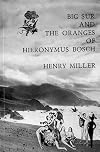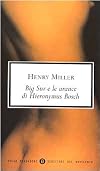
Big Sur and the Oranges of Hieronymus Bosch
by Henry Miller
On This Page
Description
In his great triptych "The Millennium," Bosch used oranges and other fruits to symbolize the delights of Paradise. Whence Henry Miller's title for this, one of his most appealing books; first published in 1957, it tells the story of Miller's life on the Big Sur, a section of the California coast where he lived for fifteen years. Big Sur is the portrait of a place-one of the most colorful in the United States-and of the extraordinary people Miller knew there: writers (and writers who did not show more write), mystics seeking truth in meditation (and the not-so-saintly looking for sex-cults or celebrity), sophisticated children, and adult innocents; geniuses, cranks, and the unclassifiable, like Conrad Moricand, the "Devil in Paradise," who is one of Miller's greatest character studies. Henry Miller writes with a buoyancy and brimming energy that are infectious. He has a fine touch for comedy. But this is also a serious book-the testament of a free spirit who has broken through the restraints and clichés of modern life to find within himself his own kind of paradise. show lessTags
Recommendations






































Member Reviews
In his great triptych "The Millennium," Bosch used oranges and other fruits to symbolize the delights of Paradise. Whence Henry Miller's title for this, one of his most appealing books; first published in 1957, it tells the story of Miller's life on the Big Sur, a section of the California coast where he lived for fifteen years. Big Sur is the portrait of a place--one of the most colorful in the United States--and of the extraordinary people Miller knew there: writers (and writers who did not write), mystics seeking truth in meditation (and the not-so-saintly looking for sex-cults or celebrity), sophisticated children and adult innocents; geniuses, cranks and the unclassifiable, like Conrad Moricand, the "Devil in Paradise" who is one show more of Miller's greatest character studies. Henry Miller writes with a buoyancy and brimming energy that are infectious. He has a fine touch for comedy. But this is also a serious book--the testament of a free spirit who has broken through the restraints and clichés of modern life to find within himself his own kind of paradise. show less
The oranges referred to in the title can be seen in the Hieronymus Bosch triptych, Garden of Earthly Delights. The fruit seem everywhere brightly illuminating the domain of the world in the central panel in which fantastic creatures mingle with real ones. The fruit seem to be part of the earthly pleasures and delights, bright, colourful, sweet. Though, I can't really tell what the connection is between Bosch and Big Sur. Perhaps Miller found in Big Sur the same earthly beauty and oddness of characters and creatures of the painting.
This is a memoir of sorts, Miller spent many years in the then communal beauty of Big Sur among other Americans who wanted a similar life. He sort of fell into it by accident and stayed after his successful show more years in France where his books sold well and his reputation made. He lived an entirely different life to the one he had before, suddenly if he needed something, he had to make it or work to make it happen then and there.
Miller is a kind of anarchist, individualist, libertarian according to this book. He believes less organisation is better for all, and people find their own way sorting things out with their neighbours to achieve their day to day needs whether for property, food, services, advice, social interaction. It probably helps if others are near enough like you in their thinking. Big Sur was less a commune than a strange accident of strange creatures in the mid 20thC. A Wild West Forest with more artists than cowhands and gunslingers. At times, Miller comes across a proto-guru to the next generation. the Beats seemed to like him and seek him out.
Only when we are truly alone does the fullness and richness of life reveal itself to us. In simplifying our lives, everything acquires a significance hitherto unknown.
The most difficult thing to adjust to, apparently, is peace and contentment.
Naturally the more attention one gives to the deplorable conditions outside the less one is able to enjoy the peace and liberty he possesses.
A great many vignettes are told of locals, visitors, episodes mixed with views on social organisation or America's role in the world. And there's plenty of advice on writing, the fruit motif pops up again here:
Have you ever heard of "bitter fruit"? Do you not know that with recognition, or "success", if you want to call it that, comes all the evils of creation? Do you realise that in accomplishing your purpose, you will never be able to reap the reward you dream of...
Perhaps that's why oranges. It's winter here, I have a lovely crop of oranges myself, I eat and read Miller's book. There's a crazy coincidence there. show less
This is a memoir of sorts, Miller spent many years in the then communal beauty of Big Sur among other Americans who wanted a similar life. He sort of fell into it by accident and stayed after his successful show more years in France where his books sold well and his reputation made. He lived an entirely different life to the one he had before, suddenly if he needed something, he had to make it or work to make it happen then and there.
Miller is a kind of anarchist, individualist, libertarian according to this book. He believes less organisation is better for all, and people find their own way sorting things out with their neighbours to achieve their day to day needs whether for property, food, services, advice, social interaction. It probably helps if others are near enough like you in their thinking. Big Sur was less a commune than a strange accident of strange creatures in the mid 20thC. A Wild West Forest with more artists than cowhands and gunslingers. At times, Miller comes across a proto-guru to the next generation. the Beats seemed to like him and seek him out.
Only when we are truly alone does the fullness and richness of life reveal itself to us. In simplifying our lives, everything acquires a significance hitherto unknown.
The most difficult thing to adjust to, apparently, is peace and contentment.
Naturally the more attention one gives to the deplorable conditions outside the less one is able to enjoy the peace and liberty he possesses.
A great many vignettes are told of locals, visitors, episodes mixed with views on social organisation or America's role in the world. And there's plenty of advice on writing, the fruit motif pops up again here:
Have you ever heard of "bitter fruit"? Do you not know that with recognition, or "success", if you want to call it that, comes all the evils of creation? Do you realise that in accomplishing your purpose, you will never be able to reap the reward you dream of...
Perhaps that's why oranges. It's winter here, I have a lovely crop of oranges myself, I eat and read Miller's book. There's a crazy coincidence there. show less
I picked up this book at City Lights bookstore in San Francisco. Although I was not headed for Big Sur on that trip, I felt like I visited it in this book. Miller lived there for many years and accurately describes the area and more importantly the people in the area in a very realistic manner. He writes with a tone that is both admiration and at times disgust which makes him seem just as realistic as the people he is describing. The book was written in 1955 and it is interesting to imagine life in a rural environment where the postman delivers the mail, supplies and gossip three times a week provided that his truck is functional. Miller describes a simpler time that many of us in this modern world yearn for. His description of the show more sheer ridiculousness of selling a barrel of oil for one dollar seems like a breath of fresh air in a world where oil is close to a hundred dollars a barrel. Even if you never make it to Big Sur, this book is an excellent description of human nature which transcends location. show less
Henry Miller moved to Big Sur after WWII when it was relatively inaccessible and housed a bohemian colony of artists and writers. He captures the physical beauty of the place and fills the book with the memorable eccentric characters who are his neighbors. If you ever dine at Nepenthe on the outdoor deck (highly recommended) you can gaze directly south to Partington Ridge where he lived.
This is no longer the bad boy Henry Miller of the Tropics, but the aging sage, with dollops of metaphysical equanimity. There are still echoes of the log shack ethos he eulogizes at Big Sur, although much has changed in the ensuing years. An enjoyable read
One of my favorite Henry Miller works. I would recommend it for anyone who thinks of Mr.Miller as the self indulgent author who focuses solely on his sexual exploits. This work is much more human as he describes his family, friends, and neighbors living in Big Sur.
Definetly one for the Miller enthusiast. colorful recollections of his days in Big Sur, and the eclectic life he lived along with the eclectic people who came in and out of his life. As usual, Miller rambles a bit here and there, but for the most part, a must read for the Miller Fan.
Members
- Recently Added By
Lists

Best literature ever!
39 works; 1 member
Author Information

232+ Works 31,673 Members
Some Editions
Series
Belongs to Publisher Series
New Directions Paperbook (161)
Literaire reuzenpocket (427)
Work Relationships
Contains
Common Knowledge
- Canonical title
- Big Sur and the Oranges of Hieronymus Bosch
- Original publication date
- 1957
- Important places
- Big Sur, California, USA
Classifications
Statistics
- Members
- 889
- Popularity
- 30,361
- Reviews
- 10
- Rating
- (3.86)
- Languages
- 10 — Dutch, English, Finnish, French, German, Italian, Japanese, Polish, Portuguese, Spanish
- Media
- Paper, Audiobook, Ebook
- ISBNs
- 18
- ASINs
- 14