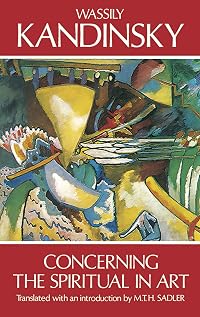
Concerning the Spiritual in Art
by Wassily Kandinsky
On This Page
Description
A pioneering work in the movement to free art from its traditional bonds to material reality, this book is one of the most important documents in the history of modern art. Written by the famous nonobjective painter Wassily Kandinsky (1866-1944), it explains Kandinsky's own theory of painting and crystallizes the ideas that were influencing many other modern artists of the period. Along with his own ground-breaking paintings, this book had a tremendous impact on the development of modern show more art. The first part issues a call for a spiritual revolution in painting that will let artists express their own inner lives in abstract, non-material terms. Just as musicians do not depend upon the material world for their music, so artists should not have to depend upon the material world for their art. In the second part, Kandinsky discusses the psychology of colors, the language of form and color, and the responsibilities of the artist. An Introduction by the translator offers additional explanation of Kandinsky's art and theories.--From publisher description. show lessTags
Recommendations




Member Reviews
Über das Geistige in Kunst is a slim monograph presenting a philosophy of art by a working artist. The post-Impressionist modernism of Kandinsky is now more than a century old, but it has been influential, and it successfully forecasted (and provoked) subsequent trends. M. T. H. Sadler, the English translator of this book, was not only a collector of the artist's work, but a personal friend and longtime correspondent.
Sadler characterizes Kandinsky as Gauguin's successor (xviii) in a "Symbolist" tradition, opposing it to a complementarily perennial "Naturalism," where the two traditions are grounded in psychological subjectivity and objectivity respectively. Kandinsky himself in the text does not profess an allegiance to the Symbolist show more school per se, although he quotes Peladan approvingly (55). He definitely emphasizes the subjective aspect in his notions of the mystical essence of art, which he grounds in a threefold "inner need" compounded from the individual need of the artist, the collective need of contemporary society, and the eternal need of art as a whole. It is the third ingredient which is truly "spiritual," while the first two find their expression in the elements of "personality" and "style" (33-4).
Beyond the staunch subjectivism that in his case even aspires to free itself entirely from pictorial representation, Kandinsky shares with the modern Symbolists a sort of progressive aesthetic vanguardism, in which individual artists and schools transcend their contemporaries on the path of artistic emancipation. The author sets this schema forth in one of his earliest chapters "The Movement of the Triangle" (6-9), which reminded me of other esoteric writings on the propagation of genius in society: Karl von Eckartshausen's The Cloud Upon the Sanctuary and Aleister Crowley's 1906 essay "Eleusis."
Although the second and longer of the book's two sections is "About Painting," Kandinsky is concerned throughout the text to consider analogies among the various arts in terms of their development. He gives particular attention to music and theater, and implies that the "triangle" of progress in painting is merely a cross-section of a more substantial artistic pyramid. "Every man who steeps himself in the spiritual possibilities of his art is a valuable helper in the building of the spiritual pyramid which will some day reach to heaven" (20).
Thelemites are likely to find Kandinsky's ideas congenial. When he writes that "the artist is not only justified in using, but it is his duty to use only those forms which fulfil his own need" (53), it is hard not to hear an echo of "So with thy all, thou hast no right but to do thy will" (CCXX I:42). show less
Sadler characterizes Kandinsky as Gauguin's successor (xviii) in a "Symbolist" tradition, opposing it to a complementarily perennial "Naturalism," where the two traditions are grounded in psychological subjectivity and objectivity respectively. Kandinsky himself in the text does not profess an allegiance to the Symbolist show more school per se, although he quotes Peladan approvingly (55). He definitely emphasizes the subjective aspect in his notions of the mystical essence of art, which he grounds in a threefold "inner need" compounded from the individual need of the artist, the collective need of contemporary society, and the eternal need of art as a whole. It is the third ingredient which is truly "spiritual," while the first two find their expression in the elements of "personality" and "style" (33-4).
Beyond the staunch subjectivism that in his case even aspires to free itself entirely from pictorial representation, Kandinsky shares with the modern Symbolists a sort of progressive aesthetic vanguardism, in which individual artists and schools transcend their contemporaries on the path of artistic emancipation. The author sets this schema forth in one of his earliest chapters "The Movement of the Triangle" (6-9), which reminded me of other esoteric writings on the propagation of genius in society: Karl von Eckartshausen's The Cloud Upon the Sanctuary and Aleister Crowley's 1906 essay "Eleusis."
Although the second and longer of the book's two sections is "About Painting," Kandinsky is concerned throughout the text to consider analogies among the various arts in terms of their development. He gives particular attention to music and theater, and implies that the "triangle" of progress in painting is merely a cross-section of a more substantial artistic pyramid. "Every man who steeps himself in the spiritual possibilities of his art is a valuable helper in the building of the spiritual pyramid which will some day reach to heaven" (20).
Thelemites are likely to find Kandinsky's ideas congenial. When he writes that "the artist is not only justified in using, but it is his duty to use only those forms which fulfil his own need" (53), it is hard not to hear an echo of "So with thy all, thou hast no right but to do thy will" (CCXX I:42). show less
It's always a pleasure to read the words of someone who is passionate about something.
Kandinsky was clearly really passionate about painting, a researcher, an explorer of new ideas.
He exposes his views in this book.
To me it was a hard read because I have not the sensibility he had and at times I felt disconnected from his explanation.
You may not understand art much better but you would understand his mind.
Kandinsky was clearly really passionate about painting, a researcher, an explorer of new ideas.
He exposes his views in this book.
To me it was a hard read because I have not the sensibility he had and at times I felt disconnected from his explanation.
You may not understand art much better but you would understand his mind.
While I don't know if Kandinsky's ideas on color theory, form, and the role of the artist are as wholly universal as claimed, it is immensely gratifying to look at his work with fresh eyes, and see his ideas in practice. I wish more visual artists wrote stuff like this
It's always a pleasure to read the words of someone who is passionate about something.
Kandinsky was clearly really passionate about painting, a researcher, an explorer of new ideas.
He exposes his views in this book.
To me it was a hard read because I have not the sensibility he had and at times I felt disconnected from his explanation.
You may not understand art much better but you would understand his mind.
Kandinsky was clearly really passionate about painting, a researcher, an explorer of new ideas.
He exposes his views in this book.
To me it was a hard read because I have not the sensibility he had and at times I felt disconnected from his explanation.
You may not understand art much better but you would understand his mind.
Kandinsky spent a lifetime painting in search of the spiritual. His body of work was his philosophical opus, provoked initially by the prodigious philosophical works of Madame Blavatsky, founder of the Theosophical Society, in which she introduced the Western world--and Kandinsky--to Eastern philosophies. Kandinsky believed that art had a duty to be spiritual in nature, an expression of "inner need," as he came to call it. He called "art for art's sake" a "vain squandering of artistic power" (p, 3). Concerning the Spiritual in Art was both his call to artists to meet their obligation to humanity and his attempt to define and explain color and form in its relation to expressing the message of the soul. (October 1996)
I tried to understand Kandinsky's philosophy here, but decided it was better to spend time gazing at his artworks.
I love Kandinsky's art. He was not a writer.
Members
- Recently Added By
Lists

Art History and Appreciation
36 works; 1 member

Books Read in 2024
4,727 works; 128 members
Author Information

156+ Works 3,491 Members
Some Editions
Series
Belongs to Publisher Series
Work Relationships
Is contained in
Common Knowledge
- Canonical title*
- Du spirituel dans l'art et dans la peinture en particulier
- Original title
- Über das Geistige in der Kunst
- Alternate titles
- The Art of Spiritual Harmony; Concerning the Spiritual in Art; Ueber das Geistige in der Kunst, insbesondere in der Malerei; Васи́лий Васи́льевич Канди́нский
- Original publication date
- 1911
- People/Characters
- Wassily Kandinsky
- Dedication
- To the memory of Elisabeth Tichejeff
- First words
- Every work of art is the child of its age and, in many cases, the mother of our emotions. It follows that each period of culture produces an art of its own which can never be repeated. Efforts to revive the art-principles of ... (show all)the past will at best produce an art that is still-born. It is impossible for us to live and feel, as did the ancient Greeks. In the same way those who strive to follow the Greek methods in sculpture achieve only a similarity of form, the work remaining soulless for all time. Such imitation is mere aping. Externally the monkey completely resembles a human being; he will sit holding a book in front of his nose, and turn over the pages with a thoughtful aspect, but his actions have for him no real meaning.
- Quotations
- There is no "must" in art, because art is free.
When we remember, however, that spiritual experience is quickening, that positive science, the firmest basis of human thought, is tottering, that dissolution of matter is imminent, we have reason to hope that the hour of pure... (show all) composition is not far away.
All means are sacred which are called for by the inner need. All means are sinful which obscure that inner need. - Last words
- (Click to show. Warning: May contain spoilers.)Finally, I would remark that, in my opinion, we are fast approaching the time of reasoned and conscious composition, when the painter will be proud to declare his work constructive. This will be in contrast to the claim of the Impressionists that they could explain nothing, that their art came upon them by inspiration. We have before us the age of conscious creation, and this new spirit in painting is going hand in hand with the spirit of thought towards an epoch of great spiritual leaders.
- Original language*
- Allemand; Russe
*Some information comes from Common Knowledge in other languages. Click "Edit" for more information.
Classifications
Statistics
- Members
- 1,816
- Popularity
- 12,030
- Reviews
- 16
- Rating
- (3.73)
- Languages
- 15 — Czech, Danish, Dutch, English, Finnish, French, German, Greek, Italian, Norwegian (Bokmål), Polish, Portuguese, Spanish, Swedish, Turkish
- Media
- Paper, Audiobook, Ebook
- ISBNs
- 94
- UPCs
- 1
- ASINs
- 29