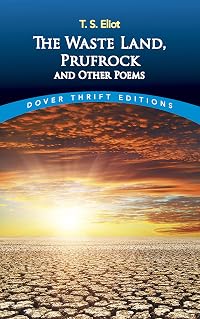
The Waste Land, Prufrock and Other Poems (Dover Thrift Editions)
by T. S. Eliot
On This Page
Description
In the masterly cadences of T. S. Eliot's verse, the 20th century found its definitive poetic voice, an incredible "image of its accelerated grimace," in the words of Eliot's friend and mentor, Ezra Pound. This volume is a rich collection of much of Eliot's greatest work. The title poem, The Waste Land (1922), ranks among the most influential poetic works of the century. An exploration of the psychic stages of a despairing soul caught in a struggle for redemption, the poem contrasts the show more spiritual stagnation of the modern world with the ennobling myths of the past. Other selections include the complete contents of Prufrock (1971), including "The Love Song of J. Alfred Prufrock," "Portrait of a Lady," "Rhapsody on a Windy Night," "Mr. Apollinax," and "Morning at the Window." From Poems (1920) there are "Gerontion," "The Hippopotamus," "Mr. Eliot's Sunday Morning Service," "Sweeney Among the Nightingales," and more. An indispensable resource for all poetry lovers, this modestly priced edition is also an ideal text for English literature courses from high school to college. Includes "The Love Song of J. Alfred Prufrock." show lessTags
Recommendations
Member Reviews
(Original review, 1981-05-10)
It seems to me that the author of 'Prufrock' and that of the Wasteland are so different as to be un-recognisable. A look at the Wasteland reveals a lot of, to me, gratuitous classical referencing for which we might like to blame Pound and while I value its novelty (whereas Prufrock reads like Kublai Khan) the Wasteland reads like deliberate pastiche.
Eliot learned the need to inject stock ingredients into a poem if it is to fly with editors, perhaps explaining why Prufrock languished for so long. Don't tell me Hughes and Heaney weren't aware of a certain formulaic approach to poetry. I'm not saying it is a liability or necessarily a bad thing but I am saying that what is considered 'good' has more to do with show more vogue than what Eliot referred to as 'the really new'. Again, Auden's earliest published poetry fell into the trap of not pandering to 'the right style', so much so that the work is still un-excavated (properly) with a few notable exceptions. His more public style of the middle and late periods got their promised reward but it speaks to the public and not to his fellow poets as the early work did. At the height of Auden's fame, fewer than a thousand ciopies of his work were sold).
I recall reading how Joyce, upon first meeting Yeats (at a train station), wondered whether Yeats wasn't too old to understand what he (Joyce) was about. Eliot's first wife and Molly were peas in a pod it sounds to me, antidotes to the ossified world of Cultoor they had to cope with.
Eliot's time at Lloyd's, working by day as a Magritteish clerk while struggling with his real self is a far more attractive (and less educated) persona than the donnish Faber editor. Respectability doesn't seem to have done Eliot, his poetry at least, much good but of course it's all a matter of taste and perspective. Millions love their Eliot the way he be served up to them.
Rilke wins for me against the earlier Eliot, 'Duino Elegies' being far more sensitive, far less showy and show-offy (far less cringely 'erudite'), every bit as precise in its detailed anatomy of the new age then dawning and at least as startlingly wonderful in its imagery. There is, also, no vaudeville (he do the police in different voices but none of it terribly well) and it didn't need that madman Pound to strip it into shape. show less
It seems to me that the author of 'Prufrock' and that of the Wasteland are so different as to be un-recognisable. A look at the Wasteland reveals a lot of, to me, gratuitous classical referencing for which we might like to blame Pound and while I value its novelty (whereas Prufrock reads like Kublai Khan) the Wasteland reads like deliberate pastiche.
Eliot learned the need to inject stock ingredients into a poem if it is to fly with editors, perhaps explaining why Prufrock languished for so long. Don't tell me Hughes and Heaney weren't aware of a certain formulaic approach to poetry. I'm not saying it is a liability or necessarily a bad thing but I am saying that what is considered 'good' has more to do with show more vogue than what Eliot referred to as 'the really new'. Again, Auden's earliest published poetry fell into the trap of not pandering to 'the right style', so much so that the work is still un-excavated (properly) with a few notable exceptions. His more public style of the middle and late periods got their promised reward but it speaks to the public and not to his fellow poets as the early work did. At the height of Auden's fame, fewer than a thousand ciopies of his work were sold).
I recall reading how Joyce, upon first meeting Yeats (at a train station), wondered whether Yeats wasn't too old to understand what he (Joyce) was about. Eliot's first wife and Molly were peas in a pod it sounds to me, antidotes to the ossified world of Cultoor they had to cope with.
Eliot's time at Lloyd's, working by day as a Magritteish clerk while struggling with his real self is a far more attractive (and less educated) persona than the donnish Faber editor. Respectability doesn't seem to have done Eliot, his poetry at least, much good but of course it's all a matter of taste and perspective. Millions love their Eliot the way he be served up to them.
Rilke wins for me against the earlier Eliot, 'Duino Elegies' being far more sensitive, far less showy and show-offy (far less cringely 'erudite'), every bit as precise in its detailed anatomy of the new age then dawning and at least as startlingly wonderful in its imagery. There is, also, no vaudeville (he do the police in different voices but none of it terribly well) and it didn't need that madman Pound to strip it into shape. show less
Michael Maier wrote in his book of alchemical emblems: “For most books are so obscurely written that they can only be understood by their Authors.”
This applies heartily to “The Waste Land,” a modern work of allegory and alchemy. I like its Gothic elements, all those dry bones and waterless stones and “voices singing out of empty cisterns and exhausted wells.” Of course there is a rat “Dragging its slimy belly on the bank.” An essential is the corpse planted in a garden. We wait for the body to sprout, even as we worry: “‘Oh keep the Dog far hence, that’s friend to men,/ Or with his nails he’ll dig it up again!’”
The horror! The horror! as Joseph Conrad would say.
I need to get the Norton edition so I can learn show more more about the literary references. Eliot’s poem led me to the Buddha’s “Fire Sermon,” and that alone makes reading “The Waste Land” worthwhile.
http://www.accesstoinsight.org/tipitaka/sn/sn35/sn35.028.nymo.html show less
This applies heartily to “The Waste Land,” a modern work of allegory and alchemy. I like its Gothic elements, all those dry bones and waterless stones and “voices singing out of empty cisterns and exhausted wells.” Of course there is a rat “Dragging its slimy belly on the bank.” An essential is the corpse planted in a garden. We wait for the body to sprout, even as we worry: “‘Oh keep the Dog far hence, that’s friend to men,/ Or with his nails he’ll dig it up again!’”
The horror! The horror! as Joseph Conrad would say.
I need to get the Norton edition so I can learn show more more about the literary references. Eliot’s poem led me to the Buddha’s “Fire Sermon,” and that alone makes reading “The Waste Land” worthwhile.
http://www.accesstoinsight.org/tipitaka/sn/sn35/sn35.028.nymo.html show less
Il "Canto d'Amore di J. Alfred Prufrock" è la poesia che segnò l'inizio della carriera poetica di T. S. Eliot, (1888–1965), il poeta inglese più importante del XX secolo e, a mio parere, uno dei migliori poeti di tutti i tempi. La poesia si presenta sotto la forma di monologo drammatico filtrato attraverso la tecnica narrativa del flusso della coscienza. Questa poesia l'ho conosciuta sulle pagine di un'antologia di poesie inglesi che avevo come testo di studio quando lavoravo in Inghilterra ai miei anni verdi. I favolosi anni sessanta, i così detti "roaring sixties". Anni “ruggenti” per gli altri, ma non di certo per me. Avevo, infatti, deciso di andarmene dall’Italia, lasciare il troppo stretto paesello del sud e andare in show more Inghilterraper imparare una lingua che non avevo mai studiato a scuola, che non conoscevo e che, eppure, mi attirava come nessun altra cosa al mondo. Il fascino delle cose impossibili che solamente chi è giovane sa decidere di inseguire. Una lingua ed una cultura che avrebbero poi caratterizzato la mia vita sia professionale che personale. Avrei, infatti, non solo insegnato quella lingua per circa 40 anni, mi avrebbe anche dato l’opportunità di incontrare l’altra metà del cielo o della mela, mia moglie, anche lei con la stessa passione linguistica.
Studiavo e lavoravo contemporaneamente per mantenermi in terra di Albione. A quei tempi, soltanto se avevi un permesso di lavoro fisso, potevi restare in Inghilterra. Ed io lavoravo in un ospedale mentale, e studiavo la lingua e la letteratura del posto per corrispondenza, per conseguire i certificati di studio dell’Università di Cambridge. Frequentavo di sera, quando mi era possibile, le lezioni di un popolare “College of Further Education” di St. Albans, l’antica città romana di Verulam. Un vecchio tutor-professore ci leggeva dalle 19 alle 21 brani di prosa e poesia inglese. Ricordo che dedicò al Canto d’amore di Alfred Prufrock le due ore di una intera lezione. Una poesia difficile da capire allora, piena di allusioni, simboli e immagini da decifrare, scritta nella tecnica divenuta poi nota come “flusso della coscienza”. Avevo con me nel banco, Puck, una dolcissima olandesina, con la quale condividevo esperimenti poetici e non. Ridevamo delle lamentazioni di Alfred, della sua petulanza, di quelle lagne che ci sembravano ridicole, da vecchi e per vecchi. Allora avevamo poco più di venti anni, ed era giusto che la pensassimo a quel modo. Alfred l’ho poi re-incontrato sui banchi dell’università, e poi per anni l’ho presentato a migliaia di giovani. Il tema centrale della poesia è quello del passare del tempo, con tutte le innumerevoli sottocategorie possibili che questo termine comporta: amore, vecchiaia, ricordi, impotenza, illusioni, delusioni, allusioni, decadenza, sogni …
Se mi pareva, allora, difficile il testo inglese, ancora più impossibile mi sembravano i versi introduttivi di Dante. Non capimmo bene le spiegazioni che il tutor addusse per spiegarne la riproduzione da parte di Eliot. Sarebbe passato poi molto tempo e studio per capire che Eliot usa quei versi per gettare una luce ironica sulle intenzioni di Alfred a recuperare il tempo passato ed al suo vano tentativo di mettere insieme i cocci delle sue diverse personalità così come il tempo le aveva modellate. Guido sembra essere Prufrock, Dante sarebbe il lettore al quale il poeta rivolge i suoi versi. A quella età, ed a quel tempo, era per me e per Puck davvero difficile, se non impossibile, seguire il pensiero vagabondo di Alfred che oscilla tra l’illogico e lo psicologico. Atmosfera appesantita dal fatto che gli anni pesano sulle sue spalle e gli fanno dire cose che soltanto da vecchi si possono comprendere. E che ne sapevamo noi di tutto ciò? Dell’impotenza, delle incapacità, delle delusioni e delle finzioni usate nel corso degli anni? Quel continuo entrare ed uscire dal proprio io, essere o individualità, era davvero una cosa incomprensibile per noi che non avevamo il peso del tempo sulle nostre spalle.
Eppure, quella lingua usata, cantata e recitata in versi stupendi, era come una melodia infinita e non-descritta che aveva solo nel suono del mare e delle sirene in sottofondo, la giusta risonanza. “Misurare il tempo a cucchiaini” è una delle più belle espressioni poetiche che un poeta possa usare sullo scorrere del tempo. Così come lo vede un “vecchio” davanti alla sua tazza di tè o di caffè, seduto ad un tavolo sul lungomare. In attesa di sentire cantare sirene che non arriveranno mai, e che lui non potrà mai sentire. Ora che gli anni sul mio groppone sono molti, posso dire di comprendere ciò che intendevano dire Alfred e Eliot: “quando la sera è distesa contro il cielo, come un paziente anestetizzato sul tavolo operatorio”, “la segatura è stesa sul pavimento del ristorante”, “le sirene pettinano le bianche onde dei capelli, “quando il vento soffia sull’acqua e la fa diventare bianca e scura”, tutto questo è la precisa sensazione dell’usura e del decadimento dell’uomo e della vittoria del tempo sulla gioventù. L’arrivo inevitabile della vecchiaia. Ieri per Alfred e Eliot. Oggi per me e per Puck. Domani per te lettore. Sorge immediato il dubbio sul senso di tutto questo, del passato e del futuro. Ma Alfred Prufrock non conoscerà mai il senso del suo futuro. Anzi, il senso del tutto. Per me, per noi giovani lettori di allora, quei versi erano solo poesia, bellissima, insuperabile poesia. Oggi, col passare degli anni e con l’avvicinarsi della vittoria del tempo, so che Alfred aveva ragione. Quella ragione era il “suo” senso. Sarà così anche per me? Ancora non so dire.
-----
Parlare di poesia è sempre un fatto soggettivo. Non a caso sono le parole gli elementi decisivi che determinano i sentimenti, le sensazioni e le intuizioni che creano il messaggio poetico. Le parole, però, sono come il vento che trascina le foglie. Esse vanno e vengono, si posano e si riposano, sostano, compaiono e scompaiono, per poi ritornare senza dire dove sono state. Non cambiano mai, eppure sono sempre le stesse. Siamo in primavera e nuove foglie stanno per rinascere dalle gemme che brillano alla luce della vita dopo il letargo invernale. Ad ogni primavera si rinnova il miracolo sia delle foglie che delle parole. Come descrivere il mutamento, questo cambiamento che ritorna per definire l’indescrivibile, misteriosa mutevolezza dell’esistenza? Il mese di marzo scivola verso la fine. Sta per ritornare l’ora legale, un’ora più di luce e di vita. Eppure non riesco a credere che un poeta come T. S. Eliot abbia potuto dire che “Aprile è il più crudele dei mesi”.
April is the cruellest month, breeding
Lilacs out of the dead land, mixing
Memory and desire, stirring
Dull roots with spring rain…
---
Aprile è il più crudele di mesi: genera
Lillà dalla morta terra, mescola
Ricordo e desiderio, stimola
Le sopite radici con la pioggia primaverile…
(Trad. M. Praz)
In questo memorabile e ineguagliabile incipit del poema "La Terra Desolata" si realizza nella mente del poeta una magia, ma si prepara un incubo per il futuro del lettore: la rappresentazione della primavera. Il poeta la idealizza e la ferma nel tempo. Il lettore ne prevede la fine sulla sua pelle. Pensieri e parole di morte per questo, di vita per l’altro. Con i suoi versi Eliot ha toccato il cuore del mondo. Ha creato una realtà più forte della realtà stessa, ha incarnato il verbo, ha rivelato il potere straordinario di dare vita dentro una coscienza a un evento quotidiano come la pioggia improvvisa che fa rinnova e rigenera ma anche tradisce e marcisce.
Passano le stagioni ma ad ogni primavera quei versi sono ancora lì a richiamare innumerevoli ricordi che rendono la vita piena di mistero. Tutto fugge, tutto rimane nelle parole e nel ricordo ma nulla resta nel tempo. I mesi transitano nelle nostre esistenze e noi con loro. Facciamo esperienze che ci modificano, attraversiamo mondi a volte lontani e impossibili, ci trasformiamo. Eppure siamo sempre lì, rincuorati e sostenuti da parole che abbiamo scelto, che forse ci hanno scelto, come se ci fosse una linea di confine tra mutevolezza e ed eternità. Per chi scrive e per chi legge. La “Terra desolata” di Eliot non è l’unico esempio poetico con cui spiegare l’effetto della poesia. La lista è lunga e penso che ognuno ne abbia una sua con cui sentirsi veramente a casa in ogni luogo. show less
Studiavo e lavoravo contemporaneamente per mantenermi in terra di Albione. A quei tempi, soltanto se avevi un permesso di lavoro fisso, potevi restare in Inghilterra. Ed io lavoravo in un ospedale mentale, e studiavo la lingua e la letteratura del posto per corrispondenza, per conseguire i certificati di studio dell’Università di Cambridge. Frequentavo di sera, quando mi era possibile, le lezioni di un popolare “College of Further Education” di St. Albans, l’antica città romana di Verulam. Un vecchio tutor-professore ci leggeva dalle 19 alle 21 brani di prosa e poesia inglese. Ricordo che dedicò al Canto d’amore di Alfred Prufrock le due ore di una intera lezione. Una poesia difficile da capire allora, piena di allusioni, simboli e immagini da decifrare, scritta nella tecnica divenuta poi nota come “flusso della coscienza”. Avevo con me nel banco, Puck, una dolcissima olandesina, con la quale condividevo esperimenti poetici e non. Ridevamo delle lamentazioni di Alfred, della sua petulanza, di quelle lagne che ci sembravano ridicole, da vecchi e per vecchi. Allora avevamo poco più di venti anni, ed era giusto che la pensassimo a quel modo. Alfred l’ho poi re-incontrato sui banchi dell’università, e poi per anni l’ho presentato a migliaia di giovani. Il tema centrale della poesia è quello del passare del tempo, con tutte le innumerevoli sottocategorie possibili che questo termine comporta: amore, vecchiaia, ricordi, impotenza, illusioni, delusioni, allusioni, decadenza, sogni …
Se mi pareva, allora, difficile il testo inglese, ancora più impossibile mi sembravano i versi introduttivi di Dante. Non capimmo bene le spiegazioni che il tutor addusse per spiegarne la riproduzione da parte di Eliot. Sarebbe passato poi molto tempo e studio per capire che Eliot usa quei versi per gettare una luce ironica sulle intenzioni di Alfred a recuperare il tempo passato ed al suo vano tentativo di mettere insieme i cocci delle sue diverse personalità così come il tempo le aveva modellate. Guido sembra essere Prufrock, Dante sarebbe il lettore al quale il poeta rivolge i suoi versi. A quella età, ed a quel tempo, era per me e per Puck davvero difficile, se non impossibile, seguire il pensiero vagabondo di Alfred che oscilla tra l’illogico e lo psicologico. Atmosfera appesantita dal fatto che gli anni pesano sulle sue spalle e gli fanno dire cose che soltanto da vecchi si possono comprendere. E che ne sapevamo noi di tutto ciò? Dell’impotenza, delle incapacità, delle delusioni e delle finzioni usate nel corso degli anni? Quel continuo entrare ed uscire dal proprio io, essere o individualità, era davvero una cosa incomprensibile per noi che non avevamo il peso del tempo sulle nostre spalle.
Eppure, quella lingua usata, cantata e recitata in versi stupendi, era come una melodia infinita e non-descritta che aveva solo nel suono del mare e delle sirene in sottofondo, la giusta risonanza. “Misurare il tempo a cucchiaini” è una delle più belle espressioni poetiche che un poeta possa usare sullo scorrere del tempo. Così come lo vede un “vecchio” davanti alla sua tazza di tè o di caffè, seduto ad un tavolo sul lungomare. In attesa di sentire cantare sirene che non arriveranno mai, e che lui non potrà mai sentire. Ora che gli anni sul mio groppone sono molti, posso dire di comprendere ciò che intendevano dire Alfred e Eliot: “quando la sera è distesa contro il cielo, come un paziente anestetizzato sul tavolo operatorio”, “la segatura è stesa sul pavimento del ristorante”, “le sirene pettinano le bianche onde dei capelli, “quando il vento soffia sull’acqua e la fa diventare bianca e scura”, tutto questo è la precisa sensazione dell’usura e del decadimento dell’uomo e della vittoria del tempo sulla gioventù. L’arrivo inevitabile della vecchiaia. Ieri per Alfred e Eliot. Oggi per me e per Puck. Domani per te lettore. Sorge immediato il dubbio sul senso di tutto questo, del passato e del futuro. Ma Alfred Prufrock non conoscerà mai il senso del suo futuro. Anzi, il senso del tutto. Per me, per noi giovani lettori di allora, quei versi erano solo poesia, bellissima, insuperabile poesia. Oggi, col passare degli anni e con l’avvicinarsi della vittoria del tempo, so che Alfred aveva ragione. Quella ragione era il “suo” senso. Sarà così anche per me? Ancora non so dire.
-----
Parlare di poesia è sempre un fatto soggettivo. Non a caso sono le parole gli elementi decisivi che determinano i sentimenti, le sensazioni e le intuizioni che creano il messaggio poetico. Le parole, però, sono come il vento che trascina le foglie. Esse vanno e vengono, si posano e si riposano, sostano, compaiono e scompaiono, per poi ritornare senza dire dove sono state. Non cambiano mai, eppure sono sempre le stesse. Siamo in primavera e nuove foglie stanno per rinascere dalle gemme che brillano alla luce della vita dopo il letargo invernale. Ad ogni primavera si rinnova il miracolo sia delle foglie che delle parole. Come descrivere il mutamento, questo cambiamento che ritorna per definire l’indescrivibile, misteriosa mutevolezza dell’esistenza? Il mese di marzo scivola verso la fine. Sta per ritornare l’ora legale, un’ora più di luce e di vita. Eppure non riesco a credere che un poeta come T. S. Eliot abbia potuto dire che “Aprile è il più crudele dei mesi”.
April is the cruellest month, breeding
Lilacs out of the dead land, mixing
Memory and desire, stirring
Dull roots with spring rain…
---
Aprile è il più crudele di mesi: genera
Lillà dalla morta terra, mescola
Ricordo e desiderio, stimola
Le sopite radici con la pioggia primaverile…
(Trad. M. Praz)
In questo memorabile e ineguagliabile incipit del poema "La Terra Desolata" si realizza nella mente del poeta una magia, ma si prepara un incubo per il futuro del lettore: la rappresentazione della primavera. Il poeta la idealizza e la ferma nel tempo. Il lettore ne prevede la fine sulla sua pelle. Pensieri e parole di morte per questo, di vita per l’altro. Con i suoi versi Eliot ha toccato il cuore del mondo. Ha creato una realtà più forte della realtà stessa, ha incarnato il verbo, ha rivelato il potere straordinario di dare vita dentro una coscienza a un evento quotidiano come la pioggia improvvisa che fa rinnova e rigenera ma anche tradisce e marcisce.
Passano le stagioni ma ad ogni primavera quei versi sono ancora lì a richiamare innumerevoli ricordi che rendono la vita piena di mistero. Tutto fugge, tutto rimane nelle parole e nel ricordo ma nulla resta nel tempo. I mesi transitano nelle nostre esistenze e noi con loro. Facciamo esperienze che ci modificano, attraversiamo mondi a volte lontani e impossibili, ci trasformiamo. Eppure siamo sempre lì, rincuorati e sostenuti da parole che abbiamo scelto, che forse ci hanno scelto, come se ci fosse una linea di confine tra mutevolezza e ed eternità. Per chi scrive e per chi legge. La “Terra desolata” di Eliot non è l’unico esempio poetico con cui spiegare l’effetto della poesia. La lista è lunga e penso che ognuno ne abbia una sua con cui sentirsi veramente a casa in ogni luogo. show less
He was not a nice man, but his poetry is unmatched. So rhythmic, visceral, rolls in the mouth, incantatory. His words are pictures, unforgettable. Even Andrew Lloyd Webber can't touch him.
So embarrassed to be giving TS Eliot 3 stars, but now that I've read it, I probably won't do a re-read. I liked Prufrock more than The Wasteland. I could spend days reading the commentaries and then the literary allusions from the poems. I felt Prufrock was delightful and read it several times. I felt I read The Wasteland multiple times (with commentary) because it was imperative to a decent poetic education. It seemed like a lot of World War I angst and soldiers returning with PTSD - a sad poem, really. I read this small book which I've owned for years because my sister decided to read his poems so we might have a discussion about it.
After reading Evelyn Waugh's A Handful of Dust, the title of which is derived from T.S. Eliot's modernist poem, The Waste Land, I was compelled to read the poem and to learn more about Eliot. Up until today, my knowledge of Eliot was limited to what I had gleaned from Woody Allen's Midnight in Paris.
I have read all around Eliot, including Djuna Barnes (whom Eliot admired)1, Ernest Hemingway, Scott Fitzgerald, Gertrude Stein, Sherwood Andersen, Ford Madox Ford, and Virginia Woolf. But I have shied away from poetry until only recently.
After reading the poem, I listened to the BBC's In Our Time podcast episode, "The Waste Land and Modernity". There was much interesting discussion about the original book version of Eliot's poem. Apparently, show more the poem itself was too short to be a book and the publisher asked Eliot to pad it out.
Eliot added a bunch of notes to the poem, many of which turned out to be superfluous. The poem had also been cut down considerably by Ezra Pound, which took away the various signals of the several stories that emerge in the poem.
I listened to a reading of the poem on YouTube, partly read by Eliot. In the In Our Time discussion, they mentioned that the poem was published at the same time BBC Radio began, so in many ways the poem lends itself to a radio reading. It is interesting how listening to the poem being read makes the different voices more obvious, whereas this is somewhat obscured in a first reading (to oneself).
In sum, an issue that constantly strikes me is that the more I read, the less I know. And in many ways, based on my reading around The Waste Land, and from the discussions on the In Our Time podcast, Eliot meant to show how we don't or can't know everything; indeed, we may not need to know everything.
Even the different interpretations by American versus English critics revealed different interpretations of common English sayings highlighted in the poem. And of course, there are many references to the classics and so on which I hope to discover by obtaining a copy of the original (pre-Pound) version of the poem, and also the published version with the superfluous notes added by Eliot.
The poem apparently took Eliot one year to write, and he was quite upset by the paltry sum first offered to him for its publication. Yet it is now regarded as the most influential poems of the twentieth century.
Like all great works, the poem deserves several readings. But if you want to really hear the different voices, the recital of the poem will bring this to the fore. show less
I have read all around Eliot, including Djuna Barnes (whom Eliot admired)1, Ernest Hemingway, Scott Fitzgerald, Gertrude Stein, Sherwood Andersen, Ford Madox Ford, and Virginia Woolf. But I have shied away from poetry until only recently.
After reading the poem, I listened to the BBC's In Our Time podcast episode, "The Waste Land and Modernity". There was much interesting discussion about the original book version of Eliot's poem. Apparently, show more the poem itself was too short to be a book and the publisher asked Eliot to pad it out.
Eliot added a bunch of notes to the poem, many of which turned out to be superfluous. The poem had also been cut down considerably by Ezra Pound, which took away the various signals of the several stories that emerge in the poem.
I listened to a reading of the poem on YouTube, partly read by Eliot. In the In Our Time discussion, they mentioned that the poem was published at the same time BBC Radio began, so in many ways the poem lends itself to a radio reading. It is interesting how listening to the poem being read makes the different voices more obvious, whereas this is somewhat obscured in a first reading (to oneself).
In sum, an issue that constantly strikes me is that the more I read, the less I know. And in many ways, based on my reading around The Waste Land, and from the discussions on the In Our Time podcast, Eliot meant to show how we don't or can't know everything; indeed, we may not need to know everything.
Even the different interpretations by American versus English critics revealed different interpretations of common English sayings highlighted in the poem. And of course, there are many references to the classics and so on which I hope to discover by obtaining a copy of the original (pre-Pound) version of the poem, and also the published version with the superfluous notes added by Eliot.
The poem apparently took Eliot one year to write, and he was quite upset by the paltry sum first offered to him for its publication. Yet it is now regarded as the most influential poems of the twentieth century.
Like all great works, the poem deserves several readings. But if you want to really hear the different voices, the recital of the poem will bring this to the fore. show less
Heavy reading, T.S. Eliot's poems really showcased his anxiety and negativity towards male/female relationships. The Wasteland is particularly hard to get through without all the footnotes. Multiple languages from Greek to Latin and even German. There are many reference to older art works and literature. If you are not familiar with these references it can leave you lost and confused. I did enjoy J. Alfred Prufrock more so than the books of The Wasteland. I believe that the poems published in this anthology are very complex and may be the reason it is still studied in academia and new theories are still being concocted.
Members
- Recently Added By
Lists

Best of British Literature
226 works; 41 members

Modernism
140 works; 9 members

College Reads (Lit Edition)
75 works; 5 members
Author Information

507+ Works 48,053 Members
T. S. Eliot is considered by many to be a literary genius and one of the most influential men of letters during the half-century after World War I. He was born on September 26, 1888, in St. Louis, Missouri. Eliot attended Harvard University, with time abroad pursuing graduate studies at the Sorbonne, Marburg, and Oxford. The outbreak of World War show more I prevented his return to the United States, and, persuaded by Ezra Pound to remain in England, he decided to settle there permanently. He published his influential early criticism, much of it written as occasional pieces for literary periodicals. He developed such doctrines as the "dissociation of sensibility" and the "objective correlative" and elaborated his views on wit and on the relation of tradition to the individual talent. Eliot by this time had left his early, derivative verse far behind and had begun to publish avant-garde poetry (including "The Love Song of J. Alfred Prufrock" (1915), which exploited fresh rhythms, abrupt juxtapositions, contemporary subject matter, and witty allusion. This period of creativity also resulted in another collection of verse (including "Gerontian") and culminated in The Waste Land, a masterpiece published in 1922 and produced partly during a period of psychological breakdown while married to his wife, Vivienne Haigh-Wood Eliot. In 1922, Eliot became a director of the Faber & Faber publishing house, and in 1927 he became a British citizen and joined the Church of England. Thereafter, his career underwent a change. With the publication of Ash Wednesday in 1930, his poetry became more overtly Christian. As editor of the influential literary magazine The Criterion, he turned his hand to social as well as literary criticism, with an increasingly conservative orientation. His religious poetry culminated in Four Quartets, published individually from 1936 onward and collectively in 1943. This work is often considered to be his greatest poetic achievement. Eliot also wrote poetry in a much lighter vein, such as Old Possum's Book of Practical Cats (1939), a collection that was used during the early 1980s as the basis for the musical, Cats. In addition to his contributions in poetry and criticism, Eliot is the pivotal verse dramatist of this century. He followed the lead of William Butler Yeats in attempting to revive metrical language in the theater. But, unlike Yeats, Eliot wanted a dramatic verse that would be self-effacing, capable of expressing the most prosaic passages in a play, and an insistent, undetected presence capable of elevating itself at a moment's notice. His progression from the pageant The Rock (1934) and Murder in the Cathedral (1935), written for the Canterbury Festival, through The Family Reunion (1939) and The Cocktail Party (1949), a West End hit, was thus a matter of neutralizing obvious poetic effects and bringing prose passages into the flow of verse. Recent critics have seen Eliot as a divided figure, covertly attracted to the very elements (romanticism, personality, heresy) he overtly condemned. His early attacks on romantic poets, for example, often reveal him as a romantic against the grain. The same divisions carry over into his verse, where violence struggles against restraint, emotion against order, and imagination against ironic detachment. This Eliot is more human and more attractive to contemporary taste. During his lifetime, Eliot received many honors and awards, including the Nobel Prize for literature in 1948. (Bowker Author Biography) show less
Series
Belongs to Publisher Series
Work Relationships
Common Knowledge
- First words
- Let us go then, you and I,
When the evening is spread out against the sky
Like a patient etherised upon a table;
Let us go, through certain half-deserted streets,
The muttering retreats
Of restlelss nights in o... (show all)ne-night cheap hotels
And sawdust restaurants with oyster-shells:
Streets that follow like a tedious argument
Of insidious intent
To lead you to an overwhelming question. . . .
Oh, do not ask, "What is it?"
Let us go and make our visit. - Last words
- (Click to show. Warning: May contain spoilers.)Shantih shantih shantih
Classifications
Statistics
- Members
- 1,176
- Popularity
- 21,400
- Reviews
- 15
- Rating
- (4.18)
- Languages
- English
- Media
- Paper, Ebook
- ISBNs
- 7
- UPCs
- 2
- ASINs
- 4