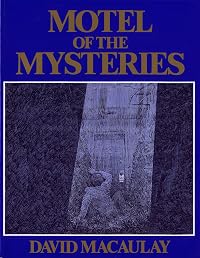
Motel of the Mysteries
by David Macaulay
On This Page
Description
A future archeologist finds the remnants of a mysterious ancient people—us—in a wry satire that is "a marvel of imagination and . . . wonderfully illustrated" (The New York Times).It is the year 4022, and the entire ancient country of Usa has been buried under many feet of detritus from a catastrophe that occurred back in 1985. Howard Carson, an amateur archeologist, is crossing the perimeter of an abandoned excavation site when he feels the ground give way beneath him. Suddenly, he show more finds himself at the bottom of a shaft, which, judging from the DO NOT DISTURB sign hanging from an archaic doorknob, is clearly the entrance to a still-sealed burial chamber.
Carson's incredible discoveries, including the remains of two bodies, one laid to rest on a ceremonial bed facing an altar that appeared to be a means of communicating with the Gods and the other lying in a porcelain sarcophagus in the Inner Chamber. These dramatic discoveries give Carson all the clues he needs to piece together the entire civilization—which he gets utterly wrong.
The acclaimed author and illustrator of Castle and Pyramid, David Macaulay presents a wonderfully tongue-in-cheek satire of both historical presumption and American self-importance.
. show less
Tags
Recommendations









Member Recommendations

PuddinTame Similarly funny looks at "archeology" in North America
bluepiano In a future ice age an expedition comes upon a queer building buried in the snow, explore it, and make the sort of deductions that people who've never heard of the Louvre or indeed of art museums might make. Artwork in this book is gorgeous.
Member Reviews
An intriguing book that spans a wide age range for interest. Macaulay writes and illustrates a story about a futuristic fictional archaeology team exploring an ancient building, only the ancient building is a motel. What is most fun about the book is seeing how objects that are familiar to the reader might be described by someone without an understanding of their purpose. A fantastic book to enjoy on its own, but it's also a great one for teaching presuppositions, limited knowledge, the limits of history (and record keeping), and so on.
A gentle poke at American culture of the mid twentieth century, and a hysterical take down of the whole academic history, archeology and cultural anthropology methods used to analyze and interpret discoveries. Lot's of subtle digs here - the lost motel from the country of Usa is the "Toot 'n' C'mon" and the discoverer is Howard Carter ... interstate highways become Nazca lines for aliens and desk lamps statues of the great god Watt. The illustrations are wonderful and the humor is very dark and very dry. Read it and laugh til you cry.
This is a clever little book that pokes fun at archaeological interpretations, particularly how quick they are to attribute items they aren't sure of to some sort of religious purpose. There are a lot of parallels to Howard Carter's excavation of Tutankhamun's tomb in Egypt, and the "archaeologist" of this book is in fact named Howard Carson.
In this generously illustrated book that takes place in the future, North America is already destroyed, having been buried beneath junk mail over 2,000 years ago. Howard stumbles upon an old motel room with a couple of bodies in them, and he interprets everything through a very wrong lens. The most base, disgusting, or mundane items become ceremonial and sacred (the bathroom is the inner sanctum, show more for example). Yet the items Howard finds are not only there to criticize fast, lazy answers in archaeology--they sometimes reflect poorly on modern priorities. For example, the TV was an altar and the remote a way to stay spiritually connected to it. They shine a light in the room to see not glints of gold, but glints of plastic.
Written in 1979, Motel of the Mysteries is fast becoming a relic itself and interestingly will need more and more interpretation itself. While most items it mentions still exist, some are obsolete and references are made to items that are less and less familiar to us (such as corded phones, the concept of banging on the top and sides of a TV to get it to work, and a list of old cars with animal names that are no longer produced). Yet it makes a timeless point and is so short I would have to consider it an essential archaeology book. show less
In this generously illustrated book that takes place in the future, North America is already destroyed, having been buried beneath junk mail over 2,000 years ago. Howard stumbles upon an old motel room with a couple of bodies in them, and he interprets everything through a very wrong lens. The most base, disgusting, or mundane items become ceremonial and sacred (the bathroom is the inner sanctum, show more for example). Yet the items Howard finds are not only there to criticize fast, lazy answers in archaeology--they sometimes reflect poorly on modern priorities. For example, the TV was an altar and the remote a way to stay spiritually connected to it. They shine a light in the room to see not glints of gold, but glints of plastic.
Written in 1979, Motel of the Mysteries is fast becoming a relic itself and interestingly will need more and more interpretation itself. While most items it mentions still exist, some are obsolete and references are made to items that are less and less familiar to us (such as corded phones, the concept of banging on the top and sides of a TV to get it to work, and a list of old cars with animal names that are no longer produced). Yet it makes a timeless point and is so short I would have to consider it an essential archaeology book. show less
An illustrated novella telling the story of archaeologists in the far future excavating the North American country of Usa. Focuses on a "burial site" (a motel room) and illustrates and speculates about all the artifacts found within. The speculations are wildly off base. I think this is meant to be a commentary on modern life and the way we idolize things we shouldn't? Not sure. The commentary about archaeology itself was obvious but seemed more jokey than satirical. It kind of missed the mark for me (and felt a little dated--maybe because we idolize different things wrongly now or in different ways than we did in 1979 when the book was published?). It was mildly amusing, and the way the illustrations and the text played on one another show more was fun. But I have to say I'm somewhat bemused. show less
This book addresses scientific questions and techniques of creating inferences from limited evidence. It takes the view of a post-apocalyptic ethnographer or anthropologist trying to look back at the late twentieth century world and to identify just from the artifacts that have been left behind, and the condition and locations in which they were left, who we were and how we lived. The extensive use of inference both acknowledges the challenges faced by real anthropologists and archeologists and provides a means for insightful satire of some of the vices of the time period.
Dark without becoming overly grim this is an excellent exercise for readers of all ages to but some academic distance between what they know about day to day life and show more what would really actually be obvious to an outside observer. show less
Dark without becoming overly grim this is an excellent exercise for readers of all ages to but some academic distance between what they know about day to day life and show more what would really actually be obvious to an outside observer. show less
Humorous with little flairs of satire all over, but ultimately the joke wears thin fairly quickly. Thankfully, this is a quick read with fun illustrations.
This is a sweet, funny, and light book with amazing illustrations -- I read it in one sitting while in a hammock in my backyard. It reminded me of A Canticle for Leibowitz in terms of misinterpretation of the past (which is our present), only Motel of Mysteries is much shorter and with pictures. This would have been a fun book to read with my kids.
Members
- Recently Added By
Lists

Favorite Childhood Books
1,646 works; 518 members

One Book, Many Authors
441 works; 40 members

1970s
657 works; 23 members

Books That Changed Our Perspective
423 works; 168 members
Talk Discussions
Past Discussions
Picture book, future archaeologists guess about modern life in Name that Book (April 2014)
Author Information

74+ Works 30,402 Members
David Macaulay was born on December 2, 1946 in Lancashire, England, but moved to Bloomfield, New Jersey when he was 11. He received a bachelor's degree in architecture from the Rhode Island School of Design (RISD). Before becoming an author and illustrator, he worked as an interior designer, a junior high school teacher, and instructor of interior show more design at RISD from 1969 to 1973. His first book, Cathedral: The Story of Its Construction, was published in 1973. His other books include City, Castle, Pyramid, Mill, Underground, Mosque, The Way Things Work, Rome Antics, Shortcut,and How Machines Work. He has received numerous awards including a Caldecott Honor Medal in 1991 for Black and White and the Washington Children's Book Guild Award for a Body of Non-Fiction Work in 1977. He won the Royal Society young people¿s book prize for the best science books for children for his book How Machines Work. (Bowker Author Biography) show less
Awards and Honors
Distinctions
Common Knowledge
- Canonical title
- Motel of the Mysteries
- Original publication date
- 1979
- People/Characters
- Howard Carson; Harriet Burton
- Important places
- Toot 'n' C'mon Motel
- Dedication
- For Ruth, with love
- First words
- In 1985 a cataclysmic coincidence of previously unknown proportion extinguished virtually all forms of life on the North American continent.
- Last words
- (Click to show. Warning: May contain spoilers.)A number of additional deaths that reportedly followed visits to the Inner Chamber prompted the Department of Yank Antiquities to order the tomb closed permanently in 4046.
Classifications
Statistics
- Members
- 1,313
- Popularity
- 18,399
- Reviews
- 33
- Rating
- (4.13)
- Languages
- Dutch, English, French, German
- Media
- Paper, Ebook
- ISBNs
- 14
- UPCs
- 1
- ASINs
- 6