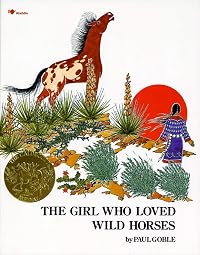
The Girl Who Loved Wild Horses
by Paul Goble
On This Page
Description
Though she is fond of her people, a girl prefers to live among the wild horses where she is truly happy and free.Tags
Recommendations
Member Reviews
One look at these lovely earth-tone illustrations reveals why Paul Goble’s slender book won the Caldecott Medal in 1979. Readers will be moved by Goble’s story of a girl who loved adventure and freedom, but never forgot her Navajo tribe. The tale is on one level, an old Navajo legend, but on another it’s the tale of Everywoman, caught between obligations to others and her own needs. Children and adults will love this book for very different reasons.
Summary: This book is one of many Native American stories by Paul Goble. In this story, a young (nameless girl) grows up with her (unidentified) tribe, and it clear to everyone that she has a way with horses unlike they have ever seen. She ends up leaving her family to live among the wild horses, seeing her family every once in awhile. In the end, it seems that she has actually turned into a wild horse herself.
Review: Paul Goble is a well noted author and illustrator. This book even won a Caldecott award in 1979. However, this is not a book I would positively review for picture books about Native Americans. Goble's books lead the reader to believe that he is sharing tribal legends, but there are no sources or ties to give that claim show more merit. Although the pictures are beautiful, because there are no attributes crediting the story to an actual tribe, this is a fairy tale made up by Goble using Native characters and should not be lauded as an ideal book to tell about Native Americans and Native histories. show less
Review: Paul Goble is a well noted author and illustrator. This book even won a Caldecott award in 1979. However, this is not a book I would positively review for picture books about Native Americans. Goble's books lead the reader to believe that he is sharing tribal legends, but there are no sources or ties to give that claim show more merit. Although the pictures are beautiful, because there are no attributes crediting the story to an actual tribe, this is a fairy tale made up by Goble using Native characters and should not be lauded as an ideal book to tell about Native Americans and Native histories. show less
Interesting book. The author is actually British, and though he's clearly done his research, and was a pioneer in portraying Native American culture with respect and as much accuracy as was accessible, his work is controversial. To many native peoples he's still an outsider, and simply by that criterion is incapable of writing a book that can be accepted as showing an authentic native story or experience.
Of course they have an excellent point. And even a reader unaware of this controversy can see that the Nation depicted in the book is not named, and may in fact be a conflation of different peoples and cultures. Again, no matter how naive, a modern reader will probably also wonder if Goble's story is based on any traditional story.
I show more would not use this book in a social studies (history, culture, etc.) classroom. It's very pretty. It's plausible. It *feels* true. But I'd shelve it with, and present it as, fiction, not ethnic studies.
(Credit due my university in Wisconsin for alerting me and my fellow teachers-in-training to read multi-cultural texts carefully.) show less
Of course they have an excellent point. And even a reader unaware of this controversy can see that the Nation depicted in the book is not named, and may in fact be a conflation of different peoples and cultures. Again, no matter how naive, a modern reader will probably also wonder if Goble's story is based on any traditional story.
I show more would not use this book in a social studies (history, culture, etc.) classroom. It's very pretty. It's plausible. It *feels* true. But I'd shelve it with, and present it as, fiction, not ethnic studies.
(Credit due my university in Wisconsin for alerting me and my fellow teachers-in-training to read multi-cultural texts carefully.) show less
I really liked the style of this book. The Native American influence is beautiful! The story is also enjoyable, since it sounds like a great bedtime folktale. =)
This is a traditional Pueblo Indian folk tale. A young girl loves horses and takes on the care of the tribe’s stock. But during a violent storm her favorite horse is spooked by the lightning and runs away with the girl on her back; the horse runs so far that they do not know how to get back to the camp. However, they notice a herd of wild horses, led by a spotted stallion, and they join that herd for help and protection. Eventually the girl returns to her people, but she finds she misses the wild horses whom she has come to love, so she leaves her home to join the wild horses.
There is a message here about the relationship between people and the natural world, about protecting the resources of the earth, and being thankful for the show more gifts received from nature.
Goble’s illustrations are marvelously detailed and evocative of the American Southwest landscape. I also really liked that he never shows the face of the girl or any of the other tribe members. show less
There is a message here about the relationship between people and the natural world, about protecting the resources of the earth, and being thankful for the show more gifts received from nature.
Goble’s illustrations are marvelously detailed and evocative of the American Southwest landscape. I also really liked that he never shows the face of the girl or any of the other tribe members. show less
I really enjoyed this book for various reasons. Firstly, when I saw this book’s cover I immediately had to reread it because I remember that this book was one of my favorite books when I was a child. The colors and art in the book are very distinct and also help to make this book even more culturally informing. The clothing and settlements of the Native American people were depicted in such a beautiful way. As a Caldecott winner, the art in this book were extremely well done. The colors were vibrant and the feel that they gave the readers was so breathtaking. I felt as if I was memorized by the drawings and the story they depicted. As there are not that many books on Native American culture, I found that this book was extremely show more informative. It really showed how the Native American people were really one with their surroundings and how much they respected nature and animals. Many of the phrases in the book also showed the Native American peoples special connection with the world around them. It seemed as if the characters in story could find so much more meaning in things we take for granted such as “daybreak when the birds [are] singing about the rising sun.” Not only were they more aware and in tune with nature, but the main character even considers animals to be her family: “They are my relatives. If you let me go back to them I shall be happy for evermore.” The story focused not only on nature and animals, but also had a strong sense of family. For example, even after the main character leaves her family to live with the horses, she does not “forget her people. Each year she would come back, and she always brought her parents a colt.” All in all, I found this book very endearing and informative. It also made me very reminiscent of my childhood, as this book had been a book that I had constantly read as a child. show less
To me personally, this story was about a girl who was forced to explore out of her comfort zone and discovered a new life that she loved. She loved her family, but wanted to be with those she loved more. Eventually, she joined the ones she loved, but always carried her human family in her heart. This story can definitely be relatable to almost anyone who has spent time apart from their parents/family members and have discovered more pieces of who they are and who they want to be. I am definitely able to connect to the text because I felt that Paul Goble, the author, basically wrote my story in a different context. I was nervous of attending a university before my freshmen year, but once I settled in and discovered a new family, I show more didn’t want to go home every weekend and just wanted to go back to campus when I was home. I didn’t miss my parents because I didn’t love them; I didn’t miss them because they didn’t give me the chance to miss them. The main character’s parents reminded me of my mom and dad when her parents “gave her a beautiful dress and the best horse in the village to ride.” This part reminded me of how my parents bought literally everything I needed to let me live comfortably on my own. In the story, the main character’s parents agree to let go of their daughter out of love, and I think my parents did the same. Lastly, I feel that readers can find many distinct hidden meanings behind the texts and illustrations, but this lesson is what I realized the most.
I did not feel a connection with the illustrations, which is a large part of my reading experience, but they did seem to support the text well. I also was not fond of the word patterns and structures of the sentences, but I feel that i may appreciate the book more later in time. show less
I did not feel a connection with the illustrations, which is a large part of my reading experience, but they did seem to support the text well. I also was not fond of the word patterns and structures of the sentences, but I feel that i may appreciate the book more later in time. show less
Members
- Recently Added By
Published Reviews
ThingScore 75
This is a story of a Plains Indian girl who joins a band of wild horses and eventually, the story implies, becomes a horse herself. Includes full-color illustrations on each page of this engaging story.
added by CourtyardSchool
Lists

Favorite Childhood Books
1,646 works; 518 members

Caldecott Medal Books
91 works; 15 members
1001 Children's Books You Must Read Before You Grow Up
774 works; 101 members

Books Read in 2023
5,547 works; 145 members

NPR Books You Love: 100 Favorite Books For Young Readers
100 works; 1 member

Horse Books for Kids
376 works; 6 members
Author Information

52+ Works 9,332 Members
Paul Goble was born in Haslemere, Surrey, England on September 27, 1933. He was a sharpshooter in the British military from 1951 to 1953. In 1959, he received a National Diploma in Design, with honors, from the Central School of Arts and Crafts in London. While working in freelance industrial design and teaching at Ravensbourne College of Art and show more Design, he and his first wife Dorothy Lee wrote four picture books. In 1977, he decided to become a full-time author and illustrator and accepted a position as the artist-in-residence at Mount Rushmore National Memorial. He and Lee divorced in 1978. He was best known for his picture books inspired by Native American culture and lore including Buffalo Woman, Iktomi and the Boulder: A Plains Indian Story, and Crow Chief: A Plains Indian Story. He received the Caldecott Medal in 1979 for The Girl Who Loved Wild Horses. He died from Parkinson's disease on January 5, 2017 at the age of 83. (Bowker Author Biography) show less
Awards and Honors
Awards
Distinctions
Notable Lists
Work Relationships
Common Knowledge
- Canonical title
- The Girl Who Loved Wild Horses
- Original publication date
- 1978
- Dedication
- For Bonnie who loves horses and for Janet
- First words
- The people were always moving from place to place following the herds of buffalo.
- Last words
- (Click to show. Warning: May contain spoilers.)Our thoughts fly with them.
- Original language
- English
Classifications
Statistics
- Members
- 3,432
- Popularity
- 4,856
- Reviews
- 118
- Rating
- (3.97)
- Languages
- English, French, Spanish, Turkish
- Media
- Paper, Audiobook
- ISBNs
- 43
- ASINs
- 9