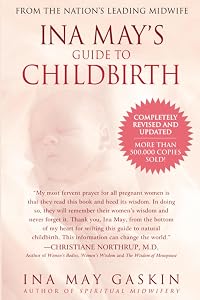
Ina May's Guide to Childbirth
by Ina May Gaskin
On This Page
Description
What you need to know to have the best birth experience for you. Drawing upon her thirty-plus years of experience, Ina May Gaskin, the nation's leading midwife, shares the benefits and joys of natural childbirth by showing women how to trust in the ancient wisdom of their bodies for a healthy and fulfilling birthing experience. Based on the female-centered Midwifery Model of Care, Ina May's Guide to Natural Childbirth gives expectant mothers comprehensive information on everything from the show more all-important mind-body connection to how to give birth without technological intervention. Filled with inspiring birth stories and practical advice, this invaluable resource includes: - Reducing the pain of labor without drugs-and the miraculous roles touch and massage play - What really happens during labor - Orgasmic birth-making birth pleasurable - And much more. show lessTags
Recommendations






Member Reviews
The midwife lent me a whole stack of books (and is always pushing me to take more), but so far the only one I've read cover-to-cover is this one. And I'm wishing I'd read this before I had Jefferson.
Roughly the first half of this book is birth stories. Almost all of them are midwife-assisted births at The Farm, a village/commune in Tennessee, mostly just in homes without a lot of special equipment. Very few of the births had to be transported to the hospital, though those are represented as well. The stories are testament to what a calm and experienced birth assistant, a trust in the power of a woman's body, and the natural process of birth itself can do -- even when the mother gets temporarily hung up by fear, even with extremely large show more babies, and even with some fairly troublesome complications.
The second half of the book is a collection of essays by Ina May on the current state of birthing in the United States. (Primarily it's about this country anyway, there is also a lot of data from other countries for comparison.) The latter chapters are sometimes hopeful, sometimes chilling, but mostly make me glad we're trying for a midwife-assisted home birth this time.
But this book is mostly famous in our house for two pictures of a face-presentation. Jefferson was looking over my shoulder one day as I was reading this book and liked all the pictures of babies. So I started flipping through it with him looking for the pictures. Most were standard mom and baby post-birth posed shots, but on page 58 there is a picture of a baby where only the face has emerged from the birth canal, and then another of the baby right after delivery, with its poor face all smooshed and swollen. I was a little worried about Jefferson's reaction, as I hadn't intended to give him quite such a graphic introduction to "where babies come from," but he loved the pictures, and for a while developed a nightly routine of wanting to see the baby pictures before bed. At one point he even indicated the face presentation and told me he wanted me to have that baby. I told him no matter how much I loved him and wanted him to be happy, I would never wish for a face presentation.
Anyway! I loved this book. Very authoritative and informational. Would recommend to anyone interested in a more natural version of childbirth. show less
Roughly the first half of this book is birth stories. Almost all of them are midwife-assisted births at The Farm, a village/commune in Tennessee, mostly just in homes without a lot of special equipment. Very few of the births had to be transported to the hospital, though those are represented as well. The stories are testament to what a calm and experienced birth assistant, a trust in the power of a woman's body, and the natural process of birth itself can do -- even when the mother gets temporarily hung up by fear, even with extremely large show more babies, and even with some fairly troublesome complications.
The second half of the book is a collection of essays by Ina May on the current state of birthing in the United States. (Primarily it's about this country anyway, there is also a lot of data from other countries for comparison.) The latter chapters are sometimes hopeful, sometimes chilling, but mostly make me glad we're trying for a midwife-assisted home birth this time.
But this book is mostly famous in our house for two pictures of a face-presentation. Jefferson was looking over my shoulder one day as I was reading this book and liked all the pictures of babies. So I started flipping through it with him looking for the pictures. Most were standard mom and baby post-birth posed shots, but on page 58 there is a picture of a baby where only the face has emerged from the birth canal, and then another of the baby right after delivery, with its poor face all smooshed and swollen. I was a little worried about Jefferson's reaction, as I hadn't intended to give him quite such a graphic introduction to "where babies come from," but he loved the pictures, and for a while developed a nightly routine of wanting to see the baby pictures before bed. At one point he even indicated the face presentation and told me he wanted me to have that baby. I told him no matter how much I loved him and wanted him to be happy, I would never wish for a face presentation.
Anyway! I loved this book. Very authoritative and informational. Would recommend to anyone interested in a more natural version of childbirth. show less
Between this and [b:The Mama Natural Week-by-Week Guide to Pregnancy and Childbirth|29430619|The Mama Natural Week-by-Week Guide to Pregnancy and Childbirth|Genevieve Howland|https://i.gr-assets.com/images/S/compressed.photo.goodreads.com/books/1488107243l/29430619._SX50_.jpg|49695208], I get the vibe that "natural" childbirth books do make pregnant folks feel less fearful about birth in general... while also instilling a fear of the medical profession and interventions, which I find less productive. Your mileage may vary. This was lent to me by a friend.
The first half is entirely anecdotes by parents who mostly birthed at The Farm commune in Tennessee or had midwife-attended/influenced births. Many of them are from the 1970s and show more 1980s, with the most recent being around 2000 (which makes sense since this was published in 2003). Still, a little disconcerting to read about births for people older than me...
...the temporal nature also applies to how I feel about the second half. In the twenty years since this was published, I do think the profession has changed- the American c-section and maternal mortality rate is still high compared to the rest of the world, but there's far more baby-friendly (per WHO rules) hospitals, including the one I plan to deliver at. When asked about birth preferences last week I mentioned wanting to avoid an episiotomy if I can, and two different docs mentioned that it's been years since they've seen one done at my local facility. Likewise, the chapter "What You Need to Know About Your Pregnancy and Prenatal Care" dismisses most screening/testing as Ina May believes they tend to lead to unnecessary interventions and... this strikes me as irresponsible, though NIPT (nonexistent in 2003) is definitely less invasive than amnio or CVS (and as someone with a genetics background, OF COURSE I was going to do testing!! It's really interesting!!)
I also have a gestational diabetes diagnosis. She thinks that "the anxiety that is often produced by [the glucose tolerance test] simply isn't worth the information gained from it. Sometimes, when the test is positive, you may be urged to undergo further expensive tests and treatments with no proven benefit" and goes on to say that sometimes women feel funny and have high sugar readings that wouldn't be detected by testing, usually because they ate something that they don't tolerate well during pregnancy, like white flour and sugar which should be eliminated from the woman's diet... ma'am, that's literally what's suggested as a GD treatment!! It would not have been on my radar if I hadn't done two different glucose tests, because while I do have some family history I don't get dizzy spells from sugar.
In short, while Ina May is probably right that avoiding screenings and tests will reduce anxiety, it does create the potential situation of going into birth blind to potential complications until it's possibly too late. I prefer knowing what's going on and the likelihood of future events. Modern medicine doesn't solely exist for profit; as someone who was a premature baby (my mom's water broke weeks early, and she was an older first time mother), I have a healthy respect for interventions as I probably wouldn't be here otherwise! I'm curious if Ina May's ever considered updating or revising this, or if it will be a snapshot of perspectives from the early 2000s after 40 years in the business.
Also: you're going to see photos of crowning babies coming out of labia in this book, just be forewarned! Fascinating, but just a heads up (heh). show less
The first half is entirely anecdotes by parents who mostly birthed at The Farm commune in Tennessee or had midwife-attended/influenced births. Many of them are from the 1970s and show more 1980s, with the most recent being around 2000 (which makes sense since this was published in 2003). Still, a little disconcerting to read about births for people older than me...
...the temporal nature also applies to how I feel about the second half. In the twenty years since this was published, I do think the profession has changed- the American c-section and maternal mortality rate is still high compared to the rest of the world, but there's far more baby-friendly (per WHO rules) hospitals, including the one I plan to deliver at. When asked about birth preferences last week I mentioned wanting to avoid an episiotomy if I can, and two different docs mentioned that it's been years since they've seen one done at my local facility. Likewise, the chapter "What You Need to Know About Your Pregnancy and Prenatal Care" dismisses most screening/testing as Ina May believes they tend to lead to unnecessary interventions and... this strikes me as irresponsible, though NIPT (nonexistent in 2003) is definitely less invasive than amnio or CVS (and as someone with a genetics background, OF COURSE I was going to do testing!! It's really interesting!!)
I also have a gestational diabetes diagnosis. She thinks that "the anxiety that is often produced by [the glucose tolerance test] simply isn't worth the information gained from it. Sometimes, when the test is positive, you may be urged to undergo further expensive tests and treatments with no proven benefit" and goes on to say that sometimes women feel funny and have high sugar readings that wouldn't be detected by testing, usually because they ate something that they don't tolerate well during pregnancy, like white flour and sugar which should be eliminated from the woman's diet... ma'am, that's literally what's suggested as a GD treatment!! It would not have been on my radar if I hadn't done two different glucose tests, because while I do have some family history I don't get dizzy spells from sugar.
In short, while Ina May is probably right that avoiding screenings and tests will reduce anxiety, it does create the potential situation of going into birth blind to potential complications until it's possibly too late. I prefer knowing what's going on and the likelihood of future events. Modern medicine doesn't solely exist for profit; as someone who was a premature baby (my mom's water broke weeks early, and she was an older first time mother), I have a healthy respect for interventions as I probably wouldn't be here otherwise! I'm curious if Ina May's ever considered updating or revising this, or if it will be a snapshot of perspectives from the early 2000s after 40 years in the business.
Also: you're going to see photos of crowning babies coming out of labia in this book, just be forewarned! Fascinating, but just a heads up (heh). show less
Although this book contains much factual information about pregnancy and childbirth, Ina May's Guide to Childbirth is just as much a book on childbirth philosophy as it is a book about the process of birthing a baby.
The heart of the book is a number of birth stories, sometimes in the words of the women who gave birth and sometimes in the words of Ina May. While some of the women further toward new age woo than I think is quite reasonable, for the most part, these are powerful stories of women finding in their bodies and minds the power to give birth in a way that doesn't treat birth as a medical problem to be fixed. One thing I appreciate about these stories is that they don't exclusively describe normal, uncomplicated births. A good show more handful of the stories contain births that were difficult.
One thing Gaskin does well is demonstrate how many of the birth interventions that are sold as conveniences can hamper birth and lead to further interventions that the woman did not originally want. For example, the labor inducing drug Pitocin (synthetic oxytocin) can force the body into labor before the pelvic region has finished preparing for birth which, in turn, leads to higher levels of cesarean sections. This isn't to say cesarean sections are bad. The point is that a woman may choose one intervention — induced labor — and end up with another which she may not have personally wanted — a cesarean section. Another example is epidurals to kill the pain of birth can lead to higher levels of perineum tears because the woman giving birth is unable to feel when she is pushing too hard or too fast.
Because of this, Gaskin advocates letting women's bodies do their work and turn to interventions only as needed. The medical interventions that doctors have available to them today are wonderful lifesavers, but by treating them as conveniences that can standardize birth, we start down a chain of interventions in way that are not always desirable.
Beyond the philosophy, this book also contains a lot of information about the birth process that emphasizes how to let the process of birth happen in its own way: let the birth take time; stand up and move around to help the baby into the right position and let gravity help you push it out; laugh or let your partner sexually stimulate you to relax you and help to loosen your muscles; etc. These aren't magical incantations to make the birth process pain free and fast, but they are ways of working with the birth process rather than against it.
You shouldn't read this book expecting a neutral presentation of non-medical birth, but you should read it if you want a book that focuses on birth as a normal process not something to be medicated away. show less
The heart of the book is a number of birth stories, sometimes in the words of the women who gave birth and sometimes in the words of Ina May. While some of the women further toward new age woo than I think is quite reasonable, for the most part, these are powerful stories of women finding in their bodies and minds the power to give birth in a way that doesn't treat birth as a medical problem to be fixed. One thing I appreciate about these stories is that they don't exclusively describe normal, uncomplicated births. A good show more handful of the stories contain births that were difficult.
One thing Gaskin does well is demonstrate how many of the birth interventions that are sold as conveniences can hamper birth and lead to further interventions that the woman did not originally want. For example, the labor inducing drug Pitocin (synthetic oxytocin) can force the body into labor before the pelvic region has finished preparing for birth which, in turn, leads to higher levels of cesarean sections. This isn't to say cesarean sections are bad. The point is that a woman may choose one intervention — induced labor — and end up with another which she may not have personally wanted — a cesarean section. Another example is epidurals to kill the pain of birth can lead to higher levels of perineum tears because the woman giving birth is unable to feel when she is pushing too hard or too fast.
Because of this, Gaskin advocates letting women's bodies do their work and turn to interventions only as needed. The medical interventions that doctors have available to them today are wonderful lifesavers, but by treating them as conveniences that can standardize birth, we start down a chain of interventions in way that are not always desirable.
Beyond the philosophy, this book also contains a lot of information about the birth process that emphasizes how to let the process of birth happen in its own way: let the birth take time; stand up and move around to help the baby into the right position and let gravity help you push it out; laugh or let your partner sexually stimulate you to relax you and help to loosen your muscles; etc. These aren't magical incantations to make the birth process pain free and fast, but they are ways of working with the birth process rather than against it.
You shouldn't read this book expecting a neutral presentation of non-medical birth, but you should read it if you want a book that focuses on birth as a normal process not something to be medicated away. show less
This book does contain some information that is useful for people with uteruses (even those who are not pregnant and don't intend to become pregnant). It also contains a lot of touchy-feely hippie dippy garbage, so, YMMV. The whole first half is birth stories that are meant to be inspiring but were, to me, equal parts horrifying and insufferably sanctimonious.
I had the opposite reaction to the first review. The birthing stories struck me as repetitive and predictable, and I skipped most of them.
What helped my mental preparation was Ina May's persuasive and rational argument for midwifery. Her research appears solid and should be read more widely. For me, that was the best part of the book.
What helped my mental preparation was Ina May's persuasive and rational argument for midwifery. Her research appears solid and should be read more widely. For me, that was the best part of the book.
If there was one book I could get everyone to read, it's this one. Whether you're planning to have a baby, are pregnant, or if you give two hoots about the care that pregnant women and babies receive in North America. I read it as part of my Doula training and wish that I'd read it while I was pregnant.
The first half of the book is birth stories, usually written by the mother giving birth. They are moving, amazing, intimate peeks into one of life's biggest adventures. So many of them start out with: "I had my first kid(s) in the hospital and it was awful. There has to be a better way! So I went to The Farm for this one. " They definitely don't have to be read in order. I found it useful to open the book at random and read the story I show more found there.
The second part of the book is more scholarly. There are references to statistics and studies that show how different pregnancy and baby care is in North America compared to the rest of the world. I was quite alarmed to learn about some things, such as stitching up a uterus after a Cesarean birth in one layer rather than two, and Ina May's experience that this practice dramatically increased dangerous hemorrhaging during subsequent labours. Stitching up in one layer is done to save time, and is one of many examples in which time and money has come to take precedence over maternal and baby health.
This book made me want to buy a bunch of land and build my own hippie commune. show less
The first half of the book is birth stories, usually written by the mother giving birth. They are moving, amazing, intimate peeks into one of life's biggest adventures. So many of them start out with: "I had my first kid(s) in the hospital and it was awful. There has to be a better way! So I went to The Farm for this one. " They definitely don't have to be read in order. I found it useful to open the book at random and read the story I show more found there.
The second part of the book is more scholarly. There are references to statistics and studies that show how different pregnancy and baby care is in North America compared to the rest of the world. I was quite alarmed to learn about some things, such as stitching up a uterus after a Cesarean birth in one layer rather than two, and Ina May's experience that this practice dramatically increased dangerous hemorrhaging during subsequent labours. Stitching up in one layer is done to save time, and is one of many examples in which time and money has come to take precedence over maternal and baby health.
This book made me want to buy a bunch of land and build my own hippie commune. show less
This is such a thoughtful, informative book regarding natural childbirth. Midwife Ina May Gaskin holds a masters degree in English and it is evident in her writing. Her thoughts stem from more than 40 years of experience attending births and highlight the stark difference between the traditional medical framework that obstetricians work within to assist women in delivering their babies and those who practice true natural childbirth. Arguably the most astounding section of her book is the statistics from 2,028 births that she has assisted. The difference between these statistics and typical hospital statistics are jaw-dropping to say the least, and left me knowing beyond a shadow of a doubt that a natural birth is not only possible, but show more also healthier for both mother and baby. Truly this is a must-read for every woman who is pregnant or who ever plans to become pregnant and every person who will assist in a woman's labor and/or delivery. show less
Members
- Recently Added By
Lists

Books That Changed Me
158 works; 46 members

Top-Rated Books on LibraryThing
272 works; 118 members

Non-Fiction Worth Reading
1,025 works; 264 members

Female Author
1,234 works; 66 members
Books That Changed Our Perspective
423 works; 168 members
Author Information

12+ Works 2,801 Members
Common Knowledge
- Important places
- The Farm, Summertown, Tennessee, USA
- Dedication
- To the women and the doctors who helped me become a midwife
- First words
- Whatever your reason for picking up this book, I salute your curiosity and your desire to know more about the important work of having babies.
- Last words
- (Click to show. Warning: May contain spoilers.)Your body is not a lemon!
- Blurbers
- Bohjalian, Chris; Wagner, Marsden; Edelman, Hope; Wolf, Naomi; Walker, Alice; Davis-Floyd, Robbie
Classifications
Statistics
- Members
- 1,509
- Popularity
- 15,399
- Reviews
- 36
- Rating
- (4.38)
- Languages
- English, French, German
- Media
- Paper, Audiobook, Ebook
- ISBNs
- 11
- ASINs
- 5