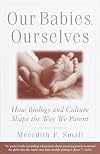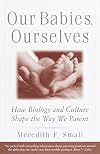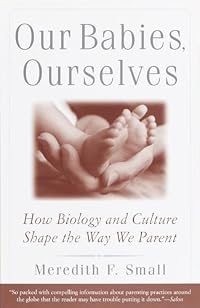
Our Babies, Ourselves: How Biology and Culture Shape the Way We Parent
by Meredith F. Small
On This Page
Description
A thought-provoking combination of practical parenting information and scientific analysis, Our Babies, Ourselves is the first book to explore why we raise our children the way we do--and to suggest that we reconsider our culture's traditional views on parenting. New parents are faced with innumerable decisions to make regarding the best way to care for their baby, and, naturally, they often turn for guidance to friends and family members who have already raised children. But as scientists show more are discovering, much of the trusted advice that has been passed down through generations needs to be carefully reexamined. In this ground-breaking book, anthropologist Meredith Small reveals her remarkable findings in the new science of ethnopediatrics. Professor Small joins pediatricians, child-development researchers, and anthropologists across the country who are studying to what extent the way we parent our infants is based on biological needs and to what extent it is based on culture--and how sometimes what is culturally dictated may not be what's best for babies. Should an infant be encouraged to sleep alone? Is breast-feeding better than bottle-feeding, or is that just a myth of the nineties? How much time should pass before a mother picks up her crying infant? And how important is it really to a baby's development to talk and sing to him or her? These are but a few of the important questions Small addresses, and the answers not only are surprising, but may even change the way we raise our children. show lessTags
Recommendations













Member Recommendations
Member Reviews
It is a pleasure to read an interesting academic book on babies. Small is an actual professor (well, was, emeritus now) of anthropology at Cornell, and this book is a popular gloss on ethnopediatrics, the anthropological subfield focusing on childrearing.
The first two chapters are a quick survey of the underlying theoretical perspectives. From an evolutionary perspective, humans are intelligent bipedal apes, and this basic biology informs the limits of what can pass through the birth canal. Human babies are notably helpless compared to other primates, effectively born 3 months premature in terms of basic motor skills. The other theory is one of cultural relativism. All cultures differ, no culture is inherently superior, and other show more cultures have useful things to teach us.
The next three chapters are focused on areas of obvious concern for new parents: sleeping, crying, and nursing. Here, Small skips among various ethnographies, showing how other cultures, especially traditional hunter-gatherers or pastoralists raise there young. The repeated impression is that the mother-baby dyad is close, and maintained by constant closeness: co-sleeping face-to-face, carrying in a sling, and breast feeding at very frequent intervals.
These traditional practices are in contrast to American childrearing, which is WEIRD (Western, Educated, Industrialized, Rich and Democratic, but also just plain odd). Medicalized western births, starting with early separations at the hospital, and continuing on through a system of quiet and isolated nurseries and regimented feeding and sleep training systems, seem to produce mostly negative outcomes, from colicky babies, to failures to breastfeed, to child mortality far in excess of other developed nations.
Small has a clear agenda against medicalized births here, from the title which is a riff on the famous feminist health book "Our Bodies, Ourselves", to her selection of ethnographic case studies. In the decades since this book has been published medical practice has move towards Small's arguments. For our upcoming birth, Kaiser will place the baby on the mother immediately after delivery (barring a clear medical emergency). Breastfeeding is, if not well supported, better supported.
This is a fascinating book, but I wish Small had included more from other developed nations. We are unlikely to adapt !Kung childrearing practices, but perhaps the Netherlands or Japan has some cultural practices that better fit working motherhood under capitalism. Still, I can see this book being revolutionary when published, and it's aged very well. show less
The first two chapters are a quick survey of the underlying theoretical perspectives. From an evolutionary perspective, humans are intelligent bipedal apes, and this basic biology informs the limits of what can pass through the birth canal. Human babies are notably helpless compared to other primates, effectively born 3 months premature in terms of basic motor skills. The other theory is one of cultural relativism. All cultures differ, no culture is inherently superior, and other show more cultures have useful things to teach us.
The next three chapters are focused on areas of obvious concern for new parents: sleeping, crying, and nursing. Here, Small skips among various ethnographies, showing how other cultures, especially traditional hunter-gatherers or pastoralists raise there young. The repeated impression is that the mother-baby dyad is close, and maintained by constant closeness: co-sleeping face-to-face, carrying in a sling, and breast feeding at very frequent intervals.
These traditional practices are in contrast to American childrearing, which is WEIRD (Western, Educated, Industrialized, Rich and Democratic, but also just plain odd). Medicalized western births, starting with early separations at the hospital, and continuing on through a system of quiet and isolated nurseries and regimented feeding and sleep training systems, seem to produce mostly negative outcomes, from colicky babies, to failures to breastfeed, to child mortality far in excess of other developed nations.
Small has a clear agenda against medicalized births here, from the title which is a riff on the famous feminist health book "Our Bodies, Ourselves", to her selection of ethnographic case studies. In the decades since this book has been published medical practice has move towards Small's arguments. For our upcoming birth, Kaiser will place the baby on the mother immediately after delivery (barring a clear medical emergency). Breastfeeding is, if not well supported, better supported.
This is a fascinating book, but I wish Small had included more from other developed nations. We are unlikely to adapt !Kung childrearing practices, but perhaps the Netherlands or Japan has some cultural practices that better fit working motherhood under capitalism. Still, I can see this book being revolutionary when published, and it's aged very well. show less
I will preface my review by saying that I recognize that I might be biased about this book because it reinforced many things about parenting that I already believe.
That being said, I really found this book enlightening. Small, an anthropologist at Cornell University, outlines research done here in the West about parenting practices and the nature of human infancy and describes parenting practices in cultures around the world. Her basic premise is that, while parents (and even those without children) often believe that there is a "right" way and a "wrong" way to raise children, what is right and wrong in parenting varies dramatically across cultures.
As a mother, I find myself now looking at my relationship with my daughter through a show more cultural lens. This book has helped shift my perspective so that I feel better able to recognize when I'm doing something contrary to the best interests of my family because of cultural influences, and I feel more free to make choices that contradict those paths deemed right by my culture. I've actually reevaluated our family's sleeping arrangements when I realized that the changes I had made and was planning to make in the near future were more based on cultural pressures than on what seemed right for my family.
I especially appreciated the inclusion of James McKenna's research on cosleeping/infant sleep. Small's discussion of SIDS was much more logical and based more on research and evidence than a lot of the information parents receive about SIDS from physicians and public health agencies, which is often way too dependent upon scare tactics, in my opinion.
For those interested in reading more about James McKenna's research and about safe cosleeping, check out his 2007 book, Sleeping With Your Baby: A Parent's Guide. show less
That being said, I really found this book enlightening. Small, an anthropologist at Cornell University, outlines research done here in the West about parenting practices and the nature of human infancy and describes parenting practices in cultures around the world. Her basic premise is that, while parents (and even those without children) often believe that there is a "right" way and a "wrong" way to raise children, what is right and wrong in parenting varies dramatically across cultures.
As a mother, I find myself now looking at my relationship with my daughter through a show more cultural lens. This book has helped shift my perspective so that I feel better able to recognize when I'm doing something contrary to the best interests of my family because of cultural influences, and I feel more free to make choices that contradict those paths deemed right by my culture. I've actually reevaluated our family's sleeping arrangements when I realized that the changes I had made and was planning to make in the near future were more based on cultural pressures than on what seemed right for my family.
I especially appreciated the inclusion of James McKenna's research on cosleeping/infant sleep. Small's discussion of SIDS was much more logical and based more on research and evidence than a lot of the information parents receive about SIDS from physicians and public health agencies, which is often way too dependent upon scare tactics, in my opinion.
For those interested in reading more about James McKenna's research and about safe cosleeping, check out his 2007 book, Sleeping With Your Baby: A Parent's Guide. show less
A great introduction to ethnopediatrics (the study of how culture and evolution affect parenting). My judgement is skewed by the fact that my wife read this first and couldn't bear to not talk about the content :) Small can be repetitive at times and relies on the same cultures, but her work seems very well researched and thought out. A great sensical assesment of what every parent should learn: don't let culture necessarily override the evolutionary symbiotic relationship of parenting.
This was a fascinating read. The author relates the parenting practices of different cultures around the world and talks about how certain parenting styles are due to the biology of human babies. As a simple example, babies were designed to be breastfed, biologically speaking. But in Western cultures, we've decided to diverge from those biologically-based practices to gain more convenience and independence from the traditionally more intimate parent-infant relationship. I like how the author says that there's nothing wrong with that, as long as we're aware of the trade-offs of choosing that different path. Babies will continue to be just fine, as long as they're not completely neglected. But for me, the book reaffirmed certain parenting show more choices we've already made:
* Breastfeed on cue for at least one year (although the book convinced me to try for two years due to the biology of baby development)
* Share the bed with our children for at least the first couple of years (co-sleeping has been shown to prevent SIDS, for example)
* Respond to cries quickly (because crying doesn't just indicate hunger or a full diaper but also the baby's developmental need for touch)
* Carry the baby as much as possible (to help with on-cue breastfeeding and responding to cries quickly)
These happen to be the choices my family has made so far, but I recognize that in some cases the trade-offs for the other side of each choice make sense for certain families. I think this book does an excellent job of giving you a full picture of each parenting choice so that you can make an informed decision. The book was a little slow-going for me at first, but once I got to the chapter comparing cultures, it really picked up and was very interesting. show less
* Breastfeed on cue for at least one year (although the book convinced me to try for two years due to the biology of baby development)
* Share the bed with our children for at least the first couple of years (co-sleeping has been shown to prevent SIDS, for example)
* Respond to cries quickly (because crying doesn't just indicate hunger or a full diaper but also the baby's developmental need for touch)
* Carry the baby as much as possible (to help with on-cue breastfeeding and responding to cries quickly)
These happen to be the choices my family has made so far, but I recognize that in some cases the trade-offs for the other side of each choice make sense for certain families. I think this book does an excellent job of giving you a full picture of each parenting choice so that you can make an informed decision. The book was a little slow-going for me at first, but once I got to the chapter comparing cultures, it really picked up and was very interesting. show less
This book provides a fascinating perspective on the effects of biology on culture and vice versa. The author cites studies, and provides explanations of biological processes, that all relate to the questions of how babies grow, develop, and learn, and how the different attitudes toward childrearing in different cultures affect babies, adults, and society. There is some really interesting information here and it is especially enlightening to read about other cultures -- some fairly similar to ours, some radically different -- and how people in those societies conceptualize babies, parenthood, infant behavior, and so forth.
As a parent in modern Western society, if you are familiar with the concepts/philosophies of "attachment parenting," show more you will find a lot of the ideas in this book familiar and validating. From that perspective it can sometimes feel like the author is subtly pushing an agenda -- this might be the book itself, or might just be in the eye of the beholder. Certainly the author does a good job of presenting the pro's and con's of particular parenting practices from the perspective of the Western world (for example: breast-feeding is widely acknowledged as superior nutritionally, but can be difficult to manage in the context of a working parent's lifestyle). What is perhaps most interesting about this book is the way it really highlights the fact that most things we might think of as universal -- our ideas of how a baby "should" fit into a family unit, how parents "should" raise a child, and so forth -- are very much cultural constructs. This book is bound to get any intelligent person thinking, and prompt him/her to take a hard look at his/her assumptions about parenting, and about society's attitudes toward children in general.
As another reviewer wrote, the book does get repetitive at times and tends in certain sections to rely too heavily on a single researcher or study. In a few places the same information is reiterated repeatedly over the course of a chapter or section. On the whole, though, it's a very worthwhile read for anyone, parent or no. show less
As a parent in modern Western society, if you are familiar with the concepts/philosophies of "attachment parenting," show more you will find a lot of the ideas in this book familiar and validating. From that perspective it can sometimes feel like the author is subtly pushing an agenda -- this might be the book itself, or might just be in the eye of the beholder. Certainly the author does a good job of presenting the pro's and con's of particular parenting practices from the perspective of the Western world (for example: breast-feeding is widely acknowledged as superior nutritionally, but can be difficult to manage in the context of a working parent's lifestyle). What is perhaps most interesting about this book is the way it really highlights the fact that most things we might think of as universal -- our ideas of how a baby "should" fit into a family unit, how parents "should" raise a child, and so forth -- are very much cultural constructs. This book is bound to get any intelligent person thinking, and prompt him/her to take a hard look at his/her assumptions about parenting, and about society's attitudes toward children in general.
As another reviewer wrote, the book does get repetitive at times and tends in certain sections to rely too heavily on a single researcher or study. In a few places the same information is reiterated repeatedly over the course of a chapter or section. On the whole, though, it's a very worthwhile read for anyone, parent or no. show less
I read this for an anthropology class at my university. Although I'm many many years away from parenting, I consider reading it a paradigm-shifting moment. I have so many ideas now about how I want to raise my children. And although I try not to be a proselytizing student of anthropology, I cringe whenever I see babies crying alone in their strollers, neglected by their caregivers and the world around them. I have to resist the urge to shove this book in the parents' faces. Please parents and future-parents of the world, put down your [b:What to Expect When You're Expecting|174703|What to Expect When You're Expecting|Heidi Murkoff|http://photo.goodreads.com/books/1298458822s/174703.jpg|257399] and read [b:Our Babies, Ourselves: How show more Biology and Culture Shape the Way We Parent|407854|Our Babies, Ourselves How Biology and Culture Shape the Way We Parent|Meredith Small|http://photo.goodreads.com/books/1320470493s/407854.jpg|397161] instead. show less
this is such an incredible book, despite its unfortunate title (it has nothing to do with the classic "our bodies, ourselves"). it is an anthropological look at parenting and is supported by evolutionary biology too. it is full of interesting facts, many pertaining to our unique (and sometimes bizarre) american parenting practices, such as putting babies to sleep in their own rooms. however, it does not take a judgmental tone and is neutral in its presentation of facts of child-rearing across cultures. i learned so much from reading this (for example, SIDS and colic are virtually unheard of among people who hold their infants more often, nurse regularly, and sleep next to them at night) and enthusiastically recommend it.
Members
- Recently Added By
Lists

Tom's Bookstore
346 works; 2 members
Author Information
10+ Works 688 Members
Meredith F. Small is professor of anthropology Cornell University.
Some Editions
Classifications
- Genres
- Anthropology, Nonfiction, General Nonfiction, Science & Nature
- DDC/MDS
- 649.122 — Applied Science & Technology Home economics & family management Child rearing; home care of people with illnesses and disabilities by family and friends Parenting Parenting Children by Age Babies
- LCC
- RJ61 .S6345 — Medicine Pediatrics Pediatrics
- BISAC
Statistics
- Members
- 347
- Popularity
- 90,685
- Reviews
- 10
- Rating
- (4.23)
- Languages
- English, Spanish
- Media
- Paper, Ebook
- ISBNs
- 6
- ASINs
- 2