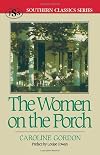
The Women on the Porch
by Caroline Gordon
On This Page
Description
One of the most remarkable novels every written by an American woman about women. First published in 1943, the story follows a woman's flight from Manhattan and her unfaithful husband to her rural ancestral home. Southern Classics Series.Tags
Recommendations










































Member Reviews
4.5 stars
Set in the South in the early 40’s, Women on the Porch is the story of Catherine Lewis Chapman, a woman living in New York, who has just caught her husband in the middle of an affair. She packs her bags and returns to her roots, Swan Quarter, a home place occupied exclusively by the women of the Lewis family, in Tennessee. At Swan Quarter, we find the elderly Miss Kit, Catherine’s grandmother, Catherine’s aunt Willy, and Willy’s cousin, Daphne, living without men and subsisting on a farm that was mortgaged and partially sold away by Willy’s now deceased brother, Jack.
It seems to me that life at Swan Quarter is in suspension. These women live in the past, trapped in a routine that is seldom broken and which shields show more them from life and perhaps from disaster. The men who have stepped through the lives of these women have mostly left them trampled and scarred, and Catherine promises to join their number if not very careful. Catherine steps into this world, fully alive, and she struggles with her urges to continue living or to sink into the rocking chair existence that lulls and pulls here.
One of the most marked themes, to me, seems to be nature vs. man and city vs. country. The contrast between Tom Manigualt and Jim Chapman is stark and striking--they are not just two different men, they are two different ways of life. Tom is a younger, verile, but troubled man, who lives as close to the earth as he can manage, much to the chagrin of his pompous society mother. Jim is a professor, who roams the city, has little understanding of this woman who shares his name, and has sacrificed most of his early promise to a life that is unfilling and undistinguished. But, Jim lives in the future and Tom is frantically trying to recapture the past.
Much of what Gordon shows us is life moving on, change taking root, and the women of Swan Quarter left behind, trying to cling to something long gone and nearly forgotten. Over and over again we see illustrations of how disastrous attempts to expand beyond this limited horizon can be for them.
When Catherine arrives, her Aunt Willy begins to think about Catherine’s mother, Agnes. She sometimes had to remind herself that Agnes was dead. It was as if she were living on there in New York, only they did not get letters from her as they used to. They live so isolated a life that they can hardly realize the effect upon themselves, even when the outside event touches their lives intimately.
There are elements of this book that will make a person squirm with discomfort. Those elements deal with the relationship of these people and the blacks who work for them. The depiction is a true one, however, and serves to remind us that some changes are worth their weight in gold. Gordon’s view is not unkind or unappreciative, but the character’s views often are. I was encouraged by the fact that the black characters are accorded personality and intelligence. Life is changing for them as well, and Maria and Joe, particularly, seem to realize that the future is not going to look anything like the past for them.
In the end, each of these women has an individual story that reeks of disappointed hopes and dreams, and they are as isolated from others, and indeed from each other, as the farm is isolated from the world it inhabits.
What we are seeing is a way of life crumbling and sweeping its inhabitants into the future or out of the world altogether. show less
Set in the South in the early 40’s, Women on the Porch is the story of Catherine Lewis Chapman, a woman living in New York, who has just caught her husband in the middle of an affair. She packs her bags and returns to her roots, Swan Quarter, a home place occupied exclusively by the women of the Lewis family, in Tennessee. At Swan Quarter, we find the elderly Miss Kit, Catherine’s grandmother, Catherine’s aunt Willy, and Willy’s cousin, Daphne, living without men and subsisting on a farm that was mortgaged and partially sold away by Willy’s now deceased brother, Jack.
It seems to me that life at Swan Quarter is in suspension. These women live in the past, trapped in a routine that is seldom broken and which shields show more them from life and perhaps from disaster. The men who have stepped through the lives of these women have mostly left them trampled and scarred, and Catherine promises to join their number if not very careful. Catherine steps into this world, fully alive, and she struggles with her urges to continue living or to sink into the rocking chair existence that lulls and pulls here.
One of the most marked themes, to me, seems to be nature vs. man and city vs. country. The contrast between Tom Manigualt and Jim Chapman is stark and striking--they are not just two different men, they are two different ways of life. Tom is a younger, verile, but troubled man, who lives as close to the earth as he can manage, much to the chagrin of his pompous society mother. Jim is a professor, who roams the city, has little understanding of this woman who shares his name, and has sacrificed most of his early promise to a life that is unfilling and undistinguished. But, Jim lives in the future and Tom is frantically trying to recapture the past.
Much of what Gordon shows us is life moving on, change taking root, and the women of Swan Quarter left behind, trying to cling to something long gone and nearly forgotten. Over and over again we see illustrations of how disastrous attempts to expand beyond this limited horizon can be for them.
When Catherine arrives, her Aunt Willy begins to think about Catherine’s mother, Agnes. She sometimes had to remind herself that Agnes was dead. It was as if she were living on there in New York, only they did not get letters from her as they used to. They live so isolated a life that they can hardly realize the effect upon themselves, even when the outside event touches their lives intimately.
There are elements of this book that will make a person squirm with discomfort. Those elements deal with the relationship of these people and the blacks who work for them. The depiction is a true one, however, and serves to remind us that some changes are worth their weight in gold. Gordon’s view is not unkind or unappreciative, but the character’s views often are. I was encouraged by the fact that the black characters are accorded personality and intelligence. Life is changing for them as well, and Maria and Joe, particularly, seem to realize that the future is not going to look anything like the past for them.
In the end, each of these women has an individual story that reeks of disappointed hopes and dreams, and they are as isolated from others, and indeed from each other, as the farm is isolated from the world it inhabits.
What we are seeing is a way of life crumbling and sweeping its inhabitants into the future or out of the world altogether. show less
Beautiful writing but confusing narrative - chapters jump between characters, and sometimes it is not clear who is speaking and at what time period. The sense of ghosts and/or spirits in this novel did not work for me. Things are referred to as having happened - but when/where/why is unclear. The ending bothered me and was disturbing. The aspect I enjoyed was the descriptive writing - there was a clear sense of place, mood etc.
I knew I was in trouble when I saw it was a contemporary retelling of Orpheus and Eurydice. Like many contemporary retellings of myths, it uses a powerful myth as spine for a trivial story. In this case, a very unconvincing one, almost from the first page. Gave this one away.
Ratings
Members
- Recently Added By
Author Information
16+ Works 444 Members
Caroline Gordon's controlled use of her craft ,as well as her conservative attitudes, stamped her as a traditionalist among modern writers. Born in Kentucky as the daughter of a classics teacher and graduated from Bethany College in 1916, she married the poet Allen Tate in 1924 and became an associate of the Fugitives and Southern Agrarian groups show more that helped to make Nashville a vital mecca for southern intellectuals during the 1970s. Her first novel, Penhally (1931), traces the decline brought about by pride and jealousy as well as the devastation of the Civil War. None Shall Look Back (1937), which had the misfortune to appear shortly after Margaret Mitchell's Gone with the Wind, is a distinguished but neglected novel with a theme similar to her first. Against the story of the Allard family, which, like the house of Penhally, deteriorates through internal weaknesses, as well as because of the Civil War, Gordon sets off the heroic figure of the Confederate General Nathan Bedford Forrest. The Garden of Adonis (1937) picks up the story of the Allards, this time during the depression of the 1930s, and shows how social conditions, as well as the family's own incapacities, have put the men of the family at the mercy of their spoiled and neurotic women. Aleck Maury, Sportsman (1934), like Gordon's most famous short story "Old Red," is remarkable for its vivid hunting scenes. Probably no other woman has written so knowledgeably and sympathetically about the outdoor man's love of the fields and streams of his native region and the almost sacramental view of nature that accompanies such allegiance. (Bowker Author Biography) show less
Some Editions
Series
Belongs to Publisher Series
Common Knowledge
- Canonical title
- The Women on the Porch
Classifications
- Genres
- Fiction and Literature, General Fiction, Romance, Historical Fiction
- DDC/MDS
- 813.52 — Literature & rhetoric American literature in English American fiction in English 1900-1999 1900-1945
- LCC
- PS3513 .O5765 .W66 — Language and Literature American literature American literature Individual authors 1900-1960
- BISAC
Statistics
- Members
- 56
- Popularity
- 548,238
- Reviews
- 3
- Rating
- (3.38)
- Languages
- English
- Media
- Paper, Ebook
- ISBNs
- 3
- ASINs
- 3