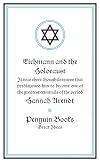
Eichmann and the Holocaust
by Hannah Arendt 
On This Page
Description
Throughout history, some books have changed the world. They have transformed the way we see ourselves - and each other. They have inspired debate, dissent, war and revolution. They have enlightened, outraged, provoked and comforted. They have enriched lives - and destroyed them. Now Penguin brings you the works of the great thinkers, pioneers, radicals and visionaries whose ideas shook civilization and helped make us who we are. Inspired by the trial of a bureaucrat who helped cause the show more Holocaust, this radical work on the banality of evil stunned the world with its exploration of a regime's moral blindness and one man's insistence that he be absolved all guilt because he was 'only following orders'. show lessTags
Recommendations





























Member Reviews
"Nothing's as hot when you're eating it as when it's cooking." The failure of that piece of conventional wisdom to predict the Holocaust, to predict the way things actually went down, cuts to the awful core of what those men--bad men, but not monsters, because that lets us all off the hook (how terrifying is it to speculate that some of them may even have been good men?)--did in the same way that Eichmann the man, the cliche-spouter, the bureaucrat, the banal evildoer, does. This happened because of our ability to keep going--to filter out, to play through, to overcome and triumph. It happened because millions of regular Germans kept their heads down and focused on what they could comprehend, not the enormity before which words fail. show more The capacity to reduce existence to platitudes--"just doing my job", "there's a war on", "Elders of Zion", "it's worse in Russia"--is the only way you can reconcile the obvious human drives toward altruism and cooperation with the Final Solution. Sometimes it feels like platitudes are also the only way we can understand it, and we should quit trying to stain the silence with words. But Arendt's words show us just how culpable we all are--and that's vital. This is a collection of excerpts from the complete Eichmann in Jerusalem: The Banality of Evil, and I don't know why you wouldn't just read the whole thing, but Eichmann and the Holocaust is still a great book. show less
This is an abridgment of Hannah Arendt's classic Eichmann in Jerusalem: A Report on the Banality of Evil. Having not read the larger work, but having been taught the point of this book decades ago, it was a short, interesting read in Penguin's "Great Ideas" series. Eichmann's character and motivations, his history and culpability, et cetera, are detailed in this work. The banality isn't evil, it's that this apparently banal guy countenanced, condoned, and perpetrated evil. This should be essential reading, now that many are questioning the Holocaust.
An excellent and detailed description of the trial of Adolf Eichmann, probably the most prominent and well-known figure behind the Holocaust. Arendt's description of the thinking of the war criminal amplifies the character of the man who felt no remorse, no shame over what he had done. She describes vividly the psychology of a narcissist whose only motivations are how he is perceived by others, his only regrets centering around himself and his aims and not around anymore code or remorse for what he did.
Arendt's writing style can be difficult. I found myself often wishing to re-write many of her sentences, breaking them down into more manageable and easily followed lengths. Her use of multiple dependent clauses and frequent parenthetical show more explanations could easily have been better edited for a more readable style. In spite of this, however, the book itself tells a vivid story free of judgmentalism and pontification. show less
Arendt's writing style can be difficult. I found myself often wishing to re-write many of her sentences, breaking them down into more manageable and easily followed lengths. Her use of multiple dependent clauses and frequent parenthetical show more explanations could easily have been better edited for a more readable style. In spite of this, however, the book itself tells a vivid story free of judgmentalism and pontification. show less
An excellent and detailed description of the trial of Adolf Eichmann, probably the most prominent and well-known figure behind the Holocaust. Arendt's description of the thinking of the war criminal amplifies the character of the man who felt no remorse, no shame over what he had done. She describes vividly the psychology of a narcissist whose only motivations are how he is perceived by others, his only regrets centering around himself and his aims and not around anymore code or remorse for what he did.
Arendt's writing style can be difficult. I found myself often wishing to re-write many of her sentences, breaking them down into more manageable and easily followed lengths. Her use of multiple dependent clauses and frequent parenthetical show more explanations could easily have been better edited for a more readable style. In spite of this, however, the book itself tells a vivid story free of judgmentalism and pontification. show less
Arendt's writing style can be difficult. I found myself often wishing to re-write many of her sentences, breaking them down into more manageable and easily followed lengths. Her use of multiple dependent clauses and frequent parenthetical show more explanations could easily have been better edited for a more readable style. In spite of this, however, the book itself tells a vivid story free of judgmentalism and pontification. show less
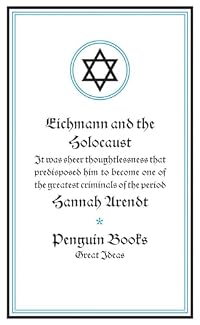
It was sheer thoughtlessness that predisposed him to become one of the greatest criminals of the period.
In her own words: "And just as you supported and carried out a policy of not wanting to share the earth with the Jewish people and the people of a number of other nations - as though you and your superiors had any right to determine who should and who should not inhabit the world - we find that no one, that is, no member of the human race, can be expected to want to share the earth with you. This is the reason, and the only reason, you must hang."
A truly memorable book. So sad . . .
A truly memorable book. So sad . . .
Ratings
Members
- Recently Added By
Author Information

260+ Works 26,137 Members
Born in Hanover, Germany, Hannah Arendt received her doctorate from Heidelberg University in 1928. A victim of naziism, she fled Germany in 1933 for France, where she helped with the resettlement of Jewish children in Palestine. In 1941, she emigrated to the United States. Ten years later she became an American citizen. Arendt held numerous show more positions in her new country---research director of the Conference on Jewish Relations, chief editor of Schocken Books, and executive director of Jewish Cultural Reconstruction in New York City. A visiting professor at several universities, including the University of California, Columbia, and the University of Chicago, and university professor on the graduate faculty of the New School for Social Research, in 1959 she became the first woman appointed to a full professorship at Princeton. She also won a number of grants and fellowships. In 1967 she received the Sigmund Freud Prize of the German Akademie fur Sprache und Dichtung for her fine scholarly writing. Arendt was well equipped to write her superb The Origins of Totalitarianism (1951) which David Riesman called "an achievement in historiography." In his view, "such an experience in understanding our times as this book provides is itself a social force not to be underestimated." Arendt's study of Adolf Eichmann at his trial---Eichmann in Jerusalem (1963)---part of which appeared originally in The New Yorker, was a painfully searching investigation into what made the Nazi persecutor tick. In it, she states that the trial of this Nazi illustrates the "banality of evil." In 1968, she published Men in Dark Times, which includes essays on Hermann Broch, Walter Benjamin, and Bertolt Brecht (see Vol. 2), as well as an interesting characterization of Pope John XXIII. (Bowker Author Biography) show less
Hannah Arendt has a Legacy Library. Legacy libraries are the personal libraries of famous readers, entered by LibraryThing members from the Legacy Libraries group.
Some Editions
Series
Belongs to Publisher Series
Great Ideas II (40)
Penguin Great Ideas (40)
Work Relationships
Is contained in
Common Knowledge
- Canonical title
- Eichmann and the Holocaust
Classifications
- Genres
- Nonfiction, History, General Nonfiction, Philosophy
- DDC/MDS
- 940.5318092 — History & geography History of Europe History of Europe 1918- World War II, 1939-1945 Social, political, economic history; Holocaust Holocaust Standard subdivisions History, geographic treatment, biography Biography
- LCC
- DD247 .E5 .A69 — History of Europe, Asia, Africa and Oceania Germany History of Germany History By period Modern, 1519- 19th-20th centuries Revolution and Republic, 1918-
- BISAC
Statistics
- Members
- 426
- Popularity
- 72,088
- Reviews
- 6
- Rating
- (3.92)
- Languages
- English, Spanish
- Media
- Paper, Ebook
- ISBNs
- 9
- ASINs
- 1