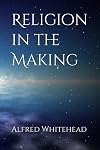
Religion in the Making
by Alfred North Whitehead
On This Page
Description
This classic text in American Philosophy by one of the foremost figures in American philosophy offers a concise analysis of the various factors in human nature which go toward forming a religion, to exhibit the inevitable transformation of religion with the transformation of knowledge and to direct attention to the foundation of religion on our apprehension of those permanent elements by reason of which there is a stable order in the world, permanent elements apart from which there could be show more no changing world. show lessTags
Recommendations






















Member Reviews
First Chapter, entitled "Religion in History". ANW considers "the type of justification which is available for belief in doctrines of religion."
He notes that it is the peculiar quality of religion that "humanity is always shifting its attitude toward it." There are grave doubts about doctrine, and no agreement on which religion is true or false. Is there any validity to a belief?
ANW goes on to his second, very famous contrast: "What is generally disputed is doubtful, and what is doubtful is relatively unimportant." After all, our conduct cannot be guided by unsettled general principles. He contrast religion with mathematics: "You USE arithmetic, but you ARE religious." And the author pursues this contrast, noting that no one is show more "justified" by his faith in the multiplication tables, but "justification is the basis of all religion". He assumes that "character is developed according to your faith". He takes this as the "primary religious truth from which no one can escape." As if Religion is a "force of belief" which can "cleanse the inward parts". And from that leap there, ANW concludes, "For this reason the primary religious virtue is sincerity, a penetrating sincerity."
Sadly, he offers no evidence of what any of this means. But he firmly grasps and conveys the idea that Religion can be defined "as a system of general truths which have the effect of transforming character when they are sincerely held and vividly apprehended." In a Chapter entitled "Religion in History", we are really forced to ask, What? What is this transforming effect of which you speak? show less
He notes that it is the peculiar quality of religion that "humanity is always shifting its attitude toward it." There are grave doubts about doctrine, and no agreement on which religion is true or false. Is there any validity to a belief?
ANW goes on to his second, very famous contrast: "What is generally disputed is doubtful, and what is doubtful is relatively unimportant." After all, our conduct cannot be guided by unsettled general principles. He contrast religion with mathematics: "You USE arithmetic, but you ARE religious." And the author pursues this contrast, noting that no one is show more "justified" by his faith in the multiplication tables, but "justification is the basis of all religion". He assumes that "character is developed according to your faith". He takes this as the "primary religious truth from which no one can escape." As if Religion is a "force of belief" which can "cleanse the inward parts". And from that leap there, ANW concludes, "For this reason the primary religious virtue is sincerity, a penetrating sincerity."
Sadly, he offers no evidence of what any of this means. But he firmly grasps and conveys the idea that Religion can be defined "as a system of general truths which have the effect of transforming character when they are sincerely held and vividly apprehended." In a Chapter entitled "Religion in History", we are really forced to ask, What? What is this transforming effect of which you speak? show less
„Religia în formare” de Alfred North Whitehead este o lucrare filozofică care explorează evoluția religiei și a experienței spirituale în viața omului, punând accent pe relația dintre gândirea filozofică, cultura și dezvoltarea religioasă.
📖 Despre autor
a) Alfred North Whitehead (1861–1947) a fost filozof și matematician britanic, cunoscut pentru contribuțiile sale la logică, matematică și filozofia procesului.
b) A colaborat cu Bertrand Russell la „Principia Mathematica” și a dezvoltat ulterior filozofia procesului și concepții despre realitate și experiență.
c) Este recunoscut pentru abordarea sa interdisciplinară și pentru analiza filozofică a religiei și culturii.
📚 Despre volum
a) Cartea show more examinează modul în care religia se dezvoltă ca experiență umană și ca fenomen cultural.
b) Analizează relația dintre cunoaștere, rațiune și credință religioasă.
c) Include reflecții asupra impactului religiei asupra societății și asupra dezvoltării morale a individului.
🔎 Teme principale
a) Formarea religiei ca experiență umană și fenomen social.
b) Interacțiunea dintre credință, rațiune și cultură.
c) Evoluția conceptelor religioase și simbolice.
d) Influența religiei asupra moralității și vieții comunitare.
e) Analiza filozofică a spiritualității și experienței religioase.
⚖️ Semnificație
a) Cartea oferă o perspectivă filozofică profundă asupra naturii și rolului religiei în societate.
b) Relevanța sa constă în înțelegerea religiei ca proces evolutiv și cultural, nu doar doctrinar.
c) Este utilă pentru studiul filozofiei religiei, teologiei și istoriei ideilor spirituale. show less
📖 Despre autor
a) Alfred North Whitehead (1861–1947) a fost filozof și matematician britanic, cunoscut pentru contribuțiile sale la logică, matematică și filozofia procesului.
b) A colaborat cu Bertrand Russell la „Principia Mathematica” și a dezvoltat ulterior filozofia procesului și concepții despre realitate și experiență.
c) Este recunoscut pentru abordarea sa interdisciplinară și pentru analiza filozofică a religiei și culturii.
📚 Despre volum
a) Cartea show more examinează modul în care religia se dezvoltă ca experiență umană și ca fenomen cultural.
b) Analizează relația dintre cunoaștere, rațiune și credință religioasă.
c) Include reflecții asupra impactului religiei asupra societății și asupra dezvoltării morale a individului.
🔎 Teme principale
a) Formarea religiei ca experiență umană și fenomen social.
b) Interacțiunea dintre credință, rațiune și cultură.
c) Evoluția conceptelor religioase și simbolice.
d) Influența religiei asupra moralității și vieții comunitare.
e) Analiza filozofică a spiritualității și experienței religioase.
⚖️ Semnificație
a) Cartea oferă o perspectivă filozofică profundă asupra naturii și rolului religiei în societate.
b) Relevanța sa constă în înțelegerea religiei ca proces evolutiv și cultural, nu doar doctrinar.
c) Este utilă pentru studiul filozofiei religiei, teologiei și istoriei ideilor spirituale. show less
Sep 24, 2025Romanian
Ratings
Members
- Recently Added By
Author Information

64+ Works 6,250 Members
Alfred North Whitehead, who began his career as a mathematician, ranks as the foremost philosopher in the twentieth century to construct a speculative system of philosophical cosmology. After his graduation from Cambridge University, he lectured there until 1910 on mathematics. Like Bertrand Russell (see also Vol. 5), his most brilliant pupil, show more Whitehead viewed philosophy at the start from the standpoint of mathematics, and, with Russell, he wrote Principia Mathematica (1910--13). This work established the derivation of mathematics from logical foundations and has transformed the philosophical discipline of logic. From his work on mathematics and its logical foundations, Whitehead proceeded to what has been regarded as the second phase of his career. In 1910 he left Cambridge for the University of London, where he lectured until he was appointed professor of applied mathematics at the Imperial College of Science and Technology. During his period in London, Whitehead produced works on the epistemological and metaphysical principles of science. The major works of this period are An Enquiry Concerning the Principles of Natural Knowledge (1919), The Concept of Nature (1920), and The Principles of Relativity (1922). In 1924, at age 63, Whitehead retired from his position at the Imperial College and accepted an appointment as professor of philosophy at Harvard University, where he began his most creative period in speculative philosophy. In Science and the Modern World (1925) he explored the history of the development of science, examining its foundations in categories of philosophical import, and remarked that with the revolutions in biology and physics in the nineteenth and early twentieth centuries a revision of these categories was in order. Whitehead unveiled his proposals for a new list of categories supporting a comprehensive philosophical cosmology in Process and Reality (1929), a work hailed as the greatest expression of process philosophy and theology. Adventures of Ideas (1933) is an essay in the philosophy of culture; it centers on what Whitehead considered the key ideas that have shaped Western culture. (Bowker Author Biography) show less
All Editions
Some Editions
Series
Belongs to Publisher Series
Common Knowledge
- Canonical title*
- De dynamiek van de religie
- Original publication date
- 1926
*Some information comes from Common Knowledge in other languages. Click "Edit" for more information.
Classifications
Statistics
- Members
- 300
- Popularity
- 107,394
- Reviews
- 2
- Rating
- (4.07)
- Languages
- 5 — Dutch, English, French, German, Spanish
- Media
- Paper, Ebook
- ISBNs
- 12
- ASINs
- 14