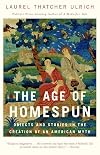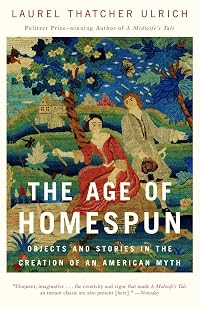
The Age of Homespun: Objects and Stories in the Creation of an American Myth
by Laurel Thatcher Ulrich
On This Page
Description
Publisher's description: Using objects that Americans have saved through the centuries and stories they have passed along, as well as histories teased from documents, Laurel Thatcher Ulrich chronicles the production of cloth -- and of history -- in early America. Under the singular and brilliant lens that Ulrich brings to this study, ordinary household goods -- Indian baskets, spinning wheels, a chimneypiece, a cupboard, a niddy-noddy, bed coverings, silk embroidery, a pocketbook, a linen show more tablecloth, a coverlet and a rose blanket, and an unfinished stocking--provide the key to a transformed understanding of cultural encounter, frontier war, Revolutionary politics, international commerce, and early industrialization in America. We discover how ideas about cloth and clothing affected relations between English settlers and their Algonkian neighbors. We see how an English production system based on a clear division of labor -- men doing the weaving and women the spinning--broke down in the colonial setting, becoming first marginalized, then feminized, then politicized, and how the new system both prepared the way for and was sustained by machine-powered spinning. Pulling these divergent threads together into a rich and revealing tapestry of -- the age of homespun -- Ulrich demonstrates how ordinary objects reveal larger economic and social structures, and, in particular, how early Americans and their descendants made, used, sold, and saved textiles in order to assert identities, shape relationships, and create history. show lessTags
Recommendations












Member Recommendations

Member Reviews
Laurel Thatcher Ulrich is one of my favorite nonfiction authors. Her writing often attempts to illuminate the every day lives of those living in the Northeast region of early America, and this book fit that theme. In it, she explores eleven everyday objects that have survived hundreds of years and uses them to study everyday life, cultural trends, political issues, and many other topics. As with all of her books, the focus is on women's lives, which are often not documented to the same extent as their male counterparts.
One of the tenets of this book is that women's "wealth" was typically in moveable objects: linens, kitchen items, small furniture, items of clothing, and decorative luxuries. Men's wealth was in land, business, and show more education. As such, studying the objects presented in this book is a study of women's lives. The objects studied were created between 1676 and 1837 and include items like an Indian basket, spinning wheels, a pocketbook, a decorative cupboard, a linen tablecloth, and silk embroidery. The items lead to explorations of the settlers interactions with the local Indians (some of the objects are made by Indian women), how women spent their days, what genealogical records leave out about women, the methods of fabric making, spinning as a a political act so as not to rely on England's manufactured goods, and many more topics.
I was interested and excited that there was so much focus on Indian culture (specifically the Abenaki people) in this book, because one of my focuses this year is going to be on reading more books by and about American Indians. This unintentionally fit that category, so it was a good way to start my reading year.
Ulrich's writing won't be for everyone; her style is not the popular narrative nonfiction prevalent today. The writing is scholarly and dense, though I found I got in a pretty good rhythm with it and was able to get immersed in the topic. I suspect her book, [A Midwife's Tale], will always be my favorite, but this is a close second and one I would like to read again some day. There is so much information that it was impossible to absorb it all in one reading.
Original publication date: 2001
Author’s nationality: American
Original language: English
Length: 481 pages
Rating: 4.5 stars
Format/where I acquired the book: purchased paperback
Why I read this: off the shelf, favorite author show less
One of the tenets of this book is that women's "wealth" was typically in moveable objects: linens, kitchen items, small furniture, items of clothing, and decorative luxuries. Men's wealth was in land, business, and show more education. As such, studying the objects presented in this book is a study of women's lives. The objects studied were created between 1676 and 1837 and include items like an Indian basket, spinning wheels, a pocketbook, a decorative cupboard, a linen tablecloth, and silk embroidery. The items lead to explorations of the settlers interactions with the local Indians (some of the objects are made by Indian women), how women spent their days, what genealogical records leave out about women, the methods of fabric making, spinning as a a political act so as not to rely on England's manufactured goods, and many more topics.
I was interested and excited that there was so much focus on Indian culture (specifically the Abenaki people) in this book, because one of my focuses this year is going to be on reading more books by and about American Indians. This unintentionally fit that category, so it was a good way to start my reading year.
Ulrich's writing won't be for everyone; her style is not the popular narrative nonfiction prevalent today. The writing is scholarly and dense, though I found I got in a pretty good rhythm with it and was able to get immersed in the topic. I suspect her book, [A Midwife's Tale], will always be my favorite, but this is a close second and one I would like to read again some day. There is so much information that it was impossible to absorb it all in one reading.
Original publication date: 2001
Author’s nationality: American
Original language: English
Length: 481 pages
Rating: 4.5 stars
Format/where I acquired the book: purchased paperback
Why I read this: off the shelf, favorite author show less
A fascinating look at history as seen through a variety of everyday objects such as an Indian basket, spinning wheels, a decorated cupboard, rugs, coverlets, tablecloths, blankets and more. In a brilliantly written series of vignettes, Ulrich seems to unravel each object strand by strand to show the cultural traditions, anthropological influences and social interactions that explain how the item came to be. Ulrich's knowledge of her subjects' lives seems bottomless and she uses her insights to keep her narrative moving at a lively, richly informative pace. She sklilfully weaves the threads of her research into what amounts to intimate portrait of young America at home during the decades before and after the revolution. This is one of show more the best histories -- of anything -- I've ever read. show less
I wanted something a little meatier than an Eric Sloane book. What I got is a full order of magnitude longer and denser. I did skim the whole thing, as well as read the whole introduction, but I could never find an actual thesis. What is the "American Myth" of the title? Maybe an academic historian like the author would get more out of the book... but maybe not. None of my college readings were anywhere near this dry or difficult.
An enjoyable read. Fascinating artifacts and incredible research behind the stories. Almost every chapter includes something about local Natives! Finally, someone has written Native People back into American History. On a scale of 1-10 she gets a 12 in book book.
This is a very frustrating book. Ulrich attempts to use specific items from early American history to attempt to construct a broader history. These include a rug, a chest and a basket. Unfortunately, the information provided from the items is so sparse that they are essentially useless. Her approach is more of a gimic than an actual methodology. The entire book could have been written without the items. The writing is almost frustrating because Ulrich randomly bounces between a variety of issues with no real connection between them. This is true within chapters as well as across them. I found her earlier work, A Midwife's Tale, very interesting. This one, not so much.
Fascinating, well-written history of early American crafts and early American life.
Interesting history of objects, however, a bit too technical for me. I wouls have enjoyed more stories about the items.
Members
- Recently Added By
Lists

Yarncrafts and Textiles in History
4 works; 1 member

Women and American History
19 works; 1 member
Author Information

14+ Works 4,852 Members
Laurel Thatcher Ulrich is Phillips Professor of Early American History at Harvard University.
Awards and Honors
Awards
Common Knowledge
- Canonical title
- The Age of Homespun: Objects and Stories in the Creation of an American Myth
- Original publication date
- 2001
- Important places
- New England, USA
- Epigraph
- "You must not go into the burial places, and look about only for the tall monuments and the titled names. It is not the starred epitaphs of the Doctors of Divinity, the Generals, the Judges, the Honourables, the Governors, o... (show all)r even of the village notables called Esquires, that mark the springs of our successes and the sources of our distinctions. These are rather effects than causes; the spinning-wheels have done a great deal more than these."
Horace Bushnell, "The Age of Homespun," 1851
"Our fathers wrung their bread from stocks and stones
And fenced their gardens with the Redman's bones."
Robert Lowell, "Children of Light," 1944
"What did they do, our grandmothers, as they sat spinning all the day? Are we not ourselves the web they wove?"
Anonymous toast
Mary Floyd Talmage Chapter
Daughters of the American Revolution
Litchfield, C... (show all)onnecticut, 1910 - Dedication
- For all the textilians
- First words
- [Prologue] If this book were an exhibit, I could arrange it as a room, one of those three-sided rooms you sometimes find in museums, open on one side like a dollhouse, with a little fence or rope across.
[Introduction] The age of homespun wasn't born in Litchfield, Connecticut, but it was christened there on August 14, 1851, on the second d of the county centennial.
The basket is four and a half inches high and four inches in diameter, about the size of a large tomato can, though smaller at the top than the bottom. - Last words
- (Click to show. Warning: May contain spoilers.)An earnest genealogist might answer those questions, but only history can explain why the person who corked this bottle memorialized both her loved ones and her mother's spinning wheel.
(Click to show. Warning: May contain spoilers.)[Prologue] But with good fortune and sympathetic readers, a book about objects might move through the cluttered rooms of nineteenth-century memory and the ordered galleries of twentieth-century scholarship into that dimly seen and never fully realized space we call history, giving us blood and greed as well as beauty, exhibiting things that did not get saved.
(Click to show. Warning: May contain spoilers.)[Introduction] To study the flow of common life is to discover the electricity of history. - Blurbers
- Kammen, Michael; Lepore, Jill; Bushman, Richard L.; Dublin, Thomas; Salisbury, Neal
- Original language
- English
Classifications
- Genres
- History, Nonfiction, General Nonfiction, Sexuality and Gender Studies, Art & Design
- DDC/MDS
- 974.03 — History & geography History of North America Northeastern United States (New England and Middle Atlantic states)
- LCC
- F8 .U47 — Local History of the United States, Canada and Latin America United States local history New England
- BISAC
Statistics
- Members
- 695
- Popularity
- 41,048
- Reviews
- 12
- Rating
- (3.85)
- Languages
- English, French
- Media
- Paper, Audiobook, Ebook
- ISBNs
- 7
- ASINs
- 4