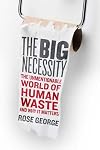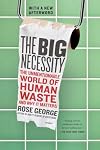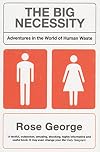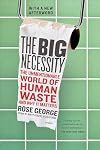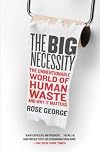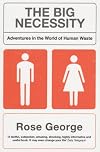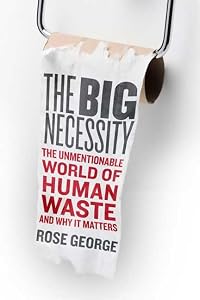
The Big Necessity
by Rose George
On This Page
Description
Human waste is a major public health threat: population growth is taxing even the most advanced sewage systems, and the disease spread by waste kills more people worldwide every year than any other single cause of death. Even in America, 1.95 million people have no access to an indoor toilet. Yet the subject remains unmentionable. The Big Necessity takes aim at the taboo, revealing everything that matters about how people do--and don't--deal with their own waste. George also explores the show more infrastructure disasters waiting to happen and the potential saviors: from China's five million biogas digesters to the U.S. Army's personal lasers used by soldiers to zap their feces in the field. show lessTags
Recommendations




















Member Recommendations
2wonderY Steinfeld's book has more facts and examples. George's book spends more time with the human part of the story, with lots of discussion about community acceptance of particular methods of waste disposal.
Member Reviews
As a typical Westerner ( I think) I had never thought about dirty latrines, or even "bush squatting" as anything more than a nasty inconvenience of traveling in developing countries. But George points out the great hazards to human health posed by ...poop. While the tone is often humorous, the subject is serious, and George provides an easy to read, interesting overview of the problems of human waste and safe drinking water. She visits India, China and Tanzania, among other places, to describe and analyze a variety of attempted solutions. The general conclusion of the book seems to be that this is a problem we can't afford to ignore, but that may have differing solutions in different places. Our Western solution (which is currently seen show more as the "gold standard") of washing waste away by mixing it with clean drinking water, seems wasteful to me after reading about the variety of other options being explored. show less
Rating: 4.75* of five
The Book Report: The crapper. The toilet. The convenience. The Porcelain God. Of them all, it's the last one that's the most correct. We should worship the waste-disposal vessel in every American home, because it and the infrastructure that supports it, invisibly to the end users, make modern life as clean, comfortable, and healthy as possible.
Rose George has done us all the service of surveying the world's various systems and non-systems of waste disposal. She reports from the front lines of poop removal all over the planet, and let me just say that, after reading her reports, I am profoundly grateful to her that I now know what I do, without having to go and see and experience and smell all the things she did.
An show more entire caste of women exist in India who make a living scooping poop. Not dog poop, either. A whole continent, Africa, has dams and irrigation canals and other water control systems, and vanishingly small numbers of waste-disposal plants; water-borne illnesses, usually code for “fecal bacteria contaminated water”, kill millions there.
Aid donors don't want to pay for sewerage systems. Not glamourous enough. Local authorities don't know what to demand. The populace doesn't know there's another possibility. So generation after generation after generation gets sick, most often dies young, and all for the lack of a few lousy billions spent on treating human waste.
Billions, to a country like this one with an annual income in the multi-trillions, ought not to be a big deal. Wouldn't be, either, if we hadn't spent several trillion bombing people who did nothing at all to us. Had to use the Chinese sugar daddy's credit card to do it, too. Now our grandkids will be lucky if they get clean water, since the asshole elite spent all that borrowed money on doing nothing worthwhile.
My Review: Oh dear, I'm off on my anti-conservative ranting again. Sorry. This book made me madder'n a swatted wasp. It makes me want to hurl when I read about the idiot Wall Street banks and bankers whimpering about their taxes, and how poorly they're spent on things like roads and bridges and health care and schools. Next up, and I am dead serious about this, next up is clean water. Privatize it, like the English did! Like we did with cable and phones! (How much more do you spend now on your phone than you did 30 years ago? I found an old bill from May 1984...$25. Now, over $200. Inflation doesn't account for but about half that increase.)
So when dysentery carries off your 90-year-old mother or your grandbaby, conservative voters, do not even think about complaining. YOU DID IT. show less
The Book Report: The crapper. The toilet. The convenience. The Porcelain God. Of them all, it's the last one that's the most correct. We should worship the waste-disposal vessel in every American home, because it and the infrastructure that supports it, invisibly to the end users, make modern life as clean, comfortable, and healthy as possible.
Rose George has done us all the service of surveying the world's various systems and non-systems of waste disposal. She reports from the front lines of poop removal all over the planet, and let me just say that, after reading her reports, I am profoundly grateful to her that I now know what I do, without having to go and see and experience and smell all the things she did.
An show more entire caste of women exist in India who make a living scooping poop. Not dog poop, either. A whole continent, Africa, has dams and irrigation canals and other water control systems, and vanishingly small numbers of waste-disposal plants; water-borne illnesses, usually code for “fecal bacteria contaminated water”, kill millions there.
Aid donors don't want to pay for sewerage systems. Not glamourous enough. Local authorities don't know what to demand. The populace doesn't know there's another possibility. So generation after generation after generation gets sick, most often dies young, and all for the lack of a few lousy billions spent on treating human waste.
Billions, to a country like this one with an annual income in the multi-trillions, ought not to be a big deal. Wouldn't be, either, if we hadn't spent several trillion bombing people who did nothing at all to us. Had to use the Chinese sugar daddy's credit card to do it, too. Now our grandkids will be lucky if they get clean water, since the asshole elite spent all that borrowed money on doing nothing worthwhile.
My Review: Oh dear, I'm off on my anti-conservative ranting again. Sorry. This book made me madder'n a swatted wasp. It makes me want to hurl when I read about the idiot Wall Street banks and bankers whimpering about their taxes, and how poorly they're spent on things like roads and bridges and health care and schools. Next up, and I am dead serious about this, next up is clean water. Privatize it, like the English did! Like we did with cable and phones! (How much more do you spend now on your phone than you did 30 years ago? I found an old bill from May 1984...$25. Now, over $200. Inflation doesn't account for but about half that increase.)
So when dysentery carries off your 90-year-old mother or your grandbaby, conservative voters, do not even think about complaining. YOU DID IT. show less
My cousin A. (who is a kind and generous person, a sterling example of the apple falling far, far away from the family tree) once complimented me on my willingness to address problems. Well, I said, what gets done when we ignore things?
This book makes me feel like I've spent my life willfully blind. HOW IS IT THAT I'VE NEVER THOUGHT ABOUT POO?
Sad-faced celebrities talk about helping people obtain access to water and helping girls get menstrual supplies so they can go to school -- what they mean (sayeth George) is that the girls' school toilets are filled with shit. There is shit on the floor and shit in the sinks; plastic bags are available for wiping, and the bags are left in a pile. This isn't about lazy people who can't be bothered show more to flush, it's a structural problem: almost no one has a flush toilet. Hundreds of thousands of people use latrines. The unlucky people use a bucket. The really unfortunate don't have that much.
People don't like talking about shit. It's gross and it smells bad and it's embarrassing. So until very recently, there existed no global organization to deal hands-on (as it were) with our global problem -- which makes things worse. Human shit brings disease: cholera, dysentery, typhus, worms of all sorts. I mean, you know about Typhoid Mary; she inadvertently killed any number of people because she had crappy (sorry) toilet access. (And then she was locked up for the rest of her life, a convenient scapegoat for a problem she hadn't really caused, and couldn't fix.)
Cleaning up human shit is human work. Specifically, it is women's work. (Even in our first-world countries, yes. Who changes the most diapers? Who cleans the most bedpans?) My cold, jaded heart feels a sneaking suspicion that the sexism in the division of labor, moreso than the act of the labor itself, is the real reason why shit is shameful, hidden, unspeakable, and ignored in favor of "more important" topics. But what is more important than the basics (she asks, rhetorically)? And how much more basic than shit can you get?
We're embarrassed to talk about it. Maybe we should be embarrassed to ignore it. show less
This book makes me feel like I've spent my life willfully blind. HOW IS IT THAT I'VE NEVER THOUGHT ABOUT POO?
Sad-faced celebrities talk about helping people obtain access to water and helping girls get menstrual supplies so they can go to school -- what they mean (sayeth George) is that the girls' school toilets are filled with shit. There is shit on the floor and shit in the sinks; plastic bags are available for wiping, and the bags are left in a pile. This isn't about lazy people who can't be bothered show more to flush, it's a structural problem: almost no one has a flush toilet. Hundreds of thousands of people use latrines. The unlucky people use a bucket. The really unfortunate don't have that much.
People don't like talking about shit. It's gross and it smells bad and it's embarrassing. So until very recently, there existed no global organization to deal hands-on (as it were) with our global problem -- which makes things worse. Human shit brings disease: cholera, dysentery, typhus, worms of all sorts. I mean, you know about Typhoid Mary; she inadvertently killed any number of people because she had crappy (sorry) toilet access. (And then she was locked up for the rest of her life, a convenient scapegoat for a problem she hadn't really caused, and couldn't fix.)
Cleaning up human shit is human work. Specifically, it is women's work. (Even in our first-world countries, yes. Who changes the most diapers? Who cleans the most bedpans?) My cold, jaded heart feels a sneaking suspicion that the sexism in the division of labor, moreso than the act of the labor itself, is the real reason why shit is shameful, hidden, unspeakable, and ignored in favor of "more important" topics. But what is more important than the basics (she asks, rhetorically)? And how much more basic than shit can you get?
We're embarrassed to talk about it. Maybe we should be embarrassed to ignore it. show less
This is a book about shit. (Sorry, but one of the author's key points is that we are all too embarrassed to talk seriously about this important topic, and that includes footling about with words like 'waste' and 'excrement').
I read it on the recommendation of a friend, and I'm glad I did. At first, I thought it was going to weigh in on the quirky-amusing end of the spectrum, with chapters about the London and New York sewers and the amazingly high-tech Japanese toilet industry, but gradually the book gets more serious - and the reader gets more concerned.
The key fact is that 2.6 billion people worldwide have no access to sanitation. And that does not mean that they have a long-drop or a bucket - it means that they have to shit on waste show more ground, or in a plastic bag. And yet sanitation is one of the lowest-priority development issues - there's plenty of focus on supplying clean water, but not on the thing that makes it dirty. (As George points out, 'water-borne diseases' is really a euphemism for 'excrement-borne diseases').
George finds some encouraging stories - mainly grassroots projects which are having a positive impact. But these are small-scale and outweighed by the shocking and depressing aspects of the book (say, India's caste of "manual scavengers" whose job is to pick up other people's shit, or the health impact of the US farming industry's use of untreated industrial waste).
And yet, I would describe this as an enjoyable read as well as an important one. I don't know how Rose George manages to maintain both a light tone and a clear sense of injustice. But she does, and the result is highly recommended - I'll certainly be giving copies to many of my friends. show less
I read it on the recommendation of a friend, and I'm glad I did. At first, I thought it was going to weigh in on the quirky-amusing end of the spectrum, with chapters about the London and New York sewers and the amazingly high-tech Japanese toilet industry, but gradually the book gets more serious - and the reader gets more concerned.
The key fact is that 2.6 billion people worldwide have no access to sanitation. And that does not mean that they have a long-drop or a bucket - it means that they have to shit on waste show more ground, or in a plastic bag. And yet sanitation is one of the lowest-priority development issues - there's plenty of focus on supplying clean water, but not on the thing that makes it dirty. (As George points out, 'water-borne diseases' is really a euphemism for 'excrement-borne diseases').
George finds some encouraging stories - mainly grassroots projects which are having a positive impact. But these are small-scale and outweighed by the shocking and depressing aspects of the book (say, India's caste of "manual scavengers" whose job is to pick up other people's shit, or the health impact of the US farming industry's use of untreated industrial waste).
And yet, I would describe this as an enjoyable read as well as an important one. I don't know how Rose George manages to maintain both a light tone and a clear sense of injustice. But she does, and the result is highly recommended - I'll certainly be giving copies to many of my friends. show less
This is a book about shit, the author's preferred term since etymologically it is the only term that uses no euphemism. While someone like Mary Roach would find humor in a global expose on human waste and toilets, George is serious about the deleterious effects of tens of millions of people in the world lacking sanitation. George tours the decaying sewers of London and New York, and learns more about Japan's toilets that wash and dry the users bottom (which despite being though of as needlessly luxurious in the West are actually better for health, cleanliness and the environment than wiping with paper). The crux of this book is the developing world, places like China, India, South Africa and Tanzania where there are stories of using show more waste as biogas, attempts to shame people for open defecation, and the uphill battle of charitable organizations to develop proper sanitation for all in a world that would rather not discuss such things. This book is at times difficult to read, but I think it's an important investigation into a topic we can't ignore. show less
This ebook was full of astonishing information that was occasionally dull (I didn't care about the fancy toilets being designed in Japan, so 4 stars there) and often fascinating (like the amount of feces deposited on city roadsides in some countries, so 5 stars there).
One fact that stays with me -- In the U.S. and other developed countries, sewage treatment plants (which, BTW, require a lot of energy) are designed with an overflow basin to contain runoff during the occasional hard rain. Unfortunately, this design does not work for the constant heavy rains we have now during climate change. Any flood is certain to contain raw sewage. So this problem is not confined to developing countries.
Another bugaboo: the "biosolids" or "sludge" show more produced by by waste water treatment plants seemed like a great fertilizer at first. But maybe not, as it contains many pollutants, including heavy metals, PCBs, and residues of prescription medications, chemicals in shampoos, etc. And people who live near the fields where sludge is applied are having a significant increase in health challenges. Still, sludge application is still legal in most places, including on food crops.
One error by the author -- Ascaris lumbricoides (roundworms) are not called "ringworm" which is not a worm at all, but a fungal infection on the skin easily spread by in infected animal or person. I'm quite familiar with both. (And I won't say how!)
I'm surprised the author only mentioned composting at the end but in no detail. The book The Humanure Handbook, by Joseph C. Jenkins published in 1996, goes into detail about the many things that can be composted, including a dead horse if your pile is big enough.
This book is hugely important for all of us (now) 8 billion people and counting. show less
One fact that stays with me -- In the U.S. and other developed countries, sewage treatment plants (which, BTW, require a lot of energy) are designed with an overflow basin to contain runoff during the occasional hard rain. Unfortunately, this design does not work for the constant heavy rains we have now during climate change. Any flood is certain to contain raw sewage. So this problem is not confined to developing countries.
Another bugaboo: the "biosolids" or "sludge" show more produced by by waste water treatment plants seemed like a great fertilizer at first. But maybe not, as it contains many pollutants, including heavy metals, PCBs, and residues of prescription medications, chemicals in shampoos, etc. And people who live near the fields where sludge is applied are having a significant increase in health challenges. Still, sludge application is still legal in most places, including on food crops.
One error by the author -- Ascaris lumbricoides (roundworms) are not called "ringworm" which is not a worm at all, but a fungal infection on the skin easily spread by in infected animal or person. I'm quite familiar with both. (And I won't say how!)
I'm surprised the author only mentioned composting at the end but in no detail. The book The Humanure Handbook, by Joseph C. Jenkins published in 1996, goes into detail about the many things that can be composted, including a dead horse if your pile is big enough.
This book is hugely important for all of us (now) 8 billion people and counting. show less
Doing research for my historical hygiene pamphlet led me down a wide variety of fascinating byways-- or should I say drains? So when I heard about this modern treatment of the topic, I had to read it.
It's worth it.
George covers the sewers of London, the World Toilet Organization, Biogas systems in China (where human and animal manure is composted together to produce burnable fuel gas for the rural family's home), the Japanese ultra-specialized toilet industry, sanitation efforts in less-developed countries including the problem of societies where "open defecation" prevails as well as "helicopter toilets" (where people eliminate into a plastic bag and throw it somewhere...), the processing of 'biosolids' (sewage sludge) into fertilizer show more and its benefits and dangers, among other topics.
While I'm lukewarm about her topical organization, I think that George's big strength is her amusing and sharp writing combined with a flair for the personality and the anecdote, which she finds in abundance here. From the founder of the World Toilet organization, through specific biogas-using Chinese ladies, there's an abundance of personalities here. There's also a lot of controversy, which George does not avoid.
What she does do is present both sides of most topics-- talking to the enthusiastic head of a highly scientific, class-A+ biosolids producing facility and on the other hand, a campaigning, anti-sludge activist who has documented hundreds of sludge related illnesses in her community and elsewhere, for instance-- first you find yourself all pro-biosolids and then pulled back into caution. I for one will never walk near what looks like a sewerpipe or a commercially fertilized field with the same insouciance again.
She also discusses the shame and the social constructs of human waste, and how they affect the way societies address the issue. (It's fascinating to learn tidbits such as the report that mothers asked to rate the offensiveness of several unlabelled dirty diapers indentified their own baby's as less disgusting.) This too has a serious side, of course, because that's how the problem of human waste goes unaddressed. Apocalyptic thinkers may ask themselves how long public investment averse communities (like, say, California and New Jersey) can avoid the fate of cholera-ridden Zimbabwe if all goes to heck. Development loving liberals will wonder what we can do to make conditions better, and the green treehuggers will wonder if we can make things better for the environment. Business and politics types may enjoy the profiles of marketing and planning successes and fiascos, though engineers will probably feel there is in no way enough detail.
Definitely worth reading, and not just in the bathroom.
Slate posted excerpts from this book at: http://www.slate.com/id/2201466/entry/2201467/
Rose George has a blog at: http://rosegeorge.com/site/category/blog/ show less
It's worth it.
George covers the sewers of London, the World Toilet Organization, Biogas systems in China (where human and animal manure is composted together to produce burnable fuel gas for the rural family's home), the Japanese ultra-specialized toilet industry, sanitation efforts in less-developed countries including the problem of societies where "open defecation" prevails as well as "helicopter toilets" (where people eliminate into a plastic bag and throw it somewhere...), the processing of 'biosolids' (sewage sludge) into fertilizer show more and its benefits and dangers, among other topics.
While I'm lukewarm about her topical organization, I think that George's big strength is her amusing and sharp writing combined with a flair for the personality and the anecdote, which she finds in abundance here. From the founder of the World Toilet organization, through specific biogas-using Chinese ladies, there's an abundance of personalities here. There's also a lot of controversy, which George does not avoid.
What she does do is present both sides of most topics-- talking to the enthusiastic head of a highly scientific, class-A+ biosolids producing facility and on the other hand, a campaigning, anti-sludge activist who has documented hundreds of sludge related illnesses in her community and elsewhere, for instance-- first you find yourself all pro-biosolids and then pulled back into caution. I for one will never walk near what looks like a sewerpipe or a commercially fertilized field with the same insouciance again.
She also discusses the shame and the social constructs of human waste, and how they affect the way societies address the issue. (It's fascinating to learn tidbits such as the report that mothers asked to rate the offensiveness of several unlabelled dirty diapers indentified their own baby's as less disgusting.) This too has a serious side, of course, because that's how the problem of human waste goes unaddressed. Apocalyptic thinkers may ask themselves how long public investment averse communities (like, say, California and New Jersey) can avoid the fate of cholera-ridden Zimbabwe if all goes to heck. Development loving liberals will wonder what we can do to make conditions better, and the green treehuggers will wonder if we can make things better for the environment. Business and politics types may enjoy the profiles of marketing and planning successes and fiascos, though engineers will probably feel there is in no way enough detail.
Definitely worth reading, and not just in the bathroom.
Slate posted excerpts from this book at: http://www.slate.com/id/2201466/entry/2201467/
Rose George has a blog at: http://rosegeorge.com/site/category/blog/ show less
Members
- Recently Added By
Lists

Unshelved Book Clubs
579 works; 5 members
Author Information

3+ Works 1,221 Members
Awards and Honors
Distinctions
Common Knowledge
- Canonical title
- The Big Necessity
- Original publication date
- 2008
- Important places
- Sewers, London, England, UK; Mumbai, Tamil Nadu, India; China
- Epigraph
- Like an apartment where there's a kitchen, bedroom, bathroom. People see that and they want the same for themselves, a bigger house with different rooms for everything. They can't have all that so they get the big necessity,... (show all) a toilet.
-Sheik Razak, slum toilet builder, Mumbai - Dedication
- For T D W George, for the introduction.
- First words
- I need the toilet.
- Last words
- (Click to show. Warning: May contain spoilers.)And the young man nodded and moved away with no further questions.
- Blurbers
- Roach, Mary; Winchester, Simon; Davis, Mike; Boorstin, Louis; Margonelli, Lisa
- Disambiguation notice
- From the author's web site:
The Big Necessity: Adventures in the World of Human Waste will be published in the UK by... (show all) Portobello Books on September 11, 2008.
The Big Necessity: The Unmentionable World of Human Waste and Why it Matters will be published in the US by Metropolitan Books on October 14, 2008.
Classifications
- Genres
- Nonfiction, General Nonfiction, Science & Nature
- DDC/MDS
- 363.72 — Society, Government, and Culture Social problems and social services Public Safety - Police, Crime Investigation Environmental Issues - Pollution, Recycling, Global Warming Sanitation - Waste control, recycling
- LCC
- RA567 .G46 — Medicine Public aspects of medicine Public aspects of medicine Public health. Hygiene. Preventive medicine Environmental health
- BISAC
Statistics
- Members
- 637
- Popularity
- 45,223
- Reviews
- 35
- Rating
- (4.05)
- Languages
- English, French, Spanish
- Media
- Paper, Audiobook, Ebook
- ISBNs
- 12
- ASINs
- 9