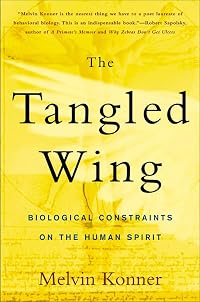
The Tangled Wing: Biological Constraints on the Human Spirit
by Melvin Konner
On This Page
Description
A vital updating of a seminal work of science First published to great acclaim twenty years ago, T"he Tangled Wing" has become required reading for anyone interested in the biological roots of human behavior. Since then, revolutions have taken place in genetics, molecular biology, and neuroscience. All of these innovations have been brought into account in this greatly expanded edition of a book originally called an "overwhelming achievement" by "The Times Literary Supplement," A masterful show more synthesis of biology, psychology, anthropology, and philosophy, "The Tangled Wing" reveals human identity and activity to be an intricately woven fabric of innumerable factors. Melvin Konner's sensitive and straightforward discussion ranges across topics such as the roots of aggression, the basis of attachment and desire, the differences between the sexes, and the foundations of mental illness. show lessTags
Recommendations










Member Reviews
Members
- Recently Added By
Author Information

15 Works 1,248 Members
Melvin Konner is the Samuel Candler Dobbs Professor of Anthropology and an associate professor and neurology at Emory University. A Fellow o f the American Association for the Advancement of Science, he lives in Atlanta.
Awards and Honors
Awards
Common Knowledge
- Canonical title
- The Tangled Wing: Biological Constraints on the Human Spirit
- Original publication date
- 1982
- People/Characters
- A. J. Ayer; John Bowlby; Paul Broca; Houston Stuart Chamberlain; Noam Chomsky; Robert Coles (show all 22); Richard Dawkins; Émile Durkheim; Friedrich Engels; Sigmund Freud; Søren Kierkegaard; Jean Baptiste Lamarck; Louis Leakey; Konrad Lorenz; Andre Malraux; Karl Marx; Rousseau, Jean-Jacques, 1712-1778; Alfred Russel Wallace; Carl Wernicke; John Watson; E. O. Wilson; Jane Goodall
- Epigraph
- All bibles or sacred codes have been the causes of the following errors:
1. That man has two real existing principles: viz: a body & a soul.
2. That energy, called evil, is alone from the body: & that reason, ca... (show all)lled good, is alone from the soul.
3. That God will torment man in eternity for following his energies.
But the following contraries to these are true:
1. Man has no body distinct from his soul; for that called body is a portion of soul discerned by the five senses, the chief inlets of soul in this age.
2, Energy is the only life, and is from the body; and reason is the bound or outward circumferance of energy.
3. Energy is eternal delight.
-- William Blake, "The Marriage of Heaven and Hell," 1790 - Dedication
- To Herbert Perluck and Irven DeVore, and to the memory of Doctor Julian Gomez
- First words
- Why we are what we are, why we do what we do, why we feel what we feel; thse questions have been on the minds of philosophers and theologians, medical men and medicine men, actors, diplomats, poets and, of course, scientists,... (show all) beginning with the first glimmer of human thought itself. (A Prefatory Inquiry)
Rousseau was not the first, nor even, probably, the most naive. - Last words
- (Click to show. Warning: May contain spoilers.)It is for us, with all our stumbling, and in the midst of our dreadful confusion, to try to disengage the tangled wing.
- Publisher's editor
- Marian Wood; Jill Weinstein
Classifications
Statistics
- Members
- 347
- Popularity
- 91,471
- Reviews
- 1
- Rating
- (3.98)
- Languages
- English, Italian
- Media
- Paper
- ISBNs
- 10
- ASINs
- 6