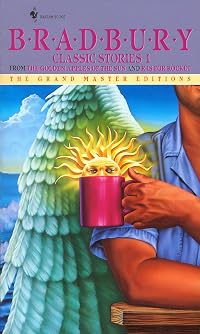
Bradbury Classic Stories 1: From the Golden Apples of the Sun and R Is for Rocket (Grand Master Editions)
by Ray Bradbury
On This Page
Description
A collection of thirty-two classic stories of fantasy and science fiction.Tags
Recommendations















Member Reviews
I was looking for something in classic science fiction, and I settled on Ray Bradbury. He’s not purely science fiction, but it was a great (and lucky) choice.
These are stories taken from two earlier published collections — The Golden Apples of the Sun (first published in 1953) and R is for Rocket (first published in 1962).
Eighteen stories from The Golden Apples of the Sun make up the first 160 or so pages. These are not heavily slanted toward science fiction per se, but more toward what you could call “imaginative fiction.” They pre-date the “space age” itself and reflect a post-war world of technological change, weaponry and power on a new scale, and a kind of Bradbury-like slipperiness to the ordinary and everyday.
They show more also reflect 50s style social mores. In The Wilderness, a woman decides whether to join her husband as pioneers on Mars. The pioneering effort mirrors the family life of the time, with the husband striking out, building a house and a place for his wife and family to follow. And we can’t help but also notice, in this and other stories, the extension of the “pioneer spirit” from the settling of the American West to the settling of the other planets of the solar system. Of course we will be going, and of course we will be living in some way there as we have lived here on Earth, in America.
This was definitely a different time. The terrors of the bomb are mellowed by a kind of manifest destiny pertaining to the universe and an optimism about human relationships. — in some stories, I confess I was waiting for the ax to fall on trust and compassion, in keeping with a more paranoid, dystopian time. But the ax rarely falls.
There are fourteen stories from R is for Rocket, making up about 180 pages. Like those from The Golden Apples of the Sun, they tend to be short stories, 10 pages or so, sometimes even less. Many are just vignettes. The one longer story, Frost and Fire, may have grabbed me the least, with its depiction of accelerated life on a planet beset by extremes of temperature.
The title story, R is for Rocket, along with several others, vividly recalls a time when rockets were magical but believable technologies. There was a logic. We were conquering space. We would reach the Moon, and it would be a stepping stone to the other planets of the solar system, which in turn would be stepping stones to other systems. It was all imaginable and seemed like it was really going to happen. We didn’t think about the distances, how close the Moon and how far the stars. We weren’t thinking that way — it was just the logic of the space age, making stories of exploring and colonizing planets feel like our future.
And “rocket men” would lead the way. As in the story R is for Rocket, there could be no higher calling. The stars would draw us to them, sometimes maybe even a bit too much, as in The Rocket Man.
This is definitely a book that reflects its time. And I enjoyed it that way, reminding me that there was a time when we were excited about the magic of space and exploration, and about a life in general that held so many possibilities. show less
These are stories taken from two earlier published collections — The Golden Apples of the Sun (first published in 1953) and R is for Rocket (first published in 1962).
Eighteen stories from The Golden Apples of the Sun make up the first 160 or so pages. These are not heavily slanted toward science fiction per se, but more toward what you could call “imaginative fiction.” They pre-date the “space age” itself and reflect a post-war world of technological change, weaponry and power on a new scale, and a kind of Bradbury-like slipperiness to the ordinary and everyday.
They show more also reflect 50s style social mores. In The Wilderness, a woman decides whether to join her husband as pioneers on Mars. The pioneering effort mirrors the family life of the time, with the husband striking out, building a house and a place for his wife and family to follow. And we can’t help but also notice, in this and other stories, the extension of the “pioneer spirit” from the settling of the American West to the settling of the other planets of the solar system. Of course we will be going, and of course we will be living in some way there as we have lived here on Earth, in America.
This was definitely a different time. The terrors of the bomb are mellowed by a kind of manifest destiny pertaining to the universe and an optimism about human relationships. — in some stories, I confess I was waiting for the ax to fall on trust and compassion, in keeping with a more paranoid, dystopian time. But the ax rarely falls.
There are fourteen stories from R is for Rocket, making up about 180 pages. Like those from The Golden Apples of the Sun, they tend to be short stories, 10 pages or so, sometimes even less. Many are just vignettes. The one longer story, Frost and Fire, may have grabbed me the least, with its depiction of accelerated life on a planet beset by extremes of temperature.
The title story, R is for Rocket, along with several others, vividly recalls a time when rockets were magical but believable technologies. There was a logic. We were conquering space. We would reach the Moon, and it would be a stepping stone to the other planets of the solar system, which in turn would be stepping stones to other systems. It was all imaginable and seemed like it was really going to happen. We didn’t think about the distances, how close the Moon and how far the stars. We weren’t thinking that way — it was just the logic of the space age, making stories of exploring and colonizing planets feel like our future.
And “rocket men” would lead the way. As in the story R is for Rocket, there could be no higher calling. The stars would draw us to them, sometimes maybe even a bit too much, as in The Rocket Man.
This is definitely a book that reflects its time. And I enjoyed it that way, reminding me that there was a time when we were excited about the magic of space and exploration, and about a life in general that held so many possibilities. show less
This is one of two books that introduced me to the short stories of Ray Bradbury. An excellent collection of earlier stories, it's hard not to find something in this book that speaks to you. A few of the stories that stand out immediately are The Fog Horn, in which a lighthouse is visited by a sea monster, attracted by the sound of,well, a fog horn. It evokes such a feeling of loneliness and alienation, it stays with the reader long after closing the book. A Sound of Thunder is another standout, and is often credited with inspiring the term 'the butterfly effect,' in which a small action by a time traveller visiting the past can have enormous repercussions in the present. One of my favorites in the collection is The Fruit at the Bottom show more of the Bowl, a darkly humorous story that one could imagine being adapted as an episode of Alfred Hitchcock Presents.
It would be silly for me to mention every story in the book in this review, but there are thirty-two of the best short stories of the twentieth century contained within those pages. Any fan of Ray Bradbury would be remiss in overlooking this collection. show less
It would be silly for me to mention every story in the book in this review, but there are thirty-two of the best short stories of the twentieth century contained within those pages. Any fan of Ray Bradbury would be remiss in overlooking this collection. show less
A retrospective of the most well-known of Bradbury's early stories, this collection includes several classics, a few clunkers and a handful of surprising gems. Bradbury switches genres with ease, dabbling in science fiction, horror, fantasy and general fiction with ease.
"A Sound of Thunder" is the most well known story here, a tale of time travel and its possible consequences on the present. Many of the stories, especially those selected from his earlier collection R is for Rocket, center on a quaint notion of space travel. These tend to have not aged well.
My personal favorite was "Frost and Fire", a tale of a group of humans stranded on a Mercury-like planet; due to the intense heat of daytime and the subzero temperatures at night, show more they can only venture out of their caves at dawn and dusk for an hour each time. Due to the planet's proximity to its star, the radiation has altered their metabolism so that their lifespan lasts 8 days; in those 8 days they experience birth, childhood, adolescence, young adulthood, adulthood, middle age, old age and death. One young man attempts to escape the planet and its 8 day death sentence.
Overall, even the less refined stories deserve a perusal as Bradbury turns a phrase like few other writers. show less
"A Sound of Thunder" is the most well known story here, a tale of time travel and its possible consequences on the present. Many of the stories, especially those selected from his earlier collection R is for Rocket, center on a quaint notion of space travel. These tend to have not aged well.
My personal favorite was "Frost and Fire", a tale of a group of humans stranded on a Mercury-like planet; due to the intense heat of daytime and the subzero temperatures at night, show more they can only venture out of their caves at dawn and dusk for an hour each time. Due to the planet's proximity to its star, the radiation has altered their metabolism so that their lifespan lasts 8 days; in those 8 days they experience birth, childhood, adolescence, young adulthood, adulthood, middle age, old age and death. One young man attempts to escape the planet and its 8 day death sentence.
Overall, even the less refined stories deserve a perusal as Bradbury turns a phrase like few other writers. show less
When I found out Ray Bradbury died back in June, I was admittedly heartbroken. He was one of my first introductions to sci-fi, and aside from one book, I’ve always enjoyed his work. (Still not a fan of Something Wicked This Way Comes.) But admittedly, I haven’t read very much from Bradbury so I quickly rectified this.
So I picked up this collection, notably containing “The Fog Horn” and “A Sound of Thunder,” to help bolster my collection. And I did like this collection. The both halves of the book contain more introspective slice-of-life tales that do take a darker look at the nostalgic days of childhood that Bradbury really likes (particularly with “I See You Never” and “The Big Black and White Game”) as well as show more genre-defying tales (STRONG reads for “The Golden Kite, the Silver Wind,” “Embroidery” and “The Exiles.”) And yet, there’s also ones that don’t work for me. (Like the aforementioned “A Sound of Thunder.” I know, classic but…I don’t know. Maybe because I know the twist already.)
That said, I do like this collection, and would give it a fair shot to anyone l think would like a quick handful of short reads. show less
So I picked up this collection, notably containing “The Fog Horn” and “A Sound of Thunder,” to help bolster my collection. And I did like this collection. The both halves of the book contain more introspective slice-of-life tales that do take a darker look at the nostalgic days of childhood that Bradbury really likes (particularly with “I See You Never” and “The Big Black and White Game”) as well as show more genre-defying tales (STRONG reads for “The Golden Kite, the Silver Wind,” “Embroidery” and “The Exiles.”) And yet, there’s also ones that don’t work for me. (Like the aforementioned “A Sound of Thunder.” I know, classic but…I don’t know. Maybe because I know the twist already.)
That said, I do like this collection, and would give it a fair shot to anyone l think would like a quick handful of short reads. show less
overall this was a great book. it's a collection which includes sci-fi, fantasy, and a couple regular fiction stories. a few of the stories were not to my liking so much but some of my favorites were The Fog Horn, The April Witch, The Fruit at the Bottom of the Bowl, The Murderer, Embroidery, Sun and Shadow, A Sound of Thunder, and The Exiles.
Ratings
Members
- Recently Added By
Lists

Books Read in 2018
4,360 works; 110 members
Author Information

940+ Works 168,427 Members
Ray Bradbury was born in Waukegan, Illinois on August 22, 1920. At the age of fifteen, he started submitting short stories to national magazines. During his lifetime, he wrote more than 600 stories, poems, essays, plays, films, television plays, radio, music, and comic books. His books include The Martian Chronicles, Fahrenheit 451, The show more Illustrated Man, Dandelion Wine, Something Wicked This Way Comes, and Bradbury Speaks. He won numerous awards for his works including a World Fantasy Award for Life Achievement in 1977, the 2000 National Book Foundation Medal for Distinguished Contribution to American Letters, the 2004 National Medal of Arts, and the 2007 Pulitzer Prize Special Citation. He wrote the screen play for John Huston's classic film adaptation of Moby Dick, and was nominated for an Academy Award. He adapted 65 of his stories for television's The Ray Bradbury Theater, and won an Emmy for his teleplay of The Halloween Tree. The film The Wonderful Ice Cream Suit was written by Ray Bradbury and was based on his story The Magic White Suit. He was the idea consultant and wrote the basic scenario for the United States pavilion at the 1964 World's Fair, as well as being an imagineer for Walt Disney Enterprises, where he designed the Spaceship Earth exhibition at Walt Disney World's Epcot Center. He died after a long illness on June 5, 2012 at the age of 91. (Bowker Author Biography) show less
Work Relationships
Contains
Common Knowledge
- Original publication date
- 1990
- Epigraph
- And this one, with love, is for Neva,
daughter of Glinda
the Good Witch of the south
_________________
. . . And pluck till time and times are done
The silver apples of the moon,
The golden apples of the... (show all) sun.
- W. B. Yeats - First words
- Out there in the cold water, far from land, we waited every night for the coming of the fog, and it came, and we oiled the brass machinery and lit the fog light up in the stone tower.
- Last words
- (Click to show. Warning: May contain spoilers.)Moving out of the blazing sun, walking softly, lightly, slowly, he headed back toward civilization.
- Original language
- English
Classifications
Statistics
- Members
- 639
- Popularity
- 45,398
- Reviews
- 5
- Rating
- (4.14)
- Languages
- English, Hungarian, Turkish
- Media
- Paper
- ISBNs
- 5
- UPCs
- 1
- ASINs
- 2