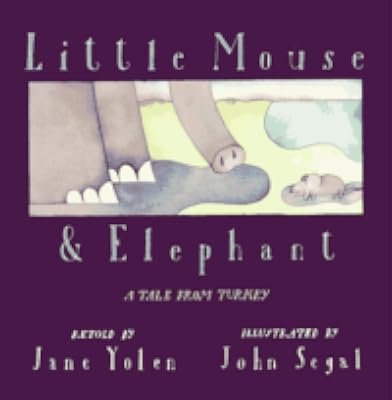
Little Mouse and Elephant: A Tale from Turkey
by Jane Yolen, John Segal (Illustrator)
On This Page
Description
Boastful Little Mouse sets out to show that he is stronger than anyone in the forest, even Elephant, and nothing that happens can change his opinion.Tags
Recommendations


Member Reviews
Little Mouse brags to everyone that he is the strongest animal around. His grandfather warns him to be cautious of his boasting, for fear that Elephant, master of the forest, will hear him. Having never seen Elephant, Little Mouse sets off to find Elephant and show him that he is the true master of the forest. When Little Mouse finally finds him, Elephant blows him away with water from his trunk. With his unfaltering prideful attitude, Little Mouse is convinced that it was just a strong storm and he is indeed still the strongest animal in the forest.
Little Mouse and Elephant starts off the way most tales do, making the reader aware that this is a story from the past by stating "there was once a mouse." For me, the lack of contractions show more in the characters' dialect really made a difference in the way I read the book. It made everything they said more matter of fact. The grandfather's wisdom is clearly conveyed through the way he speaks. Also, the way Little Mouse speaks shows not only how prideful he is, but how confident he is that he's right. show less
Little Mouse and Elephant starts off the way most tales do, making the reader aware that this is a story from the past by stating "there was once a mouse." For me, the lack of contractions show more in the characters' dialect really made a difference in the way I read the book. It made everything they said more matter of fact. The grandfather's wisdom is clearly conveyed through the way he speaks. Also, the way Little Mouse speaks shows not only how prideful he is, but how confident he is that he's right. show less
Little Mouse wants to believe that he is the strongest animal in the forest, but his grandfather disagrees and claims that the Elephant is, in fact, the strongest. With hopes of proving his grandfather wrong, the Little Mouse goes on a hunt for Elephant in the jungle. He comes across Lizard, Beetle, and Dog who all claim that they know who is master. Elephant washes Little Mouse away with one squirt of his trunk. Little Mouse, naïve and innocent as he is, thinks it was simply just a strong storm and still thinks himself to be strongest in the jungle.
Little Mouse and Elephant is about this puffed up mouse who thinks he is the master of the forest. His grandfather tells him the elephant is the master of the forest, but the mouse will not accept it. So, the mouse goes throughout the forest, running into animals asking if they are the elephant. Finally the mouse runs into the elephant and the elephant blows water out of his snout and walks away. The mouse thinks it was a storm and his still puffed up thinking he is the master of the forest. This is a cute, funny little folktale that would be fun to read to children, I can imagine putting on a little play in the classroom with the children.
Little Mouse thinks he is the strongest animal in the forest, but his grandfather tells him that he is wrong, Elephant is the srtongest in the jungle. So Little Mouse goes on a hunt for Elephant and runs into Lizard, Beetle, and Dog who all tell him they know who is master. In the end Elephant washes Little Mouse away with one squirt of his trunk. Little Mouse, with the mind he has, just thinks it was just a strong storm and he is still the strongest in the jungle. This could be used to tell students that no matter how big or small you really are, you can do whatever you set your mind to.
"Little Mouse and Elephant", is a tory which follows a pretentious mouse who believes he is the king of the forest, though warned by his Grandfather that the Elephant was the king of the forrest the mouse continued to speak in a boastful manner. Setting out on an adventure through the woods the mouse meets many animals asking if they are the elephant until he finally runs into the elephant. A great lesson about how arrogance can effect a person's outlook.
Little Mouse and Elephant: A Tale From Turkey is a story about a prideful and arrogant mouse who thinks that he is master of the forest. Children can learn about pride and arrogance from this book. They can also learn about trusting and believing in themselves to do any and everything they want.
Library Thing Part C # 6 Traditional Literature
Yolen, Jane, and John Segal. Little Mouse & Elephant: a Tale from Turkey. New York: Simon & Schuster for Young Readers, 1996. Print.
Little Mouse & Elephant is a small purple book, about 7’’ long and about 7.5” wide. It’s a nice size to hold and to carry in a book bag. Even though this book is small it does carry a heavy folktale and is told by practical animals and by one foolish mouse. The pattern of 3 is found in this folktale as the reader listens to Lizard, Beetle, and Dog politely answer little mouse’s question, “Are you Elephant?” Grandfather mouse tries to reason with little mouse’s boasting and pride but is not successful. He attempts to warn mouse about one of the show more largest animal’s in the land, but that only spurs the small mouse to challenge the elephant; an animal he has never seen but is sure he can conquer.
The folktale uses humor and contrast (huge elephant/tiny mouse) to teach one’s place, to teach respectfulness, and self-awareness through repetition. Each time mouse interacts with a creature he is demanding and insulting and believes his mere presence has caused the animal to leave, when really it was either thunder, lightening, or the master’s call, that caused them to hurry away. Eventually the mighty mouse bumps into elephant’s leg and has no sense of fear and believes he can still force the elephant to recognize his esteemed position in the land. Elephant can’t see him nor hear him very well, and elephant blows water in the direction of this little pest; all over mouse. Much to grandfather’s chagrin, mouse believes elephant was lucky that a storm had risen and saved elephant from the wrath of tiny mouse. The art work is in pastel colors with watercolor and plays an integral part of the text. Curriculum connection would be language arts, read aloud, and flannel board story time. I enjoyed this light hearted but perceptive study in character and must add it to my folktale collection.( audience prek-3rd grade) show less
Yolen, Jane, and John Segal. Little Mouse & Elephant: a Tale from Turkey. New York: Simon & Schuster for Young Readers, 1996. Print.
Little Mouse & Elephant is a small purple book, about 7’’ long and about 7.5” wide. It’s a nice size to hold and to carry in a book bag. Even though this book is small it does carry a heavy folktale and is told by practical animals and by one foolish mouse. The pattern of 3 is found in this folktale as the reader listens to Lizard, Beetle, and Dog politely answer little mouse’s question, “Are you Elephant?” Grandfather mouse tries to reason with little mouse’s boasting and pride but is not successful. He attempts to warn mouse about one of the show more largest animal’s in the land, but that only spurs the small mouse to challenge the elephant; an animal he has never seen but is sure he can conquer.
The folktale uses humor and contrast (huge elephant/tiny mouse) to teach one’s place, to teach respectfulness, and self-awareness through repetition. Each time mouse interacts with a creature he is demanding and insulting and believes his mere presence has caused the animal to leave, when really it was either thunder, lightening, or the master’s call, that caused them to hurry away. Eventually the mighty mouse bumps into elephant’s leg and has no sense of fear and believes he can still force the elephant to recognize his esteemed position in the land. Elephant can’t see him nor hear him very well, and elephant blows water in the direction of this little pest; all over mouse. Much to grandfather’s chagrin, mouse believes elephant was lucky that a storm had risen and saved elephant from the wrath of tiny mouse. The art work is in pastel colors with watercolor and plays an integral part of the text. Curriculum connection would be language arts, read aloud, and flannel board story time. I enjoyed this light hearted but perceptive study in character and must add it to my folktale collection.( audience prek-3rd grade) show less
Members
- Recently Added By
Lists

The Story of the World: Activity Book Three: Early Modern Times
191 works; 3 members
Author Information

660+ Works 104,230 Members
Jane Yolen was born February 11, 1939 in New York City. She received a bachelor's degree from Smith College in 1960 and a master's degree in education from the University of Massachusetts in 1976. After college, she became an editor in New York City and wrote during her lunch break. She sold her first children's book, Pirates in Petticoats, at the show more age of 22. Since then, she has written over 300 books for children, young adults, and adults. Her other works include the Emperor and the Kite, Owl Moon, How Do Dinosaurs Say Goodnight? and The Devil's Arithmetic. She has won numerous awards including the Kerlan Award, the Regina Medal, the Keene State Children's Literature Award, the Caldecott Medal, two Nebula Awards, two Christopher Medals, the World Fantasy Award, three Mythopoeic Fantasy Awards, the Golden Kite Award, the Jewish Book Award, the World Fantasy Association's Lifetime Achievement Award, and the Association of Jewish Libraries Award. (Bowker Author Biography) show less

Common Knowledge
- Original publication date
- 1994
- Dedication
- For Maddison Jane Piatt, a small book for small hands-J.Y.
To Emily, with love-J.S. - Quotations
- "What a storm!" said Little Mouse. "And it's mighty lucky for Elephant it came when it did. Otherwise I would have broken him to bits."
Classifications
Statistics
- Members
- 33
- Popularity
- 857,927
- Reviews
- 8
- Rating
- (3.63)
- Languages
- English
- Media
- Paper
- ISBNs
- 2
- ASINs
- 1