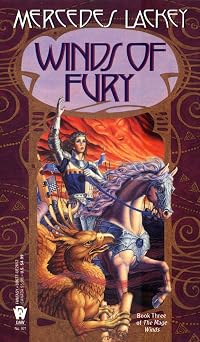
Winds of Fury
by Mercedes Lackey
Valdemar : Mage Winds Trilogy (3), Valdemar: Publication Order (12), Valdemar: Chronological Order (1403 AF)
On This Page
Description
Book Three of The Mage Winds trilogy. No longer the willful novice of Winds of Fate, Princess Herald Elspeth has completed her magical training. She returns to her homeland with her beloved partner Darkwind. Will they be strong enough to confront the magical evil that is threatening their land?Tags
Recommendations















Member Reviews
Winds of Fury is the third book in the Mage Winds trilogy, and is not only a satisfying but also quite creative and interesting conclusion to that part of Valdemar's history. The war with Ancar rages on, and the stakes are even higher now that, thanks to Ancar botching a spell, he has Falconsbane in his clutches and under magical coercions. Magic has returned to Valdemar and mages are being recruited from all over, and those with mage-potential are being looked for and trained. Everything's leading up to a battle between not only Valdemar and Ancar, but also Falconsbane, and Hulda, three of the most powerful and pissy people that Valdemar has had to deal with in an age.
That alone would be epic enough, but Lackey takes it a step further show more by giving us the character on An'desha, the man whose body Falconsbane took over and is currently inhabiting, and who is trapped in a tiny corner of Falconsbane's mind, his own personality intact but afraid. With the help of a little divine intervention, An'desha works to undermine Falconsbane's plans from the inside while the heroes of Valdemar can attack from the outside.
I've always had a fondness for stories involving trapped mental presences, other people dwelling in minds where normally there's just one personality present. (What can I say, MPD and DID have been pet interests of mine for a long while now.) An'desha appealed to me from the moment he was introduced for that reason alone, and that was just helped along when we got to see his backstory, find out how his body was taken over by Falconsbane/Ma'ar, and more interestingly, just how he managed to keep his own personality intact while quietly sharing headspace with an ancient psychopath.
If there's one thing about this book that irks me, though, it was actually the divine intervention that did it. I have no problem with deities showing their hands, but I have to admit that some things seemed a little bit like a cop-out. Avatars assisting someone, fine. But the goddess reaching down and undoing most of the physical changes that were done to both An'desha and Nyara so that they no longer looked so inhuman seemed like things were being tied up too neatly. A good chunk of the Valdemar books stress that actions have consequences, but that's just undone by admitting that sometimes your gods will step in and remove the consequences or the difficulties just because they feel like it. I'm not saying that An'desha and Nyara didn't deserve pity for what had been done to them. It's more like I'm saying it would have been far more interesting to see them continue to cope with what they had, come to grips with it, and moved beyond it. If you're looking for inspiration in characters, removing their problems rather than having them get past their problems takes away that which could be incredibly inspirational.
It also raises questions. Why didn't the goddess step in earlier and remove Falconsbane's coercions from Starblade? Why didn't she show up and smack Ma'ar down in one of his previous incarnations? Why use that great power for aesthetics? It would give An'desha and Nyara some comfort, no doubt, and was a nice reward for all that they had done to bring Falconsbane down, but it seemed rather arbitrary.
Aside from playing the deity card, this book was quite enjoyable, and a fitting end to the trilogy. It closes off that arc of the story nicely while still leaving some tantalising unanswered questions. If I didn't know there were books in the series after this, I'd be able to make a pretty good guess that there would be at least one set soon after. (As it turns out, there's another trilogy, which I will be getting to shortly.) Good Valdemaran fun, and this is pretty much where we get to see what I would consider the height of Lackey's stylistic development in the Valdemar novels. Definitely interesting to see that progression. show less
That alone would be epic enough, but Lackey takes it a step further show more by giving us the character on An'desha, the man whose body Falconsbane took over and is currently inhabiting, and who is trapped in a tiny corner of Falconsbane's mind, his own personality intact but afraid. With the help of a little divine intervention, An'desha works to undermine Falconsbane's plans from the inside while the heroes of Valdemar can attack from the outside.
I've always had a fondness for stories involving trapped mental presences, other people dwelling in minds where normally there's just one personality present. (What can I say, MPD and DID have been pet interests of mine for a long while now.) An'desha appealed to me from the moment he was introduced for that reason alone, and that was just helped along when we got to see his backstory, find out how his body was taken over by Falconsbane/Ma'ar, and more interestingly, just how he managed to keep his own personality intact while quietly sharing headspace with an ancient psychopath.
If there's one thing about this book that irks me, though, it was actually the divine intervention that did it. I have no problem with deities showing their hands, but I have to admit that some things seemed a little bit like a cop-out. Avatars assisting someone, fine. But the goddess reaching down and undoing most of the physical changes that were done to both An'desha and Nyara so that they no longer looked so inhuman seemed like things were being tied up too neatly. A good chunk of the Valdemar books stress that actions have consequences, but that's just undone by admitting that sometimes your gods will step in and remove the consequences or the difficulties just because they feel like it. I'm not saying that An'desha and Nyara didn't deserve pity for what had been done to them. It's more like I'm saying it would have been far more interesting to see them continue to cope with what they had, come to grips with it, and moved beyond it. If you're looking for inspiration in characters, removing their problems rather than having them get past their problems takes away that which could be incredibly inspirational.
It also raises questions. Why didn't the goddess step in earlier and remove Falconsbane's coercions from Starblade? Why didn't she show up and smack Ma'ar down in one of his previous incarnations? Why use that great power for aesthetics? It would give An'desha and Nyara some comfort, no doubt, and was a nice reward for all that they had done to bring Falconsbane down, but it seemed rather arbitrary.
Aside from playing the deity card, this book was quite enjoyable, and a fitting end to the trilogy. It closes off that arc of the story nicely while still leaving some tantalising unanswered questions. If I didn't know there were books in the series after this, I'd be able to make a pretty good guess that there would be at least one set soon after. (As it turns out, there's another trilogy, which I will be getting to shortly.) Good Valdemaran fun, and this is pretty much where we get to see what I would consider the height of Lackey's stylistic development in the Valdemar novels. Definitely interesting to see that progression. show less
Back to the adventure side of things. Elspeth goes home, with Darkwind, Skif and Nyara (and Need); and, much to their surprise, Firesong and the gryphons (who _meant_ to go to Firesong's vale!). Vanyel is _still_ an elegant pain in the butt (though seeing him interact with Firesong is truly amusing). Haven suddenly has a Heartstone, as well as a Herald-Mage and a good many mage-teachers. Falconsbane sticks his head up again, through some seriously weird coincidence and luck (bad and good). Major life-changes for a lot of people, just incidental to the adventure. Somehow, this book goes so fast that I can't see any over-arching meaning to it, unlike Change - there are a lot of aspects, but I don't really see a theme. Aside from "if you show more try hard enough, sometimes it works". This time Falconsbane is _thoroughly_ dealt with, as are Ancar and Hulda...and new threats and dangers start to appear. The Mage Storms trilogy follows directly from this story - not just this book, there are threads from throughout the Winds trilogy that don't get dealt with until Storms. I have to review as soon as I finish the book, mostly because otherwise I can't remember where one book stops and the next begins, in this six-book arc. Which is not a complaint - it's one magnificent story. show less
As with all Lackey books, I'm really just here for a good time and not super critical. I love Valdemar and the companions. I'm always invested in her characters and plots. That said I do think the Mage Winds trilogy is the most convoluted as Lackey ties everything going on across her world together. It feels a bit as though she had written herself into a corner and had to figure out how to write her way out.
Despite my loathing for the first two-thirds of this trilogy, I actually like Winds of Fury just fine. It's got a plot, it's got a villain, it goes somewhere and is an interesting ride most of the time - all things the earlier books fail on.
The thing that really pulls it together is the introduction of An'desha as an actual character. The idea of a villain that's literally occupying the body of a conscious and self-willed innocent is interesting, and handled deftly. He's the interesting character that would have pulled the whole thing together, if we'd met him two books ago (beyond an apropos-of-nothing POV somewhere in the second book that went nowhere.)
It'd be totally possible to only read this book and not miss much, especially on a show more reread. Good stuff, but sadly associated with two serious disappointments. show less
The thing that really pulls it together is the introduction of An'desha as an actual character. The idea of a villain that's literally occupying the body of a conscious and self-willed innocent is interesting, and handled deftly. He's the interesting character that would have pulled the whole thing together, if we'd met him two books ago (beyond an apropos-of-nothing POV somewhere in the second book that went nowhere.)
It'd be totally possible to only read this book and not miss much, especially on a show more reread. Good stuff, but sadly associated with two serious disappointments. show less
I like the books Mercedes Lackey writes, she is good at creating a believable world and people to populate it. While her writing is not the strongest I do find it engaging ang and enjoyable. I like a series I can live inside of and her books are ones that have characters I feel invested in and a world I believe could exist.
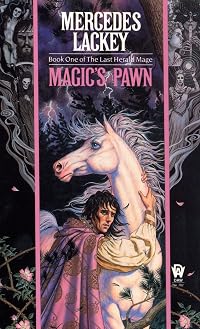
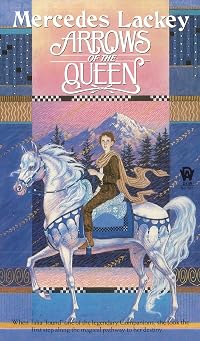
Winds of Fury is the third book in the Mage Winds trilogy, so you'd at least want to go read the first two books, starting with Winds of Fate first and I'd also recommend you first read the trilogy that starts with Arrows of the Queen. I liken the Valdemar series to good comfort food. No, this isn't very literary in quality, but I find myself rereading the series every few years, because I like the characters and the world Lackey created. I don't think this trilogy has quite the same verve as the original Arrows of the Queen trilogy, and isn't as moving as the trilogy with Vanyel that starts with Magic's Pawn. So if you're new to Lackey or the Valdemar series, go read the other books first. But if you've read the other books in this show more series and trilogy, I think you won't find this conclusion to the trilogy involving Elspeth disappointing. Go then and let yourself enjoy some times with old friends. show less
The final installment in the Mage Winds trilogy finds Elsepth, Darwind, Niara, Skiff and Firesong on a desperate mission. They must infiltrate the mage storm-wracked kingdom of Hardorn and assassinate King Ancar and the bloodmage Hulda or see Valdemar overrun by a possessed army. Making a dire situation even more perilous, Adept Mornelithe Falconsbane, arch-enemy of the Talysedras, has been pulled through a proto-gate and is helping Ancar. Should the tiny group's mission fail, all will be lost.
Riveting stuff - some loose ends get tied up. (Although some interesting action takes place off stage, so to speak.) A thrilling conclusion, albeit something of a cliff-hanger ending.
Riveting stuff - some loose ends get tied up. (Although some interesting action takes place off stage, so to speak.) A thrilling conclusion, albeit something of a cliff-hanger ending.
Members
- Recently Added By
Author Information

359+ Works 188,515 Members
Fantasy fiction author Mercedes Richie Lackey was born in Chicago on June 24, 1950, and she received a B.S. from Purdue University in 1972. She is also a professional lyricist and has rehabilitated raptors. Lackey started writing her own short stories when her favorite science fiction and fantasy authors weren't producing new books fast enough for show more her. She began writing professionally with the encouragement of author C. J. Cherryh, whom Lackey had met at a science fiction convention. Many of Lackey's books, including the Queen's Own trilogy, the Vows and Honor series, Valdemar: family Spies, and the Last Herald-Mage and Mage Winds trilogies, take place in the imaginary world of Valdemar. She has authored numerous series, including the Bardic Voices series and a series of occult mysteries featuring Diana Tregarde, a modern-day witch. Lackey enjoys collaborating and has co-written books with authors such as C.J. Cherryh, Anne McCaffrey, Piers Anthony, Marion Zimmer Bradley, Mark Shepherd, and Ru Emerson. Her title Redoubt made The New York Times Best Seller List for 2012. (Bowker Author Biography) show less
Some Editions
Awards and Honors
Awards
Series


Work Relationships
Common Knowledge
- Canonical title
- Winds of Fury
- Original publication date
- 1993-08
- People/Characters
- Elspeth; Darkwind k'Sheyna; Firesong k'Treva; Skif; Need; Starblade (show all 16); Nyara; Ancar of Hardorn; Selenay; Mornelithe Falconsbane; Treyvan; Hydona; Rris; Hulda; An'desha; Dawnfire
- Important places
- Valdemar (fictional); Velgarth (fictional)
- First words
- Ancar, King of Hardorn, slumped in the cushioned embrace of his throne and stared out into the empty Great Hall.
- Last words
- (Click to show. Warning: May contain spoilers.)Treyvan thought that the blinding light of the Avatars could never be matched. But it was challenged and eclipsed then, by the light in Elspeth's eyes.
- Original language
- English
Classifications
Statistics
- Members
- 3,018
- Popularity
- 5,943
- Reviews
- 14
- Rating
- (3.73)
- Languages
- 5 — English, French, German, Korean, Polish
- Media
- Paper, Audiobook, Ebook
- ISBNs
- 11
- ASINs
- 6