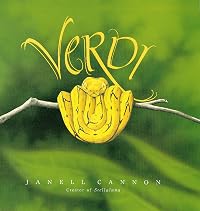
Verdi
by Janell Cannon
On This Page
Description
A young python does not want to grow slow and boring like the older snakes he sees in the tropical jungle where he lives.Tags
Recommendations













Member Reviews
Verdi is full of beautiful, lush, vibrant illustrations. It tells a story of a baby python. He and all his siblings are born yellow and his mother's wish for them all is that they grow up big and green. But Verdi doesn't want that. He thinks the green pythons are boring and lazy and does not want to be like them. Verdi is afraid of change. He does not want to grow up because he thinks he will not be him anymore. But the story is about Verdi learning that change isn't necessarily bad and who you are remains the same. It is a story about not being afraid of change or growing up, about not assuming your ideas and choices are always the best, about learning that (sometimes at least) your elders might actually know something you don't. It is show more beautifully told in a quiet voice so you are hearing the message without realizing there is a message. Children will learn the lessons but think they are just listening to a sweet story about a loveably baby python. show less
Young Verdi doesn’t want to grow up big and green. He likes his bright yellow skin and sporty stripes. Besides, all the green snakes he meets are lazy, boring, and rude. When Verdi finds a pale green stripe stretching along his whole body, he tries every trick he can think of to get rid of it--and ends up in a heap of trouble. Despite his efforts, Verdi turns green, but to his delight, he discovers that being green doesn’t mean he has to stop being himself.
2 books
2 books
Verdi was a high-spirited young tree python, one who enjoyed slithering along as fast as he could, launching himself from trees, and generally having adventures and fun. The elders in the snake community always seemed boring, lazy and rude to him, and he hoped to avoid shedding his own bright yellow skin and becoming green like them. As is so often the case, however, he couldn't really avoid growing up. Fortunately, he discovered that his elders weren't so different than he, and he managed to keep his essential character and personality, when he himself was grown.
Originally published in 1997, Verdi was author/illustrator Janell Cannon's third picture-book, following upon the now classic Stellaluna, and then Trupp. Like her first book, show more this tale of a little snake and his gradual realization that growing up doesn't have to be a bad thing manages to be both entertaining and educational. The story itself highlights some facts about snakes - the fact that they shed their skin, for instance - while the author's afterword gives more information about snakes in general. The artwork, done in acrylic paint and pencil, is vibrantly colorful, and quite beautiful. Verdi himself is gorgeous. Recommended to anyone looking for picture-books about animals in the wild, or children's stories about relations between the generations, and a child's potentially complicated feelings about getting older. show less
Originally published in 1997, Verdi was author/illustrator Janell Cannon's third picture-book, following upon the now classic Stellaluna, and then Trupp. Like her first book, show more this tale of a little snake and his gradual realization that growing up doesn't have to be a bad thing manages to be both entertaining and educational. The story itself highlights some facts about snakes - the fact that they shed their skin, for instance - while the author's afterword gives more information about snakes in general. The artwork, done in acrylic paint and pencil, is vibrantly colorful, and quite beautiful. Verdi himself is gorgeous. Recommended to anyone looking for picture-books about animals in the wild, or children's stories about relations between the generations, and a child's potentially complicated feelings about getting older. show less
Young Verdi doesn’t want to grow up big and green. He likes his bright yellow skin and sporty stripes. Besides, all the green snakes he meets are lazy, boring, and rude. When Verdi finds a pale green stripe stretching along his whole body, he tries every trick he can think of to get rid of it and ends up getting into a lot of trouble. Despite his efforts, Verdi turns green, but to his delight, he discovers that being green doesn’t mean he has to stop being himself
Young Verdi doesn’t want to grow up big and green. He likes his bright yellow skin and sporty stripes. Besides, all the green snakes he meets are lazy, boring, and rude. When Verdi finds a pale green stripe stretching along his whole body, he tries every trick he can think of to get rid of it--and ends up in a heap of trouble. Despite his efforts, Verdi turns green, but to his delight, he discovers that being green doesn’t mean he has to stop being himself. “Cannon is on a roll, her gift for creating memorable characters and scenes on glorious display in this tale of a feisty python hatchling.”--Publishers Weekly
Verdi doesn't want to grow up! Being young, agile, and yellow is way better than being old, slow, and green. Despite his best efforts though, he does grow up and when he does? It turns out being old and green isn't bad!
Young, yellow Verdi is worried that growing up means becoming a boring, green python. Verdi learns that growing up does not mean becoming boring and lazy. He learns that once he slows down, he sees things that he had always missed in his hurry to experience the world.
This book is beautifully illustrated. Each pair of pages is matched with a brightly painted picture on one side and text on the other.
This book is beautifully illustrated. Each pair of pages is matched with a brightly painted picture on one side and text on the other.
Members
- Recently Added By
Lists

Honey For a Child's Heart
1,152 works; 25 members

A Rainbow of Books: Colors in the Title
570 works; 24 members
Author Information

12+ Works 18,678 Members
Picture book author and illustrator Janell Cannon was born November 3, 1957, in St. Paul, Minnesota. The left-handed artist claims she drew so much in high school that her hand was perpetually black from smearing the ink of her favorite Bic pens. Cannon worked at the Carlsbad Library in southern California, where she discovered that there were few show more books about bats available for children, so she decided to make her own. The result, Stellaluna (1994), became a best seller, allowing Cannon to leave her job at the library and write Trupp: A Fuzzhead Tale (1995), and other books. Janell Cannon lives in California. (Bowker Author Biography) show less
Awards and Honors
Awards
Notable Lists
Common Knowledge
- Canonical title
- Verdi
- Original title
- Verdi
- Original publication date
- 1997
- People/Characters
- Verdi; Umbles; Aggie; Ribbon
- Important places
- Africa
- First words
- On a small tropical island, the sun rose high above the steamy jungle.
- Last words
- (Click to show. Warning: May contain spoilers.)I may be big and very green, but I'm still me!
- Original language
- English
Classifications
Statistics
- Members
- 3,095
- Popularity
- 5,722
- Reviews
- 80
- Rating
- (4.17)
- Languages
- 7 — Chinese, English, French, German, Italian, Portuguese, Spanish
- Media
- Paper, Audiobook
- ISBNs
- 33
- ASINs
- 2