On This Page
Description
A brilliant new translation of one of Simenon's best loved masterpieces. 'A certain furtive, almost shameful emotion ... disturbed him whenever he saw a train go by, a night train especially, its blinds drawn down on the mystery of its passengers' Kees Popinga is a respectable Dutch citizen and family man. Then he discovers that his boss has bankrupted the shipping firm he works for - and something snaps. Kees used to watch the trains go by to exciting destinations. Now, on some dark show more impulse, he boards one at random, and begins a new life of recklessness and violence. This chilling portrayal of a man who breaks from society and goes on the run asks who we are, and what we are capable of. 'Classic Simenon ... extraordinary in its evocative power' Independent 'What emerges is the bare human animal' John Gray 'Read him at your peril, avoid him at your loss' Sunday Times show lessTags
Recommendations



































Member Recommendations

thorold Respectable bourgeois discovers absurdity of life and commits motiveless crime.
Member Reviews
A novel about criminal psychology rather than a detective story. I enjoyed this, which has been lurking unread among my classic Pan collection for nearly three decades. A Dutch businessman, secretly resenting his stuffy, conventional life, is suddenly confronted with ruin, snaps, kills someone, and then tries to go to ground in central Paris, aiming to maintain a respectable anonymity while evading the police and with a diminishing stock of money. Simenon's protagonist (I won't call him "hero") is helped by some members of the Parisian criminal underclass, but is eventually undone by a random encounter with another, and by his own unravelling mental state. Despite the title, the watching of trains is rather peripheral to the action, show more though for Popinga they symbolize "the life beyond", and in the end he is inexorably drawn to the railway. The setting in mid 20th century urban and suburban Paris is lightly but convincingly drawn.
I was reminded of John Wain's "The Smaller Sky" (1967), in which a respectable businessman drops out and takes up residence in a large London railway station.
MB 27-viii-2021 show less
I was reminded of John Wain's "The Smaller Sky" (1967), in which a respectable businessman drops out and takes up residence in a large London railway station.
MB 27-viii-2021 show less
Kees Popinga, a Dutch family man, loses his job at a ships chandler in Groningen through no fault of his own. Like a dog faced with an unexpectedly open door he bolts to freedom and goes off the rails, quickly. He kills a woman, flees to Paris, and taunts the police, even as they search for him. He spends his nights in seedy hotels with prostitutes because he can’t sleep well by himself. He frets about the quality of the press he’s getting.
Kees is convinced he’s smarter than the police, and everyone else actually. Getting swindled out of the only money he has is the start of a run of bad luck that is the beginning of the end of his freedom.
Georges Simenon has the ability to get to the bleak heart of his characters through their show more flaws and desires. Kees Popinga is such a character. show less
Kees is convinced he’s smarter than the police, and everyone else actually. Getting swindled out of the only money he has is the start of a run of bad luck that is the beginning of the end of his freedom.
Georges Simenon has the ability to get to the bleak heart of his characters through their show more flaws and desires. Kees Popinga is such a character. show less
A respectable middle-aged office-worker becomes aware of the absurdity of human life and finds himself committing a motiveless violent crime. No, not Albert Camus, but Simenon, in 1938, four years before L'Etranger appeared.
L'Homme qui regardait passer les trains is not so much a conventional roman policier as a pursuit thriller coupled with a psychological exploration of what happens when we throw off all the shackles of conventional society. Although the subject is similar to L'Etranger, the technique is very different: instead of Camus's gaunt, spare prose we have a wealth of everyday detail about Kees Popinga's life both before and after the cataclysmic act. The story is, however, told almost exclusively from the POV of Kees, and show more Simenon (like Camus) effectively forces us to identify with the character. Simenon's approach centres on weaving together the details of Kees's calm and rational approach to avoiding arrest with hints of an increasingly paranoid state of mind.
This is a book that should resonate with modern readers: the background of the economic collapse of the thirties is becoming relevant to us again, and the picture of someone who faces losing job, home and pension because his boss has been siphoning off money from the company into unwise investments is not as dated as we might have thought ten years ago. What also struck me as very modern is the way the fugitive interacts with the press: reading about himself as "Le satyre d'Amsterdam" both infuriates and validates him, and he can't resist writing letters of complaint to the papers when they get things wrong about him. Eventually we realise that the policeman - who plays a key role throughout the book, even though he never directly appears in it - is manipulating the press for his own reasons as well. show less
L'Homme qui regardait passer les trains is not so much a conventional roman policier as a pursuit thriller coupled with a psychological exploration of what happens when we throw off all the shackles of conventional society. Although the subject is similar to L'Etranger, the technique is very different: instead of Camus's gaunt, spare prose we have a wealth of everyday detail about Kees Popinga's life both before and after the cataclysmic act. The story is, however, told almost exclusively from the POV of Kees, and show more Simenon (like Camus) effectively forces us to identify with the character. Simenon's approach centres on weaving together the details of Kees's calm and rational approach to avoiding arrest with hints of an increasingly paranoid state of mind.
This is a book that should resonate with modern readers: the background of the economic collapse of the thirties is becoming relevant to us again, and the picture of someone who faces losing job, home and pension because his boss has been siphoning off money from the company into unwise investments is not as dated as we might have thought ten years ago. What also struck me as very modern is the way the fugitive interacts with the press: reading about himself as "Le satyre d'Amsterdam" both infuriates and validates him, and he can't resist writing letters of complaint to the papers when they get things wrong about him. Eventually we realise that the policeman - who plays a key role throughout the book, even though he never directly appears in it - is manipulating the press for his own reasons as well. show less
This captivating page-turner is not a Detective Maigret novel but one Simenon termed roman durs, meaning uncomfortable or hard on the reader. With The Man Who Watched Trains Go By, each chapter begins with a brief epigraph, for example, the epigraph for Chapter 1 reads “In which Julius de Coster the Younger gets drunk at the Little-Saint George, and the impossible suddenly breaches the dykes of everyday life.” Here's my choice of epigram for the book itself: "The Case of Kees Popinga, or how upon hearing shocking revelations, a well-to-do bourgeois bean counter goes completely berserk."
The first pages provide the setup: One icy December evening in the northern Dutch city of Groningen, forty-year-old family man Kees Popinga walks show more down to the dock to check on a cargo delivery he scheduled himself in his capacity as head clerk of an esteemed shipping firm. The enraged ship’s captain blasts him because the shipment did not arrived. Nonplussed, Kees strolls by a nearby pub only to see through the window, to his amazement, his boss, Julius de Coster, drinking at a table.
Julius waves for him to come in, and, between swigs of brandy, breezily tells Kees in so many words that he, Mr. Pop-in-ga, is Popinga the Poopstick, prime stooge, a ninny so blind he couldn’t see how he, Julius de Coster, has been embezzling, stealing and cheating for years, not to mention having extramarital sex with former employee Pamela, an attractive young lady everyone in the company, including Kees Popinga, dreamed of going to bed with. Furthermore, Julius goes on, since he made a bad investment in sugar, the company is now bankrupt and not only will Popinga lose his job but also his life saving, thus his house and all other personal properties. Lowering his voice, Julius also informs Mr. Pop-in-ga that this is the very night he, the well-respected Julius de Coster, will be faking his own suicide and fleeing the country.
Poor Mr. Popinga! Nothing like having your well-ordered, comfortable Dutch bourgeois world come crashing down in a heap of rubble. And how, we may ask, does our staid, conservative shipping clerk react to this disaster? The next morning, he makes his first radical decision: to stay under the covers in bed. What! Not go to the office, Kees? Mrs. Popinga is shocked, to say the least. Oh, yes, new world, new man. We read: “The important thing was that he felt completely at ease. This was the real him. Yes – this is how he should have acted all along.”
So, for the first time in his adult life Kees Popinga has a taste of tranquility and joy, a state free from agitation and constant worrying, what he recognizes as “the real him” – and for good reason: many the spiritual and philosophical tradition maintaining such a combination of tranquility and joy is, in fact, our birthright, our true nature. As existential psychologist R.D. Laing observed: “Our 'normal' 'adjusted' state is too often the abdication of ecstasy, the betrayal of our true potentialities.”
And then we read: “Kees had always dreamed of being something other than Kees Popinga. That explained why he was so completely the way he was – so completely Kees Popinga – and why he even overdid it. Because he knew that if he gave even an inch, nothing would stop him again.” In other words, it’s all or nothing.- once the thin shell of rigid identity is even slightly cracked, the entire edifice breaks down. It’s as if, in his own clerkish way, Kees Popinga grasps R.D. Laing’s insight: “The condition of alienation, of being asleep, of being unconscious, of being out of one’s mind, is the condition of the normal man. Society highly values its normal man.”
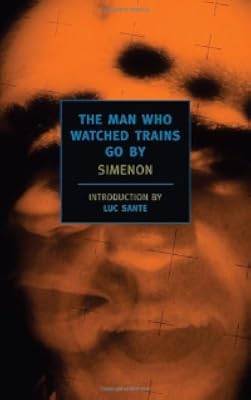
Kees Popinga finally rouses himself from bed, shaves, showers, dresses and, without telling his wife of his plans, leaves his house and family forever, having resolved to also leave behind his identity as a "normal man." What follows when he travels to Amsterdam to have sex with Pamela (Julius de Coster bragged about how he set the luscious Pamela up in a particularly posh hotel) and then on to Paris is a truly odd series of events, a story Luc Sante in his Introduction to this New York Review Books (NYRB) edition calls both galling and comic.
For my money, this Georges Simenon novel is a penetrating exploration into the psychology of personal identity. How far can Kees Popinga the bean counter free himself from his habit of counting beans (the former shipping clerk continually, almost obsessively, makes entries in a small red leather notebook he happens to find in his jacket pocket) and how far will the consequences of his actions (for starters, he quite unintentionally kills Pamela) launch him into madness? If you are up for a quizzical existential tale by turns humorous and infuriating, this is your book. show less
The first pages provide the setup: One icy December evening in the northern Dutch city of Groningen, forty-year-old family man Kees Popinga walks show more down to the dock to check on a cargo delivery he scheduled himself in his capacity as head clerk of an esteemed shipping firm. The enraged ship’s captain blasts him because the shipment did not arrived. Nonplussed, Kees strolls by a nearby pub only to see through the window, to his amazement, his boss, Julius de Coster, drinking at a table.
Julius waves for him to come in, and, between swigs of brandy, breezily tells Kees in so many words that he, Mr. Pop-in-ga, is Popinga the Poopstick, prime stooge, a ninny so blind he couldn’t see how he, Julius de Coster, has been embezzling, stealing and cheating for years, not to mention having extramarital sex with former employee Pamela, an attractive young lady everyone in the company, including Kees Popinga, dreamed of going to bed with. Furthermore, Julius goes on, since he made a bad investment in sugar, the company is now bankrupt and not only will Popinga lose his job but also his life saving, thus his house and all other personal properties. Lowering his voice, Julius also informs Mr. Pop-in-ga that this is the very night he, the well-respected Julius de Coster, will be faking his own suicide and fleeing the country.
Poor Mr. Popinga! Nothing like having your well-ordered, comfortable Dutch bourgeois world come crashing down in a heap of rubble. And how, we may ask, does our staid, conservative shipping clerk react to this disaster? The next morning, he makes his first radical decision: to stay under the covers in bed. What! Not go to the office, Kees? Mrs. Popinga is shocked, to say the least. Oh, yes, new world, new man. We read: “The important thing was that he felt completely at ease. This was the real him. Yes – this is how he should have acted all along.”
So, for the first time in his adult life Kees Popinga has a taste of tranquility and joy, a state free from agitation and constant worrying, what he recognizes as “the real him” – and for good reason: many the spiritual and philosophical tradition maintaining such a combination of tranquility and joy is, in fact, our birthright, our true nature. As existential psychologist R.D. Laing observed: “Our 'normal' 'adjusted' state is too often the abdication of ecstasy, the betrayal of our true potentialities.”
And then we read: “Kees had always dreamed of being something other than Kees Popinga. That explained why he was so completely the way he was – so completely Kees Popinga – and why he even overdid it. Because he knew that if he gave even an inch, nothing would stop him again.” In other words, it’s all or nothing.- once the thin shell of rigid identity is even slightly cracked, the entire edifice breaks down. It’s as if, in his own clerkish way, Kees Popinga grasps R.D. Laing’s insight: “The condition of alienation, of being asleep, of being unconscious, of being out of one’s mind, is the condition of the normal man. Society highly values its normal man.”
Kees Popinga finally rouses himself from bed, shaves, showers, dresses and, without telling his wife of his plans, leaves his house and family forever, having resolved to also leave behind his identity as a "normal man." What follows when he travels to Amsterdam to have sex with Pamela (Julius de Coster bragged about how he set the luscious Pamela up in a particularly posh hotel) and then on to Paris is a truly odd series of events, a story Luc Sante in his Introduction to this New York Review Books (NYRB) edition calls both galling and comic.
For my money, this Georges Simenon novel is a penetrating exploration into the psychology of personal identity. How far can Kees Popinga the bean counter free himself from his habit of counting beans (the former shipping clerk continually, almost obsessively, makes entries in a small red leather notebook he happens to find in his jacket pocket) and how far will the consequences of his actions (for starters, he quite unintentionally kills Pamela) launch him into madness? If you are up for a quizzical existential tale by turns humorous and infuriating, this is your book. show less
This captivating page-turner is not a Detective Maigret novel but one Simenon termed roman durs, meaning uncomfortable or hard on the reader. With The Man Who Watched Trains Go By, each chapter begins with a brief epigraph, for example, the epigraph for Chapter 1 reads “In which Julius de Coster the Younger gets drunk at the Little-Saint George, and the impossible suddenly breaches the dykes of everyday life.”
Here's my choice of epigram for the book itself: "The Case of Kees Popinga, or how upon hearing shocking revelations, a well-to-do bourgeois bean counter goes completely berserk."
The first pages provide the setup: One icy December evening in the northern Dutch city of Groningen, forty-year-old family man Kees Popinga walks show more down to the dock to check on a cargo delivery he scheduled himself in his capacity as head clerk of an esteemed shipping firm. The enraged ship’s captain blasts him because the shipment did not arrived. Nonplussed, Kees strolls by a nearby pub only to see through the window, to his amazement, his boss, Julius de Coster, drinking at a table.
Julius waves for him to come in, and, between swigs of brandy, breezily tells Kees in so many words that he, Mr. Pop-in-ga, is Popinga the Poopstick, prime stooge, a ninny so blind he couldn’t see how he, Julius de Coster, has been embezzling, stealing and cheating for years, not to mention having extramarital sex with former employee Pamela, an attractive young lady everyone in the company, including Kees Popinga, dreamed of going to bed with.
Furthermore, Julius goes on, since he made a bad investment in sugar, the company is now bankrupt and not only will Popinga lose his job but also his life savings, thus his house and all other personal properties. Lowering his voice, Julius also informs Mr. Pop-in-ga that this is the very night he, the well-respected Julius de Coster, will be faking his own suicide and fleeing the country.
Poor Mr. Popinga! Nothing like having your well-ordered, comfortable Dutch bourgeois world come crashing down in a heap of rubble. And how, we may ask, does our staid, conservative shipping clerk react to this disaster? The next morning, he makes his first radical decision: to stay under the covers in bed.
What! Not go to the office, Kees? Mrs. Popinga is shocked, to say the least. Oh, yes, new world, new man. We read: “The important thing was that he felt completely at ease. This was the real him. Yes – this is how he should have acted all along.”
So, for the first time in his adult life Kees Popinga has a taste of tranquility and joy, a state free from agitation and constant worrying, what he recognizes as “the real him” – and for good reason: many the spiritual and philosophical tradition maintaining such a combination of tranquility and joy is, in fact, our birthright, our true nature. As existential psychologist R.D. Laing observed: “Our 'normal' 'adjusted' state is too often the abdication of ecstasy, the betrayal of our true potentialities.”
And then we read: “Kees had always dreamed of being something other than Kees Popinga. That explained why he was so completely the way he was – so completely Kees Popinga – and why he even overdid it. Because he knew that if he gave even an inch, nothing would stop him again.”
In other words, it’s all or nothing.- once the thin shell of rigid identity is even slightly cracked, the entire edifice breaks down. It’s as if, in his own clerkish way, Kees Popinga grasps R.D. Laing’s insight: “The condition of alienation, of being asleep, of being unconscious, of being out of one’s mind, is the condition of the normal man. Society highly values its normal man.”
Kees Popinga finally rouses himself from bed, shaves, showers, dresses and, without telling his wife of his plans, leaves his house and family forever, having resolved to also leave behind his identity as a "normal man."
What follows when he travels to Amsterdam to have sex with Pamela (Julius de Coster bragged about how he set the luscious Pamela up in a particularly posh hotel) and then on to Paris is a truly odd series of events, a story Luc Sante in his Introduction to this New York Review Books (NYRB) edition calls both galling and comic.
This Georges Simenon novel is a penetrating exploration into the psychology of personal identity. How far can Kees Popinga the bean counter free himself from his habit of counting beans (the former shipping clerk continually, almost obsessively, makes entries in a small red leather notebook he happens to find in his jacket pocket)? And how far will the consequences of his actions (for starters, he quite unintentionally kills Pamela) launch him into madness? If you are up for a quizzical existential tale by turns humorous and infuriating, this is your book.
Georges Simenon in Paris. Frequently, the author would observe people on the street, pick out an interesting face, usually a man, and imagine him dealing with an unexpected event that would strip him of all comfortable social clothing and push him to the limit. show less
The Man Who Had a Psychotic Break
Review of the Penguin Books paperback edition (November 2016) of a new translation* by Siân Reynolds of the French language original "L'Homme qui regardait passer les trains" (1938)
The Man Who Watched Trains Go By has very little to do with actual trains, which instead become more of a symbol for what the protagonist, Dutchman Kees Popinga, begins to believe is a life that has passed him by. The bookkeeper discovers that his boss has swindled his company and is going on the run. Seeing the end of his comfortable life and expecting to also be blamed for the swindle, he abandons his wife and 2 kids and begins a deranged run from Holland to Paris, France.
Along the way, he strangles his boss's mistress and show more becomes labelled as the Dutch sex maniac in the Paris newspapers. He falls in with a prostitute and her pimp's gang of car thieves until his paranoia causes him to escape them as well. He then goes back to attack the prostitute, all the while taunting the Paris newspapers and police with letters instructing them on where their perceptions of him are incorrect. He begins to believe himself a master criminal as he evades capture for a period of a few weeks over a Christmas and New Year period. Finally his funds are dwindled and he himself falls victim to a crime. The police are closing in.
See image at https://i.gr-assets.com/images/S/compressed.photo.goodreads.com/books/1550580948...
Cover of the first French language edition published by Gallimard in 1938. Image sourced from Goodreads
After reading the first dozen Simenon Maigret novels this year, I'm now reading a half-dozen or so of the non-Maigrets. Many of the non-Maigret books are being translated into English for the first time and there are still probably quite a few yet to be done.
The Man Who Watched Trains Go By is the 5th of my readings of Georges Simenon's romans durs** (French: hard novels) which was his personal category for his non-Chief Inspector Maigret fiction. This is like Graham Greene, who divided his work into his "entertainments" and his actual "novels." Similar to Greene, the borders between the two areas are quite flexible as we are often still dealing with crime and the issues of morals and ethics. Simenon's romans durs are definitely in the noir category though, as compared to the sometimes lighter Maigrets where the often cantankerous Chief Inspector provides a solution and the guilty are brought to justice.
Trivia and Links
* L'Homme qui regardait passer les trains was previously translated into English several times. The earliest appears to be published by Routledge in 1943 translated by Stuart Gilbert (not found on Goodreads) and as recently as The Man Who Watched Trains Go By (NYRB 2005) translated by Marc Romano.
** There is a limited selection of 100 books in the Goodreads' Listopia of Simenon's romans durs which you can see here. Other sources say there are at least 117 of them, such as listed at Art and Popular Culture.
The Man Who Watched Trains Go By has been adapted once for film.
The adaptation was in English in 1952 directed by Harold French and starring Claude Rains as Kees Popinga. There doesn't appear to be a trailer, but a clip from the film can be viewed on YouTube here. The film was released in America as The Paris Express. show less
Review of the Penguin Books paperback edition (November 2016) of a new translation* by Siân Reynolds of the French language original "L'Homme qui regardait passer les trains" (1938)
The Man Who Watched Trains Go By has very little to do with actual trains, which instead become more of a symbol for what the protagonist, Dutchman Kees Popinga, begins to believe is a life that has passed him by. The bookkeeper discovers that his boss has swindled his company and is going on the run. Seeing the end of his comfortable life and expecting to also be blamed for the swindle, he abandons his wife and 2 kids and begins a deranged run from Holland to Paris, France.
Along the way, he strangles his boss's mistress and show more becomes labelled as the Dutch sex maniac in the Paris newspapers. He falls in with a prostitute and her pimp's gang of car thieves until his paranoia causes him to escape them as well. He then goes back to attack the prostitute, all the while taunting the Paris newspapers and police with letters instructing them on where their perceptions of him are incorrect. He begins to believe himself a master criminal as he evades capture for a period of a few weeks over a Christmas and New Year period. Finally his funds are dwindled and he himself falls victim to a crime. The police are closing in.
See image at https://i.gr-assets.com/images/S/compressed.photo.goodreads.com/books/1550580948...
Cover of the first French language edition published by Gallimard in 1938. Image sourced from Goodreads
After reading the first dozen Simenon Maigret novels this year, I'm now reading a half-dozen or so of the non-Maigrets. Many of the non-Maigret books are being translated into English for the first time and there are still probably quite a few yet to be done.
The Man Who Watched Trains Go By is the 5th of my readings of Georges Simenon's romans durs** (French: hard novels) which was his personal category for his non-Chief Inspector Maigret fiction. This is like Graham Greene, who divided his work into his "entertainments" and his actual "novels." Similar to Greene, the borders between the two areas are quite flexible as we are often still dealing with crime and the issues of morals and ethics. Simenon's romans durs are definitely in the noir category though, as compared to the sometimes lighter Maigrets where the often cantankerous Chief Inspector provides a solution and the guilty are brought to justice.
Trivia and Links
* L'Homme qui regardait passer les trains was previously translated into English several times. The earliest appears to be published by Routledge in 1943 translated by Stuart Gilbert (not found on Goodreads) and as recently as The Man Who Watched Trains Go By (NYRB 2005) translated by Marc Romano.
** There is a limited selection of 100 books in the Goodreads' Listopia of Simenon's romans durs which you can see here. Other sources say there are at least 117 of them, such as listed at Art and Popular Culture.
The Man Who Watched Trains Go By has been adapted once for film.
The adaptation was in English in 1952 directed by Harold French and starring Claude Rains as Kees Popinga. There doesn't appear to be a trailer, but a clip from the film can be viewed on YouTube here. The film was released in America as The Paris Express. show less
While discussing Black Swan with friends the other day, I realized this novel has a similarity or two with Darren Aronofsky movies. Remember those movies ( Requiem for a Dream, Pi, The Wrestler, Black Swan ) where we have one or more characters going on with their lives when somehow things begin spiraling out of control. And how!. The Man Who Watched Trains Go By has a similar premise, except the transition in the protagonist's life is relatively more sudden. He steps around a corner from where there is no turning back.
Kees Popinga, the protagonist, has always done what is expected of him by the society, his family and his employer. He has built a stable and seemingly content life for himself. However, while trying too hard to be show more perfect, he has lost himself somewhere, forgotten who he really was and how he really wishes to live. He is tired and bored of being himself. He is bogged down by the monotony of his life, though he doesn't yet realize as much. One fateful night, his predictable life takes an unexpected turn and Popinga breaks down. He is now no longer the man who always used to watch trains go by while staying put, but hops on a train himself to start afresh and live on his own terms. And the reader accompanies him on his existential journey.
Simenon writes well. He never goes too deep into Popinga's psychology, but lets us understand his psyche by telling a lot of the story from Popinga's point-of-view. Popinga gets himself into a cat-and-mouse game with the police. He goes about playing this game objectively, thinking and planning out every move he makes. While Popinga takes pride in being so clear-headed and smart, the reader can only feel sorry for the poor fellow's foolishness. Whatever you feel about his actions, you can't help feeling pity for him. You want to grab him by the shoulders and shake some sense into his head. Like those times when you find yourself yelling at someone on your TV screen.
Simenon also sprinkles the plot with suspense which adds another interesting dimension to the story.
There are sure to be many Popingas in the world around us who are wearied of their stressful lives and wish to breathe free. show less
Members
- Recently Added By
Lists

Best of French Literature
138 works; 27 members

Recommend the 20 best books you've read in the last five years
2,168 works; 606 members

French Books
102 works; 15 members

Short and Sweet
246 works; 24 members

Books mentioned in Julian Symons’ Bloody Murder
438 works; 6 members

Favorite Books in Translation
320 works; 133 members
Author Information

1,331+ Works 63,188 Members
The prolific Belgian-born writer Georges Simenon produced hundreds of fictional works under his own name and 17 pseudonyms, in addition to more than 70 books about Inspector Maigret, long "the favorite sleuth of highbrow detective-story readers" (SR). More than 50 "Simenons" have been made into films. In addition to his mystery stories, he wrote show more what he called "hard" books, the serious psychological novels numbering well over 100. The autobiographical Pedigree, set in his native town of Liege, is perhaps his finest work. The publication of Simenon's intimate memoirs also attracted considerable attention. Simenon himself once said that he would never write a "great novel." Yet Gide called him "a great novelist, perhaps the greatest and truest novelist we have in French literature today," and Thornton Wilder (see Vol. 1) found that Simenon's narrative gift extends "to the tips of his fingers." The following are some of Simenon's novels, exclusive of the Maigret detective stories, that are in print. (Bowker Author Biography) Georges Simenon was born on February 13, 1903 in Liege, Belgium. He wrote more than 200 fiction works under 16 different pseudonyms. His first book, The Case of Peter the Lent led to 80 more of the like including the main character, Inspector Maigret. He published over 400 books that were translated into 50 different languages and sold by the millions. He also wrote psychological novels, including The Man Who Watched the Train Go By. He died on September 4, 1989 in Lausanne. (Bowker Author Biography) show less
Some Editions
Series

Belongs to Publisher Series
Work Relationships
Is contained in
Is abridged in
Common Knowledge
- Canonical title
- The Man Who Watched Trains Go By
- Original title
- L'Homme qui regardait passer les trains
- Original publication date
- 1938
- People/Characters
- Kees Popinga; Julius de Coster Jr.
- Important places
- Paris, France; Groningen, Groningen, Netherlands
- First words
- As far as Kees Popinga was concerned, it cannot be denied that at eight that evening there was still time, his destiny still hung in the balance.
- Last words*
- (Click to show. Warning: May contain spoilers.)- La veritat no existeix, ¿oi que no?
- Original language
- French
*Some information comes from Common Knowledge in other languages. Click "Edit" for more information.
Classifications
- Genres
- Fiction and Literature, General Fiction, Mystery
- DDC/MDS
- 843.912 — Literature & rhetoric French Literature French fiction 1900- 20th Century 1900-1945
- LCC
- PQ2637 .I53 .H6213 — Language and Literature French, Italian, Spanish and Portuguese literatures French literature Modern literature 1900-1960
- BISAC
Statistics
- Members
- 1,290
- Popularity
- 18,902
- Reviews
- 32
- Rating
- (3.75)
- Languages
- 14 — Catalan, Czech, Danish, Dutch, English, Finnish, French, German, Hebrew, Italian, Polish, Portuguese, Spanish, Swedish
- Media
- Paper, Audiobook, Ebook
- ISBNs
- 45
- ASINs
- 28