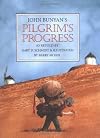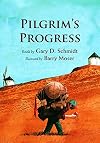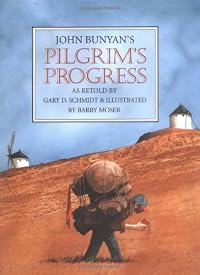
Pilgrim's Progress: A Retelling
by Gary D. Schmidt
On This Page
Description
National Book Award finalist and two-time Newbery Honor-winning author Gary D. Schmidt recaptures the classic tale of one man's spiritual journey in this contemporary retelling of John Bunyan's Pilgrim's Progress, masterfully illustrated with watercolors by artist Barry Moser.Here again is the tale of Christian's epic trek from the City of Destruction to the Heavenly Palaces - of the pitfalls that threaten to waylay him and the graces that strengthen him along the way. Matching Bunyan's show more flare for storytelling and vivid imagery, Gary Schmidt's new narrative also echoes the style of writers like J.R.R. Tolkien, Dante, Sir Thomas Browne, E.M. Forster, and Nathaniel Hawthorne.Even after three centuries, this odyssey of faith and human perseverance continues to inspire readers today - and now Schmidt's engaging retelling will delight and stir the imaginations of a new generation of pilgrims. show lessTags
Recommendations


















Member Recommendations
Member Reviews
I have long felt that I should read The Pilgrim's Progress by John Bunyan. I even started to once, but only made it a page before putting it down. So when I found this retelling, putting the story into contemporary language, I knew it was my chance to at least see what the book was all about. So understand going into my review that this is in no way a comparison of this retelling to the original. And my comments are specific to this version, because I can't say what might be different from the original. With that being said, I do think that some of what I didn't like about this story would extend back to the original source.
After I finished reading this, as I tried to analyze what I'd read and did some research to understand others' show more views on the allegory, I flashed right back to high school. After reading The Great Gatsby, I wrote that I didn't understand why my teacher would have us read a book that so glorified the drinking and partying in the book. She wrote back about her disappointment that I thought she'd promote those things, and that perhaps I didn't really understand the book. That it's the type of book one might have to read multiple times to grasp. That's kind of how I feel about this book.
My first apparent misunderstanding is that it seemed to me that Christian had to essentially earn his salvation. He struggled with his burden on the way to the cross, after coming to an understanding that he had this burden and needed external help to release it. Others say that he was actually saved when entering through the gate that started this journey, and releasing his burden at the cross was simply an illustration about how we don't often let go of our guilt upon salvation and have to still come to that understanding that Jesus wants to relieve us of that guilt. However, it was at the cross, after losing his burden, that Christian was handed the Roll, which seemed to be needed in order to enter the Celestial City. I took this as a symbol of his salvation, but then, when he was audacious enough to rest a little too long, he lost the Roll and later had to go back and look for it.
I won't go into any other details, but for whatever this book might mean to some people, at least the people who "get it," to me it looks like a book that could send the wrong message to new Christians or curious unbelievers, especially those who, like me, aren't so great at understanding allegory. From start to finish, it makes me feel like a Christian walk is nothing but trial and tribulation. Constant struggling to stay on the right path, to stay good. Yes, some of that is true to a degree, because it can feel like a constant struggle to avoid temptation to sin, but where's the other side? Why do we not see much of the joy and peace that can come, in this life, from following Christ? For that matter, why is God so completely absent until Christian reaches the Celestial City? If I were to write an allegory about a Christian journey, it would include God interacting with the pilgrim in a much more tangible way (or at all...).
I seem to be pretty hit-or-miss in my enjoyment of much-loved older books and classics, and this is another for my pile of misses. I'm glad I read it, though. Originally I thought it might end up being a stepping stone to going on and reading the original. I've decided to leave it right here, at this simplified version, and just be one of the few who've never read the original. show less
After I finished reading this, as I tried to analyze what I'd read and did some research to understand others' show more views on the allegory, I flashed right back to high school. After reading The Great Gatsby, I wrote that I didn't understand why my teacher would have us read a book that so glorified the drinking and partying in the book. She wrote back about her disappointment that I thought she'd promote those things, and that perhaps I didn't really understand the book. That it's the type of book one might have to read multiple times to grasp. That's kind of how I feel about this book.
My first apparent misunderstanding is that it seemed to me that Christian had to essentially earn his salvation. He struggled with his burden on the way to the cross, after coming to an understanding that he had this burden and needed external help to release it. Others say that he was actually saved when entering through the gate that started this journey, and releasing his burden at the cross was simply an illustration about how we don't often let go of our guilt upon salvation and have to still come to that understanding that Jesus wants to relieve us of that guilt. However, it was at the cross, after losing his burden, that Christian was handed the Roll, which seemed to be needed in order to enter the Celestial City. I took this as a symbol of his salvation, but then, when he was audacious enough to rest a little too long, he lost the Roll and later had to go back and look for it.
I won't go into any other details, but for whatever this book might mean to some people, at least the people who "get it," to me it looks like a book that could send the wrong message to new Christians or curious unbelievers, especially those who, like me, aren't so great at understanding allegory. From start to finish, it makes me feel like a Christian walk is nothing but trial and tribulation. Constant struggling to stay on the right path, to stay good. Yes, some of that is true to a degree, because it can feel like a constant struggle to avoid temptation to sin, but where's the other side? Why do we not see much of the joy and peace that can come, in this life, from following Christ? For that matter, why is God so completely absent until Christian reaches the Celestial City? If I were to write an allegory about a Christian journey, it would include God interacting with the pilgrim in a much more tangible way (or at all...).
I seem to be pretty hit-or-miss in my enjoyment of much-loved older books and classics, and this is another for my pile of misses. I'm glad I read it, though. Originally I thought it might end up being a stepping stone to going on and reading the original. I've decided to leave it right here, at this simplified version, and just be one of the few who've never read the original. show less
NCLA Review - In this lovely little book, Gary D. Schmidt has retold Pilgrim’s Progress for a contemporary audience. In his introduction he states, “My retelling is not another edition, nor is it just Pilgrim’s Progress with the language simplified or the lengthy discussions cut out.” Rather, Schmidt is trying to capture the spirit of what John Bunyan intended for the story—that it be told in a contemporary way using contemporary language. Schmidt succeeds at this goal while staying true to the original story. The result is an engaging, accessible book that will appeal to teenagers and adults. Barry Moser’s beautifully detailed full-color paintings illustrate most of the two-page spreads in the book. This book would be show more perfect for teen book discussions and would be a fine addition to any church library. Rating: 4 —AMG show less
This book contains beautiful drawings and interesting story. However, I would be a bit wary of assigning this book because of its strong religious overtones. Nevertheless, I am sure that for children whose parents are christians it would be quite suitable. I wouldn't say that the story translates to children particularly well as it is heavily symbolic and allegorical. It would probably work starting from about the 2nd grade on if properly explained/contextualized.
Appropriate for Grammar stage reader.
Ratings
Members
- Recently Added By
Author Information

44+ Works 14,502 Members
A much published and oft-translated author of children's books, Gary D. Schmidt has earned national acclaim. In 2011, his Okay for Now was a National Book Award finalist and was listed on the Notable. Children's Book lists of the New York Times, the Chicago Tribune; and the Boston Globe. Trouble (2008) was a Junior Library Guild Selection and show more appeared on the Kids Reading list for Oprah's Book Club. The Wednesday Wars (2007) and Lizzie Bright and the Buckminster Boy (2004) were both John Newbery Honor Books. Schmidt is also professor of English at Calvin College and the author and coeditor of several scholarly books on children's literature and children's book authors. He lives in Alto, Michigan. show less
All Editions
Awards and Honors
Awards
Common Knowledge
- First words
- In the fields just below a small house, a man walked slowly, bent over by the weight of the great pack heaped up over his back and shoulders.
- Disambiguation notice
- Retelling by Gary D. Schmidt - please don't combine with the original or different retellings/abridgements!
Classifications
- Genres
- Fiction and Literature, Children's Books
- DDC/MDS
- 813.54 — Literature & rhetoric American literature in English American fiction in English 1900-1999 1945-1999
- LCC
- PZ7 .S3527 .P — Language and Literature Fiction and juvenile belles lettres Fiction and juvenile belles lettres Juvenile belles lettres
- BISAC
Statistics
- Members
- 285
- Popularity
- 112,025
- Reviews
- 4
- Rating
- (4.42)
- Languages
- English
- Media
- Paper, Ebook
- ISBNs
- 4
- ASINs
- 3