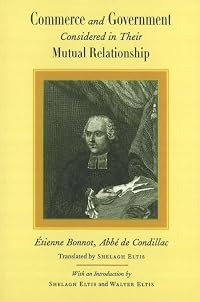
Commerce and Government
by Etienne Bonnot de Condillac
34 Members (5.00)
On This Page
Description
This book is the first English language edition of Le Commerce et le Gouvernement by the distinguished eighteenth century economist and philosopher Condillac. It was one of the most original contributions to French economics in the eighteenth century. In this edition the editors provide an English translation of the original and a comprehensive account of Condillac's life and contribution to economics. In the late eighteenth century Condillac used the clarity and precision of thought of a show more leading philosopher to derive a fundamental set of economic principles and their implications for policy. He arrived at the same free trade conclusions as Adam Smith, and Le Commerce et le Gouvernement was published in the same year as The Wealth of Nations.Condillac's economics was initially condemned by the physiocrats because in his utility-based analysis, industry and commerce and not just agriculture contributed to the wealth of France. The original French edition was quickly dismissed by those in positions of power in France who preferred dirigism to competition, while across the Channel the British were unaware of its existence. The importance of Condillac's contribution to economics was recognised after the marginal revolution of the 1870's. In the eighteenth century Condillac won the respect of Voltaire and Rousseau, and the high regard of the King and the Church. His work has since been admired by Allais, Hayek, Menger and Weulersse, while Jevons believed that it provided the first distinct statement of the true connection between value and utility. Commerce and Government will be of special interest to historians of economic thought and those interested in the economic history of the eighteenth century. show lessTags
Recommendations

















Member Reviews
Members
- Recently Added By
Author Information

51+ Works 250 Members
Born in Grenoble, France, Etienne Bonnot de Condillac studied theology at Saint-Sulpice and the Sorbonne and was ordained a Catholic priest in 1740. He was, however, always less interested in pursuing his sacred calling than in the advancement of secular knowledge. In this he was supported and encouraged by his cousin, the philosopher Jean le Rond show more d'Alembert, who introduced him to the circle of the encyclopedists. Condillac set out to develop an experience-centered epistemology founded on sensation, modeled on Locke's genetic account of human knowledge and on the mechanistic paradigm of science embodied in nineteenth-century Newtonian physics. The result was that, along with Hume, Condillac invented modern empiricism. His first works were A Treatise on Systems and An Essay on the Origin of Human Knowledge (both 1746). The former was a critique of traditional metaphysicians and the latter a positive statement of Condillac's sensationalist psychology and epistemology. Condillac composed his most influential work, the Treatise on Sensations (1754), in which he attempted to explain how through sensation the mind naturally arrives at the ideas of independent material objects. His later writings include Commerce and Government (1776), a defense of physiocratic doctrines, and the posthumously published Logic (1792). (Bowker Author Biography) show less
Some Editions
Common Knowledge
- Canonical title
- Commerce and Government
- Original title
- Le commerce et le gouvernement, considérés relativement l'un à l'autre
- Original language
- French
Classifications
Statistics
- Members
- 34
- Popularity
- 839,477
- Rating
- (5.00)
- Languages
- English, French
- Media
- Paper
- ISBNs
- 5