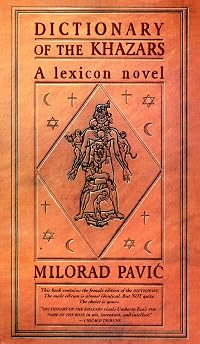
Dictionary of the Khazars: A Lexicon Novel in 100,000 Words {Female Edition}
by Milorad Pavić
Dictionary of the Khazars (Female)
On This Page
Description
A national bestseller, Dictionary of the Khazars was cited by The New York Times Book Review as one of the best books of the year. Written in two versions, male and female (both available in Vintage International), which are identical save for seventeen crucial lines, Dictionary is the imaginary book of knowledge of the Khazars, a people who flourished somewhere beyond Transylvania between the seventh and ninth centuries. Eschewing conventional narrative and plot, this lexicon novel combines show more the dictionaries of the world's three major religions with entries that leap between past and future, featuring three unruly wise men, a book printed in poison ink, suicide by mirrors, a chimerical princess, a sect of priests who can infiltrate one's dreams, romances between the living and the dead, and much more. show lessTags
Recommendations
























Member Reviews
No man ever reads the same book twice?
Everything is made of a million pieces of the past. Everything will eventually fall apart to become part of a million other things. In this book, composition and decomposition occur so closely on one another's heels as to be indistinguishable from one another. Pay attention to what version of this text you're composing as you read--and what is gained and lost in the process.
Everything is made of a million pieces of the past. Everything will eventually fall apart to become part of a million other things. In this book, composition and decomposition occur so closely on one another's heels as to be indistinguishable from one another. Pay attention to what version of this text you're composing as you read--and what is gained and lost in the process.
It's fiction that pretends to masquerade as fact, and I don't think I've ever enjoyed fiction more. The density of connections in "Dictionary of the Khazars" is astounding; it commonly references mythological themes and tropes, some of which originate in our "real" myths and some of which seem wholly confined to the book. These allusions are made indistinguishably, and that only helps to break down divisions between fact and fiction (what, after all, is a "real" myth?) and also to break down divisions between subjective and objective.
Experimental fiction requires experimental reading. My three month quest to read “Dictionary of the Khazars” began slowly in great confusion. It warmed as I grew to be inside the story, then burned like a hot fire that obsessed me for weeks on end. One day, I realized the fire had waned yet still felt comforting and toasty. Another day came when I had not picked up the book in two weeks. I had “finished” reading it. For now. Memories of that flame make me hope I will at some point reread this “Dictionary of the Dictionaries on the Khazar Question.”
from “The Green Book: Islamic sources on the Khazar question”:
“Khazars — in Arabic ‘Khazar,’ in Chinese ‘K’osa’; the name of a people of Turkish origin. The name show more is derived from the Turkish QUAZMAK (to wander, move) or from QUZ (the northern, shaded side of the mountain)….
“Islamic sources say the Khazars were excellent tillers of the soil and fishermen…. They are so resourceful that they have oysters breeding on trees. They take a tree of the sea, bend its branches into the water, and hold them down with a rock; within two years the branches become so heavy with oysters that by the third year they break loose from the rock and rise out of the water, bearing a splendid yield of tasty shellfish. The river that flows through the Khazar Empire has two names, because in the same riverbed half of its course runs from east to west, and the other half from west to east. The names of this river are the names of two Khazar calendar years, because the Khazars believe that passing through the four seasons are two years, not one, and that they move in opposite directions (like the Khazars’ river). Both years shuffle the days and seasons like cards, mixing winter days with spring, and summer days with autumn. Moreover, one of the two Khazar years flows from the future to the past, and the other from the past to the future.” (143-4)
from “The Red Book: Christian sources on the Khazar question”:
“Greek sources on the Khazar question are supported by an important document … ‘The Great Parchment.’ According to this source, a Khazar legation was sent to the Byzantine Emperor Theophilus, and one of the envoys had the Khazars’ history and topography tattooed on his body — in the Khazar language, but using Hebrew letters. ….
“…. The beginning of the parchment was lost, because the part of the envoy’s body on which the first and second great Khazar years had been written had been chopped off at some point as a act of punishment. The preserved part of Khazar tale begins, therefore, with the third large year ….
“…. the Khazar envoy ended his life at the court of some caliph by turning his soul inside out and slipping it on like an inverted glove. His torn skin, tanned and bound like a big atlas, held a place of honor in the caliph’s palace in Samarra. According to a second group of sources, the envoy had many a nasty moment. First while still in Constantinople, he had to let his hand be cut off, because an influential man at the Greek court had paid in solid gold for the second large Khazar year, written on the envoy’s left palm. A third group of sources claim that on two or three occasions the envoy was forced to return to the Khazar capital, where he had to undergo corrections of the historical and other facts he bore, or where he was replaced by another envoy, whose skin had been imprinted with the corrected and revised version of history.” (73-77)
from “The Yellow Book: Hebrew sources on the Khazar question”:
“Khazars — a warrior people who settled in the Caucasus between the 7th and 10th centuries, had a powerful state, ships sailing two seas, the Caspian and the Black, as many winds as there are fish, three capitals (summer, winter, and wartime), and years as towering as the pine threes. They preached a faith unknown today, worshipped salt, carved their temples into underground salt rocks or saline hills. According to Halevi, they adopted Judaism in the year 740, and the last Khazar kaghan, Joseph, even made contact with the Spanish Jews, because he sailed on the seventh day, when the earth curses man and its malediction drives ships away from shore. These ties were broken in the year 970, when the Russians captured the Khazar capital and destroyed the Khazar state. Some Khazars subsequently merged with the East European Jews, others with the Arabs, Turks, and Greeks, so that today we know only about that small oasis of Khazar people who, without either a religion or a language of their own, continued to live in autonomous districts in Eastern and Central Europe until the outbreak of World War II (1939), and then entirely disappeared.” (251) show less
from “The Green Book: Islamic sources on the Khazar question”:
“Khazars — in Arabic ‘Khazar,’ in Chinese ‘K’osa’; the name of a people of Turkish origin. The name show more is derived from the Turkish QUAZMAK (to wander, move) or from QUZ (the northern, shaded side of the mountain)….
“Islamic sources say the Khazars were excellent tillers of the soil and fishermen…. They are so resourceful that they have oysters breeding on trees. They take a tree of the sea, bend its branches into the water, and hold them down with a rock; within two years the branches become so heavy with oysters that by the third year they break loose from the rock and rise out of the water, bearing a splendid yield of tasty shellfish. The river that flows through the Khazar Empire has two names, because in the same riverbed half of its course runs from east to west, and the other half from west to east. The names of this river are the names of two Khazar calendar years, because the Khazars believe that passing through the four seasons are two years, not one, and that they move in opposite directions (like the Khazars’ river). Both years shuffle the days and seasons like cards, mixing winter days with spring, and summer days with autumn. Moreover, one of the two Khazar years flows from the future to the past, and the other from the past to the future.” (143-4)
from “The Red Book: Christian sources on the Khazar question”:
“Greek sources on the Khazar question are supported by an important document … ‘The Great Parchment.’ According to this source, a Khazar legation was sent to the Byzantine Emperor Theophilus, and one of the envoys had the Khazars’ history and topography tattooed on his body — in the Khazar language, but using Hebrew letters. ….
“…. The beginning of the parchment was lost, because the part of the envoy’s body on which the first and second great Khazar years had been written had been chopped off at some point as a act of punishment. The preserved part of Khazar tale begins, therefore, with the third large year ….
“…. the Khazar envoy ended his life at the court of some caliph by turning his soul inside out and slipping it on like an inverted glove. His torn skin, tanned and bound like a big atlas, held a place of honor in the caliph’s palace in Samarra. According to a second group of sources, the envoy had many a nasty moment. First while still in Constantinople, he had to let his hand be cut off, because an influential man at the Greek court had paid in solid gold for the second large Khazar year, written on the envoy’s left palm. A third group of sources claim that on two or three occasions the envoy was forced to return to the Khazar capital, where he had to undergo corrections of the historical and other facts he bore, or where he was replaced by another envoy, whose skin had been imprinted with the corrected and revised version of history.” (73-77)
from “The Yellow Book: Hebrew sources on the Khazar question”:
“Khazars — a warrior people who settled in the Caucasus between the 7th and 10th centuries, had a powerful state, ships sailing two seas, the Caspian and the Black, as many winds as there are fish, three capitals (summer, winter, and wartime), and years as towering as the pine threes. They preached a faith unknown today, worshipped salt, carved their temples into underground salt rocks or saline hills. According to Halevi, they adopted Judaism in the year 740, and the last Khazar kaghan, Joseph, even made contact with the Spanish Jews, because he sailed on the seventh day, when the earth curses man and its malediction drives ships away from shore. These ties were broken in the year 970, when the Russians captured the Khazar capital and destroyed the Khazar state. Some Khazars subsequently merged with the East European Jews, others with the Arabs, Turks, and Greeks, so that today we know only about that small oasis of Khazar people who, without either a religion or a language of their own, continued to live in autonomous districts in Eastern and Central Europe until the outbreak of World War II (1939), and then entirely disappeared.” (251) show less
Milorad Pavic's "Dictionary of the Khazars: A Lexicon Novel in 100,000 Words" is definitely a book that I appreciated more than I enjoyed.
The book is essentially the story of the Khazars and their conversion to Christianity, Judaism and Islam. Told in three different books-- one for each religion -- the stories cross reference each other and conflict with each other frequently. I read this as a "choose your own adventure" style, following the cross references rather than in a linear fashion and I think this is the way to go.
I read the female version of the book, which differs from the male version just by a single paragraph (which can be found online.) I don't think the paragraph made much difference to me and my understanding of this show more book.
Reading this felt like a lot of work without a payoff in the end. Ultimately, the subject just wasn't all that compelling to me. show less
The book is essentially the story of the Khazars and their conversion to Christianity, Judaism and Islam. Told in three different books-- one for each religion -- the stories cross reference each other and conflict with each other frequently. I read this as a "choose your own adventure" style, following the cross references rather than in a linear fashion and I think this is the way to go.
I read the female version of the book, which differs from the male version just by a single paragraph (which can be found online.) I don't think the paragraph made much difference to me and my understanding of this show more book.
Reading this felt like a lot of work without a payoff in the end. Ultimately, the subject just wasn't all that compelling to me. show less
It is those who actually differ among themselves who pose the greatest danger. They long to meet one another, because their differences do not bother them. And they are the worst. We and our enemies will combine forces to fight those who allow us to differ from them and do not let this difference disturb their sleep; we will destroy them in one fell swoop from three sides...I'd be mightily pleased if the back cover claim of "A national bestseller" proved true, a hope strong enough to keep me floating on unfounded assumptions rather than springing me forth to actually track the numbers down. Name drops here include Eco, Borges, García Márquez, all of whom I agree with, all of them parts in this greater whole show more of parable myth, religious cornerstones, and a long running river of fact versus fiction, life versus dream, reader versus reading. Save this for when you need a day heavy with thoughtful meanderings down lines of history and arcs across that cradle of the East both Europe and Middle and much else besides, centuries before and decades after those names were put into a place of attempted definition. Attempting to this day, if the rich complexity and muddled fury of both book and current day have anything to say about it.
-Nikon Savast, a.k.a. Satan
Pardon my reverting to name association once again, but the strongest thought that kept recurring during my reading was that of Borges this, Borges those. The book is a dictionary, male edition, picked into multiple parts via introduction, appendices, and the split between Christian, Judaism, and Islam, the former three complete with colorful pictographs that make the inside as beautifully eclectic as the outer cover. As for the definitions themselves, they resemble Borges short fictions in that the definition is a proof of words, the crux of the surrounding the story rather than briefly explicated in no more than a sentence or two, perhaps a tail or two of alternate embodiment if you're lucky.
The entries are collaborated and cross-referenced across the different sections, so one may leapfrog from one crossed/starred/mooned (you'll understand when you read it) from one denoted name to the next, if they like. As my reading tastes are more of the barreling through than the flitting sort, I read the text straight with detours made only for footnotes and the occasional backtrack to a previous entry grown fuzzy with further reading. As a result, people and events and cultures did not tie together as quickly as they could have, but there was plenty of that feeling I love when one open ended factoid finally comes upon its proper partner and clinks together with a satisfying aha! So I was happy with my methodology.
If I'm making this horribly exciting, apologies. Certain parts are very exciting, true, but in the slow and stolid way of final understanding rather than quickening way of action and romance and all that jazz. At times the constant tall tale expoundings on every noun one came across grew tedious, at others one wondered whether entire pages were worth reading in the broader context of the book. Not to mention the footnotes being less of the intriguing tidbits of other works, instead containing bibliographic references in multiple languages that would put a polyglot historian of fifteen varied cultures to shame. Oh, and the sections rendered completely in Hebrew, Greek, and/or Arabic. But, of course, all of these are enjoyable so long as one is in the right mind frame, so perhaps its best to leave you with the advice to take your time with this. Forcing yourself through this diaphanous display is akin to the bull in the ancient attic smothered in centuries of dust; choking, clogging, and all that beauty gone to waste.
For there is no man's reality around us that someone else is not dreaming about somewhere in this human ocean tonight, nor is there somebody's dream that is not becoming the reality of another.As for the difference between the male and female editions? Enter here if you dare. show less
I liked the idea of a book about the Khazars. I liked the idea of a book that presents three vastly different viewpoints of the same thing. But I did not at all like this book. The entries were baffling, various parts story, riddle, and pseudo-philosophy. Whenever I had time to read I found myself doing other little things - anything, really - in order to avoid having to once again open this book. I wanted to like it, I tried to like it, it failed to be likable.
The only way to describe it is DIFFERENT, and yes, in big letters. It was with some hesitation that i started this novel owing to its unusual format --- it is a purported lexicon about the Khazar people composed of three books, the Red, the Green, and the Yellow book, representing Christian, Islamic and Hebrew record sources respectively. Some of the entries are cross-referenced to each other, but the story/description in one book may be different or even be conflicting with that in another book, so one may end up with different versions of the same story. The book can be read in many different ways, and here the reader can opt how to proceed -- i chose to read the cross-referenced entries first, and then what were "independent" entries show more --- whether randomly or by a more systematic approach doesn't matter, the entries are folk tales and narratives which are interrelated, but can stand as individual tales in themselves.
The book takes the reader to the realm of dreams, legends, myths, folklore, and there is a lot of beautiful imagery and wonderful prose (I didn't know before this how poor my imaginative skill was!) :-) I had to learn to let go of the usual mindset when reading a novel (plot, characterization, setting, etc) everytime i opened the book because only then do i start to enjoy the vivid images that each page evoke. This is a book recommended for those who are feeling a little adventurous and courageous to try something unusual... show less
The book takes the reader to the realm of dreams, legends, myths, folklore, and there is a lot of beautiful imagery and wonderful prose (I didn't know before this how poor my imaginative skill was!) :-) I had to learn to let go of the usual mindset when reading a novel (plot, characterization, setting, etc) everytime i opened the book because only then do i start to enjoy the vivid images that each page evoke. This is a book recommended for those who are feeling a little adventurous and courageous to try something unusual... show less
Members
- Recently Added By
Lists

Experimental Literature
141 works; 18 members

Shaking a Leg
111 works; 3 members

Books as Objects & Metatextual Works
32 works; 3 members

Reading Globally
136 works; 16 members

Ergodic Literature
11 works; 1 member
Talk Discussions
Past Discussions
Group Read, March 2015: Dictionary of the Khazars in 1001 Books to read before you die (March 2015)
Author Information

71+ Works 3,560 Members
Milorad Pavic was born in Belgrade on October 15, 1929. After receiving a doctorate from the University of Zagreb, he taught philosophy at the University of Novi Sad followed by the University of Belgrade. During his lifetime, he wrote several novels including Dictionary of the Khazars, Landscape Painted with Tea, The Inner Side of the Wind, and show more Last Love in Constantinople. He also wrote short stories, nonfiction and poetry. He died due to complications of a heart attack on November 30, 2009 at the age of 80. (Bowker Author Biography) show less
Some Editions
Awards and Honors
Series

Work Relationships
Is contained in
Has the adaptation
Has as a commentary on the text
Common Knowledge
- Canonical title
- Dictionary of the Khazars: A Lexicon Novel in 100,000 Words {Female Edition}
- Original title
- Хазарски речник. Роман-лексикон у 100.000 речи; Hazarski rečnik: Roman-leksikon y 100,000 reči
- Original publication date
- 1989-02-13
- Epigraph
- Here lies the reader
who will never open this book.
He is here forever dead. - Original language
- Serbo-Croatian
- Disambiguation notice
- The Dictionary of the Khazars was published simultaneously in "male" and "female" versions. There is a slight, but critical, difference between the texts; please distinguish between them. This LT Work is the Female... (show all) Edition. Thank you.
Classifications
- Genres
- Fiction and Literature, General Fiction, Fantasy
- DDC/MDS
- 891.8235 — Literature & rhetoric Literatures of other languages East Indo-European and Celtic literatures West and South Slavic languages (Bulgarian, Slovene, Polish, Czech, Slovak, Serbo-Croatian, and Macedonian) Serbo-Croatian Fiction 1900–1991
- LCC
- PG1419.26 .A78 .H3213 — Language and Literature Slavic languages and literatures. Baltic languages. Albanian language Slavic. Baltic. Albanian Serbo-Croatian
- BISAC
Statistics
- Members
- 1,072
- Popularity
- 23,859
- Reviews
- 17
- Rating
- (3.77)
- Languages
- 16 — Czech, Dutch, English, Finnish, French, German, Greek, Italian, Latvian, Norwegian (Bokmål), Polish, Portuguese, Russian, Serbian, Spanish, Swedish
- Media
- Paper, Ebook
- ISBNs
- 33
- ASINs
- 8