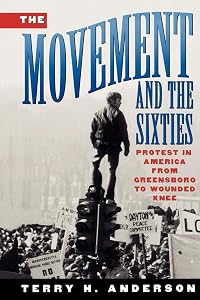
The Movement and the Sixties: Protest in America from Greensboro to Wounded Knee
by Terry H. Anderson
On This Page
Description
Traces the roots of social activism of the 1960s, documents each wave of protest, and examines the lasting effects of a time when Americans questioned their country. It began in 1960 with the Greensboro sit-ins. By 1973, when a few Native Americans rebelled at Wounded Knee and the U.S. Army came home from Vietnam, it was over. In between came Freedom Rides, Port Huron, the Mississippi Summer, Berkeley, Selma, Vietnam, the Summer of Love, Black Power, the Chicago Convention, hippies, Brown show more Power, and women's liberation--The Movement--in an era that became known as The Sixties. Why did millions of citizens take to the streets and become activists, and what impact did they have on America? These are questions Terry H. Anderson explores in this searching history of the social activism that defined a generation of young Americans and that called into question the very nature of "America." Drawing on interviews, "underground" manuscripts collected at campuses and archives throughout the nation, and many popular accounts, Anderson begins with Greensboro and reveals how one event built upon another and exploded into the kaleidoscope of activism by the early 1970s. Civil rights, student power, and the crusade against the Vietnam War composed the first wave of the movement, and during and after the rip tides of 1968, the movement changed and expanded, flowing into new currents of counterculture, minority empowerment, and women's liberation. The parades of protesters, along with shocking events--from the Kennedy assassination to My Lai--encouraged other citizens to question their nation. Was America racist, imperialist, sexist? Unlike other books on this tumultuous decade, this is neither a personal memoir, nor a treatise on New Left ideology, nor a chronicle of the so-called leaders of the movement. Instead, it is a national history, a compelling and fascinating account of a defining era that remains a significant part of our lives today.--Adapted from book jacket. show lessTags
Recommendations
































Member Reviews
Provides an interesting and useful collage of activism in the 1960s. His lively discussion of the 1950s is more about how the members of the movement, growing up in the period, would think of the time in retrospect. His account of the civil rights movement, which provides "a boot camp" for the movement, is cut loose from much good work that has been done (Dittmer's Local People) on the interconnections between the local people who had been fighting Mississippi white supremacy since the 40s. The impressionistic view of 1968 is an enjoyable read, with very readable portraits of the student protest at Columbia, the campaigns of RFK, McCarthy and Nixon. The conventions in Miami and Chicago. And the devastating murders of RFK and MLK. But show more were did all of this come from? It would seem that Anderson's view of this "reform" movement is like his view of all reform movements in American history, somewhat spontaneous in which the grievances are sufficient cause for the existence of protest. His portrait of women's liberation that follows in the second wave is interesting in that he throws out opposition to the ERA by Phyllis Schlafly without contextualizing this within debates surrounding women's empowerment stretching back to the early 20th C. Both the Civil Rights Movement of the 1960s and the Women's Liberation Movement in the 1970s have long histories stretching back into at least the early 20th C. The massive parallelism that Anderson uses tends to obscure these discrete histories. At bottom, the problem with Anderson's account, entertaining though it may be is that this reader, at least, remains unconvinced that history really works that way. How do we explain the persistence of racial tensions today, or the gender contest in the workplace, or the class conflicts which are visible in a society in which a sinking tide is lowering all boats. Perhaps as Sara Evans points out this is best seen as the companion book to the documentary Making Sense of the Sixties?
David Chalmers defines Anderson's contribution this way:
Defining "movement" as "all the activists who demonstrated for social change" between 1960 and the end of the Vietnam War, Anderson finds it too volatile and amorphous to be understood through leadership, organizational history, or ideology. Favoring the term "kaleidoscopic," he rejects tracing themes in favor of a chronological unfolding. His metaphor is properly oceanic, the surge of the earlier sixties yields to the rip tides of 1968, with the second wave flowing along the currents of empowerment and liberation, cresting and then receding after having brought a sea change to the American Cold War Culture. (p. 1289)
And on the impact of the sixties, Chalmers points out that
Anderson credits the sixties with altering the Cold War culture and creating an ethic more flexible and tolerant, more skeptical of experts, leaders and institutions, and more open about feelings, more compassionate, and more liberated sexually. (p. 1289)
Sara Evans credits his book with challenging "the declension narrative about the late 1960s activism offered by a number of other authors (see for example Todd Gitlin The Sixties [1987]." (p. 941) but then she goes on to point out that he has ignored issues of race, class and gender in his narrative and acts as if these streams in the movement come out of nowhere. As she points out "each of the issues and constituencies mobilized during the 1960s had its own history and dynamic. Anderson tends to skim over these, describing in each case the wrongs they set out to right as sufficient cause." (p. 942) show less
David Chalmers defines Anderson's contribution this way:
Defining "movement" as "all the activists who demonstrated for social change" between 1960 and the end of the Vietnam War, Anderson finds it too volatile and amorphous to be understood through leadership, organizational history, or ideology. Favoring the term "kaleidoscopic," he rejects tracing themes in favor of a chronological unfolding. His metaphor is properly oceanic, the surge of the earlier sixties yields to the rip tides of 1968, with the second wave flowing along the currents of empowerment and liberation, cresting and then receding after having brought a sea change to the American Cold War Culture. (p. 1289)
And on the impact of the sixties, Chalmers points out that
Anderson credits the sixties with altering the Cold War culture and creating an ethic more flexible and tolerant, more skeptical of experts, leaders and institutions, and more open about feelings, more compassionate, and more liberated sexually. (p. 1289)
Sara Evans credits his book with challenging "the declension narrative about the late 1960s activism offered by a number of other authors (see for example Todd Gitlin The Sixties [1987]." (p. 941) but then she goes on to point out that he has ignored issues of race, class and gender in his narrative and acts as if these streams in the movement come out of nowhere. As she points out "each of the issues and constituencies mobilized during the 1960s had its own history and dynamic. Anderson tends to skim over these, describing in each case the wrongs they set out to right as sufficient cause." (p. 942) show less
A very good summary for a wide readership.
Ratings
Members
- Recently Added By
Lists

r/AskHistorians' Recommended Books
1,068 works; 19 members

Books that don't know they belong in a bathroom
41 works; 3 members
Author Information

9 Works 428 Members
Terry H. Anderson is Professor of History at Texas AM University. A Vietnam veteran, he has taught in Malaysia and Japan, and was a Fulbright professor in China and the Mary Ball Washington Professor of American History at University College, Dublin. His is the author of numerous books, including The Movement and the Sixties.
Common Knowledge
- Canonical title
- The Movement and the Sixties: Protest in America from Greensboro to Wounded Knee
- Important places
- USA
- Original language
- English
Classifications
- Genres
- Nonfiction, History, General Nonfiction, Politics and Government
- DDC/MDS
- 303.48 — Society, government, & culture Social sciences, sociology & anthropology Social processes Social change Causes of change
- LCC
- HN90 .R3 .A6764 — Social sciences Social history and conditions. Social problems. Social reform Social history and conditions. Social problems. By region or country
- BISAC
Statistics
- Members
- 164
- Popularity
- 200,191
- Reviews
- 2
- Rating
- (4.17)
- Languages
- English
- Media
- Paper
- ISBNs
- 2