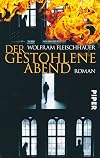
Der gestohlene Abend: Roman
by Wolfram Fleischhauer
On This Page
Tags
Recommendations
Member Recommendations
JuliaMaria In beiden Romanen ist der Literaturwissenschaftler Paul de Man Vorbild.

Member Reviews
Matthias was looking forward to the 1987-88 school year, that he would spend at Hillcrest studying at the prestigious INAT (Institute for New Aesthetic Theory). Once there however, he finds out that exchange students are only allowed to take beginner level subjects.
Thoroughly disillusioned, he chooses 3 subjects at random and resigns himself to a wasted year. Oddly enough, he manages to befriend (read: have a fling with) the girlfriend of the INAT's star student. The girl is pretty enough, and Matthias' hopes of finding out more about the mysterious INAT don't seem so unattainable anymore.
I started reading The stolen evening hoping for a campus murder mystery, but instead got to explore the merits of a certain type of literary analysis. show more At the end, after becoming a fan of the theory, I get thrown for a loop contemplating its validity, given the circumstances of the theory's origin.
I am sorely tempted to dis the whole thing, because it took over 60% of the book for the action to start. And to be fair, all this time I kept wondering what the point of everything was.
On the other hand, without the introduction into the INAT philosophy, complete with actual "practical" examples of its use, the rest of the much-awaited action would make no sense.
Admittedly, the book does leave us with an interesting dilemma: is it possible to separate the author from his work? And if so, can he be considered innocent of any damage that his written work may have caused?
Expressed like this, the question may seem rather abstract and of little interest. If you however, consider said damaging work to bea series of cruel antisemitic articles written during Word War II it suddenly gains a lot more interest.
Score: 3.45 / 5
I found the literary theory utterly fascinating, and I also greatly enjoyed Matthias' detective work which has thrown a new light over said theory. The question that the book invites us to ponder is a very thought-provoking one.
But an introduction lasting 60% of the book is rather much. Not to mention the ending that kept being postponed. Things had all been solved, people humiliated left right and center... and yet the author still finds room for an epilogue. show less
Thoroughly disillusioned, he chooses 3 subjects at random and resigns himself to a wasted year. Oddly enough, he manages to befriend (read: have a fling with) the girlfriend of the INAT's star student. The girl is pretty enough, and Matthias' hopes of finding out more about the mysterious INAT don't seem so unattainable anymore.
I started reading The stolen evening hoping for a campus murder mystery, but instead got to explore the merits of a certain type of literary analysis. show more At the end, after becoming a fan of the theory, I get thrown for a loop contemplating its validity, given the circumstances of the theory's origin.
I am sorely tempted to dis the whole thing, because it took over 60% of the book for the action to start. And to be fair, all this time I kept wondering what the point of everything was.
On the other hand, without the introduction into the INAT philosophy, complete with actual "practical" examples of its use, the rest of the much-awaited action would make no sense.
Admittedly, the book does leave us with an interesting dilemma: is it possible to separate the author from his work? And if so, can he be considered innocent of any damage that his written work may have caused?
Expressed like this, the question may seem rather abstract and of little interest. If you however, consider said damaging work to be
Score: 3.45 / 5
I found the literary theory utterly fascinating, and I also greatly enjoyed Matthias' detective work which has thrown a new light over said theory. The question that the book invites us to ponder is a very thought-provoking one.
But an introduction lasting 60% of the book is rather much. Not to mention the ending that kept being postponed. Things had all been solved, people humiliated left right and center... and yet the author still finds room for an epilogue. show less
Ein Buch über einen Austauschstudent der in den 80ern an einer amerikanischen Uni studiert klingt auf den ersten Blick wenig spannend - aber genau das Gegenteil ist hier der Fall. In einer gekonnten Mischung aus Kampus, Krimi, Kultur, Intrige und Romantik, erzählt Fleischhauer diese semi-autobiografische Geschichte, die, wie sich später herausstellt, sich um einen skandalösen Fall dreht der in den 80er die Welt der Literaturwissenschaft in Aufruhr gebracht hat (die entsprechende Person hat einen fiktiven Namen - wie fast alle mehr oder weniger "Gegenwärtigen" Personen im Buch, basiert aber auf einem wahren Fall). Alles in allem ein sehr empfehlenswertes Buch was zudem spannend und edukativ ist.
Ratings
Members
- Recently Added By
Lists

Academia in Fiction
158 works; 23 members

Best Campus Novels
99 works; 18 members
Author Information

21+ Works 613 Members
Classifications
Statistics
- Members
- 17
- Popularity
- 1,450,763
- Reviews
- 2
- Rating
- (3.29)
- Languages
- English, German
- Media
- Paper
- ISBNs
- 2