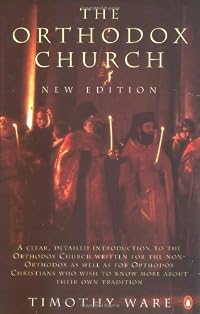
The Orthodox Church
by Kallistos Ware
On This Page
Description
"Since its first publication thirty years ago, Timothy Ware's book has become established throughout the English-speaking world as the standard introduction to the Orthodox Church. Orthodoxy continues to be a subject of enormous interest among Western Christians, and the author believes that an understanding of its standpoint is necessary before the Roman Catholic and Protestant churches can be reunited. He explains the Orthodox views on such widely ranging matters as ecumenical councils, show more sacraments, free will, purgatory, the papacy and the relation between the different Orthodox churches"--Back cover. show lessTags
Recommendations






Member Recommendations

by anonymous user
Member Reviews
Like many Protestants, I have not experienced an in-depth introduction to Eastern Orthodoxy in my life. I’ve driven by its churches, sure, I’ve met its churchgoers, and in religion classes, I’ve read about its history. However, I never have taken a deep-dive into its culture on my own, mediated only be an advocate for its faith expression. Therefore, I read Timothy Ware’s classic work, now in a third edition, on the Eastern Orthodox Christian faith with the hope of better appreciating this church.
Historically, the western and eastern churches began to drift apart in the later half of the first millennium because of language and cultural differences. The frosty relationship was cemented in 1054 when the patriarchs of Rome and show more Constantinople excommunicated each other. As such, they’ve developed two very different histories, with the Protestant Reformation in the West and a pronounced interaction with Islam in the East. Even the theological terminologies, methodologies, and questions tend to be starkly different among the two groups.
I appreciated much of what this book taught me about Eastern Orthodoxy. I find its theological tradition mostly appealing, but I struggle with its understanding of the church (ecclesiology). Eastern Orthodoxy, like almost every other religious movement, suffers from the idea that its tradition must be exclusively right instead of just another voice in a healthy dialogue. This book’s final chapter on ecumenism illustrates this pitfall well. The church’s only proposal for reconciliation is for other groups to see the “error” in their ways. It’s hard to erase 1500 years of isolation without respecting the other side’s isolation first.
This book offers a solid introduction to Eastern Orthodoxy and represents a good exposition of the religious differences of the church with other Christian faiths. It should continue to help seminary and divinity students understand the rich theological world they inhabit. It’s written more for that ilk and not for the wider reading public. Nonetheless, it helps elucidate the historical forces in one of the most ancient of faiths. show less
Historically, the western and eastern churches began to drift apart in the later half of the first millennium because of language and cultural differences. The frosty relationship was cemented in 1054 when the patriarchs of Rome and show more Constantinople excommunicated each other. As such, they’ve developed two very different histories, with the Protestant Reformation in the West and a pronounced interaction with Islam in the East. Even the theological terminologies, methodologies, and questions tend to be starkly different among the two groups.
I appreciated much of what this book taught me about Eastern Orthodoxy. I find its theological tradition mostly appealing, but I struggle with its understanding of the church (ecclesiology). Eastern Orthodoxy, like almost every other religious movement, suffers from the idea that its tradition must be exclusively right instead of just another voice in a healthy dialogue. This book’s final chapter on ecumenism illustrates this pitfall well. The church’s only proposal for reconciliation is for other groups to see the “error” in their ways. It’s hard to erase 1500 years of isolation without respecting the other side’s isolation first.
This book offers a solid introduction to Eastern Orthodoxy and represents a good exposition of the religious differences of the church with other Christian faiths. It should continue to help seminary and divinity students understand the rich theological world they inhabit. It’s written more for that ilk and not for the wider reading public. Nonetheless, it helps elucidate the historical forces in one of the most ancient of faiths. show less
Great overview of the Orthodox churches; there's not much to complain about. I would've liked a bit more theology, but you can't have everything. To my surprise, the twentieth century history bits were my favorites- what could easily have devolved into an 'oh how we were oppressed by evil communists' rant was very balanced and insightful. It's odd that someone with such a firm grasp on history can still claim that the Orthodox church practices Christianity as is was practiced during the age of the great councils, but no doubt there's a way to finesse the somewhat obvious differences between the national (dare I say nationalist?) churches of the present and the ideas of primitive Christianity.
This book and Bp. Kalistos' other, "The Orthodox Way" was recommended by the Orthodox priest who taught me a lot about the church. I converted to Orthodoxy because of these books, so they are a great guide to one considering becoming a catechumen.
Reading Timothy Ware’s book Orthodox Christianity, I realized that the joy of life was the essence of Orthodoxy. God became incarnate, thus transforming the material world by sanctifying it. Orthodox theology emphasizes the unknowability of God. The fundamental truths of Christianity are mysteries, ineffable, beyond our understanding.
Ware concisely explains the schism between the Latin and Eastern churches. Linguistic differences made the churches strangers to each other, with Rome speaking Latin and Constantinople Greek. Cultural differences contributed to the rift, too. In the 11th century the East was richest, most sophisticated empire in the world. They saw the West as smelly upstarts, not much more evolved than barbarians. Ware, show more an Orthodox priest, expresses regret that the East wasn’t more tolerant.
The schism was mainly caused by arguments about religious doctrine. The problem of the Filioque was a dispute about the emanation of the Holy Spirit and the Trinity, which spoke directly to the place of Christ within the Trinity and the nature of Christ himself. Another fight was on papal authority; the West was for a highly centralized authority while the East preferred a system of patriarchates, with the Bishop of Rome as first among equals, not superior to other churches. There were other religious differences, such as marriage for priests and the use of leavened or unleavened bread for communion, but these were not as severe as the questions around the Filioque or papal authority. show less
Ware concisely explains the schism between the Latin and Eastern churches. Linguistic differences made the churches strangers to each other, with Rome speaking Latin and Constantinople Greek. Cultural differences contributed to the rift, too. In the 11th century the East was richest, most sophisticated empire in the world. They saw the West as smelly upstarts, not much more evolved than barbarians. Ware, show more an Orthodox priest, expresses regret that the East wasn’t more tolerant.
The schism was mainly caused by arguments about religious doctrine. The problem of the Filioque was a dispute about the emanation of the Holy Spirit and the Trinity, which spoke directly to the place of Christ within the Trinity and the nature of Christ himself. Another fight was on papal authority; the West was for a highly centralized authority while the East preferred a system of patriarchates, with the Bishop of Rome as first among equals, not superior to other churches. There were other religious differences, such as marriage for priests and the use of leavened or unleavened bread for communion, but these were not as severe as the questions around the Filioque or papal authority. show less
This is a worthwhile book for anyone who is embarking on a study of Orthodox Christianity whether for academic or spiritual reasons. Bishop Ware's style is straightforward and clear, and his summaries are an adequate introduction. The sections on theology accomplish their purpose quite nicely, the sections on history less so. While the book establishes a basic timeline for Orthodox history, it's apparent that Ware is not a historian by training and the sections suffer from various anachronisms and misuses of theory. Most egregiously, Ware projects the notion of a modern Russian nation backwards onto Kievan Rus. My recommendation would be to skim the history sections and spend your time in the excellent and succinct introduction to show more Orthodox theology. show less
the book begins by giving a lot of fascinating history of the Orthodox Church. To me, as a western Christian, it makes a lot of sense to start with the history because it helps explain the eastern mindset a bit.. especially since the eastern church hasn't had the same controversies that helped form the western church. The book finishes up by briefly explaining how the Orthodox Church worships, sacramental and practical.
Essential book for anyone considering joining the Orthodox church. He is inclined to look on the "bright" side of certain issues, like ecumenical relations.
Members
- Recently Added By
Lists

Mo's Reading List
218 works; 1 member

Orthodox Christianity
98 works; 2 members
Author Information

77+ Works 4,909 Members
Kallistos Ware is an English bishop within the Eastern Orthodox Church under the Ecumenical Patriarchate of Constantinople and one of the best-known contemporary Eastern Orthodox theologians. From 1982 he has held the Titular Bishopric of Diokleia.
Series
Belongs to Publisher Series
Common Knowledge
- Canonical title
- The Orthodox Church
- Original publication date
- 1963
- Epigraph
- Unknown and yet well known. 2 Corinthians vi, 9
Introduction.
[There are also one or more epigraphs to chapters 1-6, 8 and 10-16]. - Dedication
- [None]
- First words
- 'All Protestants are Crypto-Papists,' wrote the Russian theologian Alexis Khomiakov to an English friend in the year 1846.
Introduction.
These are two accounts of Church life in Russia shortly before the Second World War.
Chapter 1. The beginnings. - Last words
- (Click to show. Warning: May contain spoilers.)Meanwhile the persecuted Orthodox Church serves as a reminder to the west of the importance of martyrdom, and constitutes a living testimony to the value of suffering in the Christian life.
- Original language
- English
Classifications
- Genres
- Religion & Spirituality, Nonfiction, History, General Nonfiction
- DDC/MDS
- 281.9 — Religion Christian denominations Early church and Eastern churches Eastern or Greco-Russian or Holy orthodox church
- LCC
- BX106 .W3 — Philosophy, Psychology and Religion Christian Denominations Christian Denominations Eastern churches. Oriental churches General
- BISAC
Statistics
- Members
- 2,228
- Popularity
- 9,012
- Reviews
- 12
- Rating
- (4.18)
- Languages
- 5 — English, Greek, Polish, Spanish, Swedish
- Media
- Paper, Ebook
- ISBNs
- 11
- ASINs
- 13