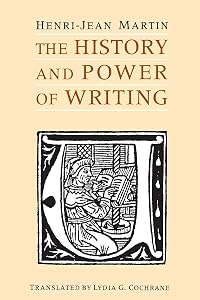
The History and Power of Writing
by Henri-Jean Martin
On This Page
Description
Cultural history on a grand scale, this immensely readable book is the story of writing from its very beginnings to its recent transformations through technology. Traversing four millennia, Martin shows how the written word originated, how it spread, and how it figured in the evolution of civilization. In pursuit of writing's origins, Henri-Jean Martin asks how much those origins owed to practical necessity, and how much to religious and social systems of symbols. He describes the precursors show more to writing and reveals its place in early civilizations as a mnemonic device in service of the spoken word. The tenacity of the oral tradition plays an important part in this history. All written texts were normally read aloud well into the thirteenth century, Martin notes, and even as late as the eighteenth century the concept of "taking notes" was largely unknown to educated individuals trained in classical rhetoric and arts of memory. The story of writing is also a history of technology, and Martin charts the progress of the written word from Sumerian clay tablets to papyrus to paper and the advent of the printing press. His discussion of technology and materials details the development of standardized writing as well, placing such innovations as spacing and capital letters in relation to the increased use and demystification of writing. Paying particular attention to the technological advances that took place in Germany, Martin chronicles the growing importance of printing right down to its explicit role in the spread and success of the Protestant Reformation. He shows how these technological and cultural movements gathered impetus with the Industrial Revolution, when literacy became preeminent. Continuing on to the electronic revolution, Martin's account takes in the changes wrought on writing by computers and electronic systems of storage and communication, and offers surprising insights into the influence these new technologies have had on children born into the computer age. The power of writing to influence and dominate is, indeed, a central theme in this history, as Martin explores the processes by which the written word has gradually imposed its logic on society over four thousand years. The summation of decades of study by one of the world's great scholars on the subject, this fascinating account of writing explains much about the world we inhabit, where we uneasily confer, accept, and resist the power of the written word. show lessTags
Recommendations






















Member Reviews
This book is a towering achievement in bridging the gap between the technical complexities of the history of writing as an academic subject, and the needs of a layperson or student with some education, a curiosity about the subject, and an open mind. There is very little about this work that can be called pop, but it's also not so opaque that it's completely inaccessible. In other words, Martin taught me a whole lot about the history of writing and printing and dispelled some common misconceptions and misunderstandings---all in a relatively short treatment, considering he deals with all of human history. The amount of detail is surprising, and the extensive references will satisfy anyone more serious about the subject. Martin's style show more does encourage the reader at a few places to do some legwork of his own, and, admittedly, anyone not interested in the subject at some level will be bored to the point of suicide, but for me the book just flew by. Even if the reader is not willing to do any further research, and doesn't mind skipping some sections that don't interest him (such as the redacting of contracts of commerce during the Renaissance, to pick one example at random), he will nevertheless walk away more knowledgeable about the subject than he ever imagined possible in such a short time-frame. show less
Henry-Jean Martin propone con un lavoro poderoso e importante un lungo viaggio nella storia della scrittura, con l’ambizioso obiettivo di andare oltre i confini geografici. L’uomo diventa sociale quando introduce il mezzo scritto per regolamentare i rapporti, per dare una memoria ai fatti. E la stessa scrittura impone cambiamenti sociali, tecnici, i supporti, papiro, pergamena e carta non sono neutri, così come le tecniche di scritture. La scrittura consente di introdurre la moneta, diventa la premessa della normazione e, quindi, delle organizzazioni sociali. La prima parte, quella che affronta i tempi più remoti, è molto impegnativa, si vede il lavoro dello storico attraverso la ricostruzione dei passaggi temporali. Poi man mano show more che ci si avvicina all’epoca contemporanea la narrazione diventa decisamente più fluida, tutto è più semplice, chiaramente anche la maggiore conoscenza delle cose da parte del lettore fa la sua parte. Molto interessanti anche le considerazioni finali che danno una prospettiva futura allo scritto, rimarcando l’importanza di non perdere di vista la storia. Una buona lettura di un libro utilissimo anche in sede di consultazione. show less
Sep 5, 2022Italian
I have mixed feelings about this book, I already enjoyed it so much, it was enlightening and with a lot of historical information that you have to process very slowly and, maybe you have to go back sometimes just to reinforce all the knowledge you're getting with this book. It should be definitively a must and a reference book for librarians, students of librarianship and people related with book industry. I'm convinced every librarian around the globe must have this book in his/her personal library
However I said I have mixed feelings and this is because although in the title never mention anything about "universal" history of writing, sometimes (especially from chapter 6 to the end of the book) I feel it was just about the history of show more writing in Europe and specially in France, with a few exceptions talking about Germany, England and the United States. The author never mention the case of Mexico and I think it's a huge mistake not to include a country where we had the first press in all the continent, even before the United States.
And what about the ebook? Although the last part talks about of the development of machines and their impact to writing culture, it never really talks about the most important development for writing records since Gutenberg's press. The book was first published in 1988, of course we can talk about the boom of the ebook in the 2007 but in fact ebooks have been around 70s.
It deserves another revision in order to solve this two big missing points of a great, great history. show less
However I said I have mixed feelings and this is because although in the title never mention anything about "universal" history of writing, sometimes (especially from chapter 6 to the end of the book) I feel it was just about the history of show more writing in Europe and specially in France, with a few exceptions talking about Germany, England and the United States. The author never mention the case of Mexico and I think it's a huge mistake not to include a country where we had the first press in all the continent, even before the United States.
And what about the ebook? Although the last part talks about of the development of machines and their impact to writing culture, it never really talks about the most important development for writing records since Gutenberg's press. The book was first published in 1988, of course we can talk about the boom of the ebook in the 2007 but in fact ebooks have been around 70s.
It deserves another revision in order to solve this two big missing points of a great, great history. show less
Jul 26, 2023Spanish
Ratings
Members
- Recently Added By
Lists

Tiro Typeworks on Grapholinguistics
41 works; 1 member
Author Information

All Editions
Some Editions
Awards and Honors
Awards
Common Knowledge
- Canonical title*
- Histoire et pouvoirs de l'écrit
- Original title
- Histoire et pouvoirs de l'écrit
- Original publication date
- 1988-12 (1e édition originale française, Histoire et décadence, Perrin) (1e é | dition originale franç | aise, Histoire et dé | cadence, Perrin); 1996 (Réédition française, Bibliothèque de l'évolution de l'humanité, Albin Michel) (Ré | é | dition franç | aise, Bibliothè | que de l'é | volution de l'humanité | , Albin Michel)
- Dedication*
- Pour Odile
- Original language*
- Français
*Some information comes from Common Knowledge in other languages. Click "Edit" for more information.
Classifications
Statistics
- Members
- 206
- Popularity
- 158,858
- Reviews
- 3
- Rating
- (4.04)
- Languages
- English, French, Italian, Spanish
- Media
- Paper
- ISBNs
- 7
- UPCs
- 1
- ASINs
- 2