The Wump World
by Bill Peet
On This Page
Description
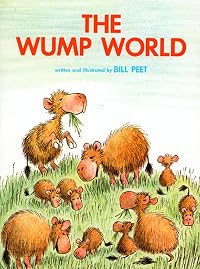
The Wump World is an unspoiled place until huge monsters bring hordes of tiny creatures from the planet Pollutus.Tags
Recommendations



Member Recommendations

by bookel
Member Reviews
Readers who found Dr. Seuss' The Lorax too simplistic a denunciation of pollution (and the causes thereof) will undoubtedly be appalled at Bill Peet's The Wump World, an environmentally-themed picture-book first published in 1970, in which an idyllic world inhabited by peaceful quadrupeds known as (what else?) Wumps, is invaded by the evil Pollutians! Soon, the grassy planet has been paved over, cities have risen, the skies are clogged with smoke, and the once-happy Wumps live in miserable exile beneath the surface of their own world. Can things ever be set to rights...?
The answer to that, of course, is yes and no - and that's about the only example of "nuance" in the story. Released the year before The Lorax, this book was definitely a show more trail-blazer, one of the first children's storybooks to address the issues of pollution and environmental degradation. The story itself is engaging, with classic good guys (gentle Wumps) and bad guys (expansionist Pollutians), and adorable artwork. I found it entertaining enough that I will be seeking out more of Bill Peete's work.
But although The Wump World does a good job of raising awareness about the damage done by pollution (and interplanetary colonization, one presumes) it really does nothing to increase its readers' understanding of that pollution - what causes it, and how to fight it. Many of the pressing environmental problems facing us today have little to do with evil outsiders, and everything to do with bad habits, and unhealthy social and economic structures. With close to half of the human population now living in urban environments, Peet's evident distaste for cities didn't seem very constructive to me. It may be unfair, but I couldn't help comparing this with Pete Brown's excellent The Curious Garden, which chronicles the ways in which a city landscape is improved by gardens.
Still, despite these criticisms, I enjoyed the story, loved the illustrations, and respect Peet's role as a picture-book pioneer. The Wump World is still relevant, and still has a place on the contemporary children's shelf. Just make sure you also have books like The Curious Garden. show less
The answer to that, of course, is yes and no - and that's about the only example of "nuance" in the story. Released the year before The Lorax, this book was definitely a show more trail-blazer, one of the first children's storybooks to address the issues of pollution and environmental degradation. The story itself is engaging, with classic good guys (gentle Wumps) and bad guys (expansionist Pollutians), and adorable artwork. I found it entertaining enough that I will be seeking out more of Bill Peete's work.
But although The Wump World does a good job of raising awareness about the damage done by pollution (and interplanetary colonization, one presumes) it really does nothing to increase its readers' understanding of that pollution - what causes it, and how to fight it. Many of the pressing environmental problems facing us today have little to do with evil outsiders, and everything to do with bad habits, and unhealthy social and economic structures. With close to half of the human population now living in urban environments, Peet's evident distaste for cities didn't seem very constructive to me. It may be unfair, but I couldn't help comparing this with Pete Brown's excellent The Curious Garden, which chronicles the ways in which a city landscape is improved by gardens.
Still, despite these criticisms, I enjoyed the story, loved the illustrations, and respect Peet's role as a picture-book pioneer. The Wump World is still relevant, and still has a place on the contemporary children's shelf. Just make sure you also have books like The Curious Garden. show less
In my opinion, this is a great book for teaching science! This book describes a grassy filled world, where the Wumps live, that gets invaded by Pollutians who turn the world into a concrete jungle. Pollution of our Earth, or any world for that matter, can be a tough issue to present to children as urgent and important. In this book, children can immediately see the contrasting difference between the grassy world and the concrete city through the illustrations. The illustrations have a lot of detail that depicts how harmful and disgusting a smoky grey sky can be. The water in the illustrations is a mixture of greens and browns instead of refreshing blues. In addition, the book still makes the new world relatable to our world through show more showing pictures of highways filled with cars. Finally, I think this is a great book because the creative plot allows for a child to become engaged in, what could be considered, a boring topic. By including a “great flock of potbellied monsters” zooming through the sky, the children are intrigued by who the monsters could be; and the suspense of such a terrifying creature flying through the sky makes them wonder what the creature will do to the innocent Wumps. Overall, this story is very engaging and can be a great tool to teach more than one subject! show less
Honestly, of all the books I read throughout my childhood, this one stuck with me the most and I think about it fairly regularly. I without question credit this and [b:The Lorax|7784|The Lorax|Dr. Seuss|https://i.gr-assets.com/images/S/compressed.photo.goodreads.com/books/1327879938l/7784._SX50_.jpg|886002] for turning me into an environmentalist before I even knew what that meant.
Trees ♥
Trees ♥
2023 - 1970’s Immersion Reading Challenge
The Wumpy World by Bill Peet (1970) 44 pages.
READING LEVEL: 5.3 AR POINTS: 0.5
I’m starting the new year off with 6 Bill Peet children’s books from the ‘70s. These will all be donated to Bridge City Elementary School
Putting aside today’s political scam on “climate change” to coerce a move towards a one world government, this book actually does show the truth about humans and our destructive ways here on earth…except this takes place on Wump World.
The author should have devoted more than one page about the cute little Wumps and their carefree life before the Pollutians from Pollutus came and destroyed everything so kids can connect and really feel sorry for them. Otherwise, a good show more little story. show less
The Wumpy World by Bill Peet (1970) 44 pages.
READING LEVEL: 5.3 AR POINTS: 0.5
I’m starting the new year off with 6 Bill Peet children’s books from the ‘70s. These will all be donated to Bridge City Elementary School
Putting aside today’s political scam on “climate change” to coerce a move towards a one world government, this book actually does show the truth about humans and our destructive ways here on earth…except this takes place on Wump World.
The author should have devoted more than one page about the cute little Wumps and their carefree life before the Pollutians from Pollutus came and destroyed everything so kids can connect and really feel sorry for them. Otherwise, a good show more little story. show less
This book was kinda long and I would recommend reading it to older students because it used imagination. You could have a class draw their own world and it getting taken over as well.
If you are looking for a book that can inform children about environmental issues, the Wump World could be a good storybook. This book is about the Wump World that got invaded by other creatures that was looking for a better place to live. This book is a great book for 3rd - 4th grade children.
The wumps live in a wonderful green planet that is invaded by aliens called Pollutians who come and destroy the beautiful planet and pollute the air. After the Pollutians realize this planet had become too polluted they leave to find another planet to inhabit, and the wumps are able to live there again as nature is slowly restored.
Members
- Recently Added By
Lists

Favorite Animal Fiction
359 works; 156 members

Fiction to Read for Earth Day
50 works; 8 members

Favorite Picture Books
479 works; 160 members

Written and Illustrated By
805 works; 1 member

Favorite Picture and Board Books
480 works; 1 member
Talk Discussions
Past Discussions
scifi about a species that advances so fast they pave over the world only to be forced to leave it in Name that Book (August 2010)
Author Information

51+ Works 18,162 Members
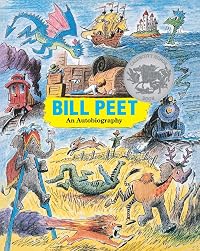
Bill Peet was born William Bartlett Peed on January 29, 1915 in Grandview, Indiana. He graduated from the John Herron Art Institute in Indianapolis. In 1937, he began his artistic career at Walt Disney Studios. While there, he worked on several feature films including Fantasia, Sleeping Beauty, Song of the South, Alice in Wonderland, and Peter show more Pan. He was both an artist and the screenwriter for several films including Cinderella, 101 Dalmatians, and Sword in the Stone. While working at Disney, he also wrote his own children's books and eventually left to become a full-time writer. His first book, Hubert's Hair-Raising Adventure, was published in 1955. During his lifetime, he wrote and illustrated 35 children's books including The Pinkish, Purplish, Bluish Egg; The Whingdingdilly; Chester the Worldly Pig; and Luckiest One of All. His book, Bill Peet: An Autobiography, was named a Caldecott Honor Book in 1989. He died on May 11, 2002 at the age of 87. (Bowker Author Biography) show less
Awards and Honors
Notable Lists
Common Knowledge
- Canonical title
- The Wump World
- Original publication date
- 1970
- People/Characters
- The Wumps; The Pollutians
- Important places
- Pollutus
Classifications
Statistics
- Members
- 1,428
- Popularity
- 16,615
- Reviews
- 17
- Rating
- (4.18)
- Languages
- English
- Media
- Paper
- ISBNs
- 13
- UPCs
- 3
- ASINs
- 11