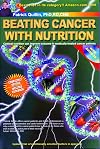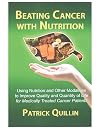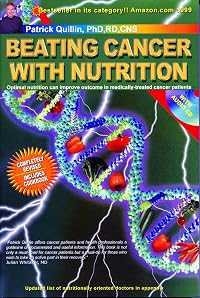
Beating Cancer with Nutrition (Fourth Edition) Rev
by Patrick Quillin
On This Page
Description
Optimal nutrition works synergistically with modern oncology procedures and can dramatically improve the quality and quantity of life for cancer patients. Nutrition helps to harness the incredible healing power of nature and science, with the results being a healthy human body that is self-regulating and self-repairing..
Tags
Recommendations
Member Reviews
Ever wonder what goes on at Cancer Centers of America? This book may give you some clues, as the author was associated with those cancer hospitals.
His program in three steps:
1- Debulk tumors with “traditional” treatments: surgery, radiation, chemo, plus hyperthermia.
2- Regulate remaining cancer cells with enzymes.
3- Feed the immune system. Build resistance with nutrition.
What is meant by nutrition? “Anti-cancer” foods, especially proteins and vegetables, plus megasupplements: vitamins, minerals, herbs, glandulars, fatty acids, probiotics, food extracts. This book assumes that cancer is caused by deficiencies, not excesses.
The recipes in this book include ingredients that should be off-limits to cancer patients: salt, sugar, show more garlic, meats, cheese and dairy, wine, bacon and eggs. Even “liquid smoke,” whatever that is. This book states repeatedly that sugar feeds cancer. Then why do its recipes call for brown sugar? It says on page 115 that brown sugar is “virtually identical to white sugar.” The author calls salt an “essential nutrient.” Being inorganic, salt is neither essential nor a nutrient. Organic sodium and organic chloride are essential, but you won’t find them in salt. He thinks a vegetarian diet might be too alkaline, but cancer patients tend to be too acidic. He calls garlic a “superfood” but garlic is a toxic irritant that contains allicin and mustard oil.
The “traditional” treatments included in this program disable or damage the immune system. Can nutrition repair that damage? Many of these “super” nutrients are said to “boost” the immune system, but how do they do that? Some of them are toxic. If you ingest poison you will get an immune response, but provoking the immune system is not the same as boosting it. Garlic, for example, is credited with stimulating the immune system; its toxicity provokes an immune response. On page 73 this book says, “Biological therapies attempt to fine-tune and focus the immune system into a more vigorous attack on the cancer,” but “most forms have extremely toxic side effects.” So it is unlikely that the damage to the immune system can be undone, and that is the bottom line of this program.
A good discussion but too much science and not enough nature, in my opinion. Too many dubious “super” nutrients to balance against one another. Too much complex biochemistry to manage. Healing does not need to be this complicated. Are concentrated supplements effective in pill form? Can they even be safe in megadoses?
This book is right to assert the importance of nutrition in cancer but I am reminded of Herbert M. Shelton’s sage advice: “There are no superfoods.” show less
His program in three steps:
1- Debulk tumors with “traditional” treatments: surgery, radiation, chemo, plus hyperthermia.
2- Regulate remaining cancer cells with enzymes.
3- Feed the immune system. Build resistance with nutrition.
What is meant by nutrition? “Anti-cancer” foods, especially proteins and vegetables, plus megasupplements: vitamins, minerals, herbs, glandulars, fatty acids, probiotics, food extracts. This book assumes that cancer is caused by deficiencies, not excesses.
The recipes in this book include ingredients that should be off-limits to cancer patients: salt, sugar, show more garlic, meats, cheese and dairy, wine, bacon and eggs. Even “liquid smoke,” whatever that is. This book states repeatedly that sugar feeds cancer. Then why do its recipes call for brown sugar? It says on page 115 that brown sugar is “virtually identical to white sugar.” The author calls salt an “essential nutrient.” Being inorganic, salt is neither essential nor a nutrient. Organic sodium and organic chloride are essential, but you won’t find them in salt. He thinks a vegetarian diet might be too alkaline, but cancer patients tend to be too acidic. He calls garlic a “superfood” but garlic is a toxic irritant that contains allicin and mustard oil.
The “traditional” treatments included in this program disable or damage the immune system. Can nutrition repair that damage? Many of these “super” nutrients are said to “boost” the immune system, but how do they do that? Some of them are toxic. If you ingest poison you will get an immune response, but provoking the immune system is not the same as boosting it. Garlic, for example, is credited with stimulating the immune system; its toxicity provokes an immune response. On page 73 this book says, “Biological therapies attempt to fine-tune and focus the immune system into a more vigorous attack on the cancer,” but “most forms have extremely toxic side effects.” So it is unlikely that the damage to the immune system can be undone, and that is the bottom line of this program.
A good discussion but too much science and not enough nature, in my opinion. Too many dubious “super” nutrients to balance against one another. Too much complex biochemistry to manage. Healing does not need to be this complicated. Are concentrated supplements effective in pill form? Can they even be safe in megadoses?
This book is right to assert the importance of nutrition in cancer but I am reminded of Herbert M. Shelton’s sage advice: “There are no superfoods.” show less
Ratings
Members
- Recently Added By
Author Information
14 Works 439 Members
Patrick Quillin, PhD, RD, CNS, FACN is an internationally recognized expert in the area of nutrition and cancer. He has 40 years of experience as a clinical nutritionist, including 10 years as Vice President of Nutrition for Cancer Treatment Centers of America where he worked with thousands of cancer patients' in multiple hospital settings. He has show more earned his bachelor's, master's, and doctorate degrees in nutrition and is a registered and licensed dietitian (RD LD) and Certified Nutrition Specialist (CNS) and fellow of the American College of Nutrition (FACN). Appeared on over 40 television and 250 radio shows nationwide and is a regular speaker for medical and trade conventions. His 17 books have sold over 2 million copies and include 12 KEYS TO A HEALTHIER CANCER PATIENT He organized 3 CME symposiums on "Adjuvant Nutrition in Cancer Treatment" and co-edited the subsequent textbook. show less
All Editions
Common Knowledge
- Original publication date
- 1998
Classifications
Statistics
- Members
- 196
- Popularity
- 167,195
- Reviews
- 1
- Rating
- (3.33)
- Languages
- English
- Media
- Paper, Ebook
- ISBNs
- 9
- ASINs
- 4