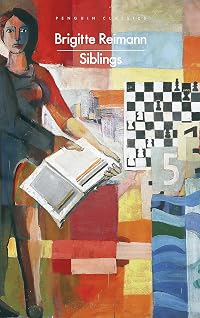
Siblings
by Brigitte Reimann
On This Page
Description
"1960. The border between East and West Germany has closed. For Elisabeth, a young painter, the GDR is her generation's chance to build a glorious, egalitarian socialist future. For her brother Uli, it is a place of stricture and oppression. Separating them is the ever-wider chasm of the Party line; over them loom the twin specters of opportunity and fear, and the shadow of their defector brother Konrad, setting up a clash of idealism and suppression, familial loyalty, and desire. Considered show more a master of socialist realism, Brigitte Reimann (1933-1973) wrote irreverent, autobiographical works that addressed issues and sensibilities otherwise repressed in the GDR. She wrote in her diaries: "I enjoyed success too early, married the wrong man, and hung out with the wrong people; too many men have liked me, and I've liked too many men." After her death from cancer in 1973 at the age of 39, she garnered cult-like attention. This is Reimann's first work of fiction to appear in English"-- show lessTags
Recommendations






















Member Reviews
Brigitte Reimann’s novel Siblings, published in 1963, provides a fascinating window on life in the German Democratic Republic (GDR or East Germany) in the early 1960s, at the height of the Cold War. At the core of the novel is the relationship between Uli and Elisabeth Arendt, young siblings who live in the east with their parents. The two are deeply connected and, as children, spent most of their time together. But education and experience have left them divided on ideological grounds, and their disagreements occasionally turn shrill. Elisabeth, trained as an artist, believes passionately that life in the GDR, which she admits is hardly idyllic, presents an opportunity for their generation to construct an egalitarian future in which show more everyone will strive toward a socialist ideal. Uli, trained as an engineer with a specialization in ship design, wants to follow his chosen profession. But Uli realizes that in socialist East Germany he will be assigned a position that might fill a need but won’t necessarily match his skillset. Where Elisabeth sees opportunity, Uli sees constraint and oppression and when he tells her that he wants to defect to the West, they argue. Uli believes he has no choice. Elisabeth regards defection as betrayal. Adding a bitter edge to the discussion is the fact that the family has already lost older brother Konrad, who defected some years earlier and is, by his own account, doing well for himself. But Konrad’s defection took place before the border dividing the two Germanys was closed (construction of the Berlin Wall began in 1961). Elisabeth narrates. She is a young woman hopelessly divided within herself: in thrall to socialism and suspicious of western influences, but also protective of her brother, wanting him to be happy but unwilling to let him simply walk out of her life. Reimann’s novel generates tension by focusing on the cruel dilemma forced on the population by an iron-fisted regime that had become insular and paranoid as it blindly toed the Soviet ideological line. Siblings is a novel of grim realities that depicts a sad, bleak, utilitarian landscape and at times seems written in shades of gray. In stark contrast, Elisabeth’s fierce intelligence and fiery nature shine through on every page. Brigitte Reimann’s life was cut short in 1973, when she died from cancer at age 39, but she left behind a substantial legacy of fiction and nonfiction works, as well as diaries. Siblings is the first of her novels to be made available in English translation. show less
Siblings is the story of three children in the GDR which was part of the Soviet bloc from 1949 to 1990. Konrad has defected to the west and his presence in the novel is mostly a ghostly absence; Elisabeth has embraced the ideals of a glorious socialist future; and her brother Uli is chafing under the oppression of the regime. When he confides in Elisabeth that he is going to defect too, the scene is set for a tussle between love and duty; loyalty and desire. In a microcosm of a world then bifurcated by the competing philosophies of capitalism and socialism, this novel depicts what it meant to families to have to choose.
For Elisabeth, an artist working in an industrial complex to train the workers as artists too, the GDR offers show more opportunity. But Uli's career has been blighted by a fleeting association with a university professor who transgressed against the regime. He has excellent qualifications as an engineer but can only get work as a draughtsman.
In a narrative that weaves the recent past with the present, the fault lines begin to emerge as Elisabeth encounters criticism from the Party at work. She had made the mistake of expressing her reservations about one of her worker painters that had been foisted on [her] by an overly ambitious union man.
60 years after this novel was published, contemporary readers are familiar through books and film with the modes of suppression and surveillance in the Soviet bloc, but this novella — drawing on the experience of the author's brother's defection and her own work leading a circle of writing workers at a coal mine — was courageous in its time. Brigitte Reimann (1933-1973) rejected Party interference in the arts. According to Wikipedia...
Ultimately, Siblings is about the very real human problem of political differences within families.
To read the rest of my review please visit https://anzlitlovers.com/2023/11/20/siblings-1963-by-brigitte-reimann-translated... show less
For Elisabeth, an artist working in an industrial complex to train the workers as artists too, the GDR offers show more opportunity. But Uli's career has been blighted by a fleeting association with a university professor who transgressed against the regime. He has excellent qualifications as an engineer but can only get work as a draughtsman.
In a narrative that weaves the recent past with the present, the fault lines begin to emerge as Elisabeth encounters criticism from the Party at work. She had made the mistake of expressing her reservations about one of her worker painters that had been foisted on [her] by an overly ambitious union man.
A few of them had only their longing and love of painting to offer. Two or three of them had real talent, and for these I had high hopes. But mostly there were too many clever amateurs who copied soppy landscapes of purple heather and idealised fisherman's cottages. You could have bought half a dozen decent reproductions for the prices they wanted for their kitsch. I would argue with them, then run, sobbing, to tell Lukas that he could carry out his damned cultural revolution on his own, for all I cared. (p.36)
60 years after this novel was published, contemporary readers are familiar through books and film with the modes of suppression and surveillance in the Soviet bloc, but this novella — drawing on the experience of the author's brother's defection and her own work leading a circle of writing workers at a coal mine — was courageous in its time. Brigitte Reimann (1933-1973) rejected Party interference in the arts. According to Wikipedia...
Reimann never joined the Socialist Unity Party of Germany and was critical of the East German state's involvement in the country's literary movement. She wrote in her diary that there were 'Opportunists and numbskulls everywhere. The only subject worth discussing in a novel, it seems, is the need to increase work productivity ... Human problems are not in vogue.'
Ultimately, Siblings is about the very real human problem of political differences within families.
To read the rest of my review please visit https://anzlitlovers.com/2023/11/20/siblings-1963-by-brigitte-reimann-translated... show less
This short novel is the first work by the German writer Brigitte Reimann (1933-1973) to be translated into English, and I hope there will be more. Apparently new editions of several of her books have been published in Germany.
Die Geschwister was first published in 1963 and set in 1960, and explores life in a divided Germany, through a whole series of arguments and conversations.
Elisabeth and her brothers grew up in Dresden where they would have been children at the end of the war and the Nazi regime, and the geographic/political partition of Germany. She still lives and works as a painter and a factory based artist/art teacher in the German Democratic Republic, the Communist State of East Germany, under a government cultural scheme. show more However, she has issues at work with a senior male colleague and famous painter over their differing views on art, factory workers, probably history and society.
Now, she is arguing with her beloved brother over his plans to leave East Germany for the West. He feels that his chances of a good life in the GDR are blocked because their brother Konrad already defected a few years ago, drawn to capitalist and consumerist values. Elisabeth also had a schoolfriend/old flame who she visited in West Berlin.
So the story is structured through conversations, flashbacks to Elisabeth's more recent past as a very young adult and further back to her childhood. In fact the present of the story is only a couple of days.
To be approved by the censors and published in the GDR, this story would have to have a constructively "happy ending" or at least some kind of positive resolution, and to make it clear that the GDR offers a good life to supporters of this model of socialism. Apparently this translation includes material from Reimann's manuscript that probably didn't originally get past the 1960s censors. For all that, the story offers an interesting and more nuanced look at the dilemmas of the characters, and an insight into the sexism faced by a woman on both sides of the border. It is significant that it was set before the Berlin Wall was put up to stop the likes of Uli, Konrad and Gregory simply choosing to move to the capitalist side of the border.
I was disappointed that this edition of the book in the Penguin Classics series doesn't include an introduction or afterword, just a very brief biographical paragraph. That Siblings may be partly autobiographical is really just hinted at. Also, the novel has its own interesting backstory. There are four pages of interesting and relevant endnotes which help in understanding some of the terminology and references in the story. I really want to know more about Brigitte Reimann and hope some more of her work will be translated and published in English. show less
Die Geschwister was first published in 1963 and set in 1960, and explores life in a divided Germany, through a whole series of arguments and conversations.
Elisabeth and her brothers grew up in Dresden where they would have been children at the end of the war and the Nazi regime, and the geographic/political partition of Germany. She still lives and works as a painter and a factory based artist/art teacher in the German Democratic Republic, the Communist State of East Germany, under a government cultural scheme. show more However, she has issues at work with a senior male colleague and famous painter over their differing views on art, factory workers, probably history and society.
Now, she is arguing with her beloved brother over his plans to leave East Germany for the West. He feels that his chances of a good life in the GDR are blocked because their brother Konrad already defected a few years ago, drawn to capitalist and consumerist values. Elisabeth also had a schoolfriend/old flame who she visited in West Berlin.
So the story is structured through conversations, flashbacks to Elisabeth's more recent past as a very young adult and further back to her childhood. In fact the present of the story is only a couple of days.
To be approved by the censors and published in the GDR, this story would have to have a constructively "happy ending" or at least some kind of positive resolution, and to make it clear that the GDR offers a good life to supporters of this model of socialism. Apparently this translation includes material from Reimann's manuscript that probably didn't originally get past the 1960s censors. For all that, the story offers an interesting and more nuanced look at the dilemmas of the characters, and an insight into the sexism faced by a woman on both sides of the border. It is significant that it was set before the Berlin Wall was put up to stop the likes of Uli, Konrad and Gregory simply choosing to move to the capitalist side of the border.
I was disappointed that this edition of the book in the Penguin Classics series doesn't include an introduction or afterword, just a very brief biographical paragraph. That Siblings may be partly autobiographical is really just hinted at. Also, the novel has its own interesting backstory. There are four pages of interesting and relevant endnotes which help in understanding some of the terminology and references in the story. I really want to know more about Brigitte Reimann and hope some more of her work will be translated and published in English. show less
I really liked this book a lot, the writing was really tight and evocative. Also, I learned new things about the DDR, which is always exciting. There's nothing like a good fiction book to make historical things come alive for me, and to stay in my mind for later contemplation and reference and understanding.
There are two reasons why this isn't a 5 star book for me: first, the jumping around in time confused me a bit; second, the ending didn't make sense, and this point probably needs some elaboration.
Basically, Uli wants to go over the Wall and explains pretty clearly to Elizabeth why this is so; Elizabeth debates him several times, but is unable to refute his problems except with "You have to fight if you feel you've been treated show more unjustly". For the whole 2.5 days (I think? Again, the timeline is hard to follow) he is dead set on leaving, and then in the end Joachim shows some interest in a book Uli is reading and now Uli isn't going to go over the wall - what the hell is that about? It never addresses the fundamental problem: Uli is unable to get work with his engineering degree and must work in a factory all because there is a black mark (unwarranted) next to his name, and he's not a Party member. This problem is 100% not addressed, he seemingly out of nowhere decides to just stay, apparently to toil away at a job he hates with no prospects of life ever getting better.
The book was written by an East German in 1963, and while the ending makes sense in that context it is pretty clumsily done. The author should have shown the reader how this change of heart happened, to help the reader understand something so drastic, but perhaps it was left open because the intended audience was East German and they wouldn't have needed any further elaboration. In any case, it's hard to understand from this distance and culture. show less
There are two reasons why this isn't a 5 star book for me: first, the jumping around in time confused me a bit; second, the ending didn't make sense, and this point probably needs some elaboration.
The book was written by an East German in 1963, and while the ending makes sense in that context it is pretty clumsily done. The author should have shown the reader how this change of heart happened, to help the reader understand something so drastic, but perhaps it was left open because the intended audience was East German and they wouldn't have needed any further elaboration. In any case, it's hard to understand from this distance and culture.
Although Brigitte Reimann, translated into English here by Lucy Jones, uses some powerfully descriptive words and phrases in this short novel, the setting is - for me - too claustrophobic.
It's East Germany in the early 1960's, more particularly a factory in a small town peopled by a few main characters.The subject is the East German socialist state and the characters' reaction to it, as they go about their day-to-day lives.
Told through the eyes of a girl, Elizabeth, who is an artist in a workers' collective, it concerns her brother's plan to escape to the West, and her feelings about it. There is an abundance of angst, introspection and moodiness which, in the end, gives the whole work an adolescent flavour with very little depth, show more shade or tone, despite some pleasant narrative passages.
The best that can be said about this book, in my opinion, is that is 'of its time'. So, if your interest is the motivation and interplay of characters in socialist East Germany in the 1960's, you may enjoy "Siblings".
For me, it was too one-dimensional and introspective. It was hard work, but I finished it. show less
It's East Germany in the early 1960's, more particularly a factory in a small town peopled by a few main characters.The subject is the East German socialist state and the characters' reaction to it, as they go about their day-to-day lives.
Told through the eyes of a girl, Elizabeth, who is an artist in a workers' collective, it concerns her brother's plan to escape to the West, and her feelings about it. There is an abundance of angst, introspection and moodiness which, in the end, gives the whole work an adolescent flavour with very little depth, show more shade or tone, despite some pleasant narrative passages.
The best that can be said about this book, in my opinion, is that is 'of its time'. So, if your interest is the motivation and interplay of characters in socialist East Germany in the 1960's, you may enjoy "Siblings".
For me, it was too one-dimensional and introspective. It was hard work, but I finished it. show less
“C’est parce que je suis groggy, que j’en ai plein le dos… Je ne peux pas rester ici, j’étouffe… Je me sens prisonnier derrière des barreaux d’imbécillité et de bureaucratie, je ne prend plus aucun plaisir au travail ni à tout ce que nous faisions quand nous étions étudiants, le vie entière me dégoûte.”
(...)
“Est-ce que tu as ce qu’on appelle une conviction ?”
“Non. Et c’est pour cela que je m’en vais.”
(p. 70, Chapitre 6).
Merci aux éditions Métailié de m’avoir permis de découvrir ce livre, via netgalley.
Il est toujours un peu compliqué de savoir comment apprécier un livre écrit en un temps où la censure s’exerçait sans vergogne et sous des cieux qui me semblent très loin de moi, de show more mon quotidien et de mon imaginaire. Ici, c’est la RDA du début des années 60, celle d’avant le mur et celle d’après Staline, mais la RDA tout de même. Un pays, ou un bout de pays déchiré en deux, dans lequel vit la jeune Elisabeth, toute jeune peintre œuvrant pour le rapprochement entre le monde de l’art et le monde ouvrier. Et un jour de 1961, Uli, ce frère avec qui elle a tout partagé, jeux, idées, frasques…, lui annonce qu’il part s’installer à l’Ouest. Pour elle, c’est un double déchirement : celui de voir son frère choisir une voie qui l’éloigne de ses convictions politiques à elle, et celui de s’apercevoir qu’elle n’a pas vu ce fossé qui se creusait avec celui qui était son alter ego.
Ce livre raconte, sur un temps resserré, intercalé de souvenirs de différentes périodes, les tiraillements d’une jeune fille pleine d’idéaux, qui se confronte à la réalité et aux choix des autres. Brigitte Reimann, une autrice que je ne connaissais pas mais qui semble avoir eu un certain succès à l’époque, a vécu une situation similaire puisque son frère a suivi le même chemin qu’Uli. Un chemin qui n’est pas un exil, puisque c’est toujours l’Allemagne, juste une autre partie, de plus en plus étanche, du même pays. Mais un chemin qui est celui de rêves différents et de familles irrémédiablement déchirées.
Un témoignage à la fois intime et politique, une vision intime de la partition de l’Allemagne que j’ai trouvée plutôt intéressante, surtout pour moi qui ne me suis jamais suffisamment intéressée à ce pan de notre histoire récente. Une bonne façon de commencer à réparer ce manque.
--------------------------------------------------
Ce livre a été écrit en 1961, mais n’est pas qu’en 1963, le temps d’obtenir les autorisations nécessaires (et le temps de couper quelques parties…). En 1961, Brigitte Reimann s’étonnait que le sujet n’ait pas encore été traité par la littérature. En 1963, est sorti un livre de Christa Wolf, Le Ciel divisé, sur le même sujet ! Comme quoi… C’est intéressant cependant, que ce soient deux femmes qui se soient saisies de ce sujet. Pas sûre que ce soit une coïncidence...
Et comme j’ai découvert Christa Wolf cette année, maintenant je me dis que je lirais bien aussi celui-là... show less
Dec 24, 2024 (Edited)French
Die Geschwister sind Elisabeth und Uli, die sich sehr mögen. Es ist 1961. Zwar steht die Mauer noch nicht, doch es gibt zwei deutsche Staaten und Uli möchte in den Westen gehen. Elisabeth sieht die DDR durchaus auch kritisch, aber sie glaubt an diesen Staat und kann Ulis Entschluss nicht verstehen.
Das Buch ist wirklich erstaunlich deutlich und verhandelt viele Themen, die bereits damals auf dem Tisch lagen, auch die Einschränkung der Reisefreiheit. Zudem wird der Bitterfelder Weg positiv und kritisch beleuchtet, in dem Arbeiter und Künstler in einem Werk zusammenarbeiten, Arbeiter also auch Künstler sind.
Vor wenigen Jahren wurde in einem Verschlag in Hoyerswerda das gesamte Urmanuskript gefunden, so dass hier eine Ausgabe ohne die show more von der DDR gewünschten Streichungen vorliegt. Das Nachwort klärt darüber auf. Ich hätte das gern auch im Text markiert gesehen, das wäre sicher interessant gewesen, hätte aber den Lesefluss vermutlich gestört. show less
Das Buch ist wirklich erstaunlich deutlich und verhandelt viele Themen, die bereits damals auf dem Tisch lagen, auch die Einschränkung der Reisefreiheit. Zudem wird der Bitterfelder Weg positiv und kritisch beleuchtet, in dem Arbeiter und Künstler in einem Werk zusammenarbeiten, Arbeiter also auch Künstler sind.
Vor wenigen Jahren wurde in einem Verschlag in Hoyerswerda das gesamte Urmanuskript gefunden, so dass hier eine Ausgabe ohne die show more von der DDR gewünschten Streichungen vorliegt. Das Nachwort klärt darüber auf. Ich hätte das gern auch im Text markiert gesehen, das wäre sicher interessant gewesen, hätte aber den Lesefluss vermutlich gestört. show less
Mar 17, 2024German
Members
- Recently Added By
Published Reviews
ThingScore 100
Als je weet dat Reimann de roman plaatst in de maanden voorafgaand aan de bouw van de Berlijnse Muur, alhoewel dit nergens ter sprake komt, wordt het verhaal des te aangrijpender. De roman is een van de weinige boeken die in deze periode geschreven zijn, waarin de last van het leven in het communistische Oost-Duitsland zo goed is beschreven, een bijzondere leeservaring...lees verder >
added by Jordaan
As a young woman in East Germany, Brigitte Reimann claimed that she would rather live 30 wild years than 70 well-behaved ones. When she died from cancer in 1973, aged only 39, she left behind an impressive but tantalisingly incomplete set of literary achievements. Her life – as her riveting diaries and autobiographical novels attest – was as fascinating as she hoped it would be. Reimann show more started writing early and quickly became a GDR literary star. A dedicated socialist, she joined a state initiative that sent her to write and teach workers at a coal-fired power plant. There she won success with a communist Bildungsroman about factory life, spawning a whole genre of imitators. Over time, however, she grew increasingly frustrated with the strictures of both married life and the GDR cultural sphere; she was also shaken by her brother Lutz’s emigration to the west in 1960. In art and life, she relentlessly criticised the GDR: not quite a dissident, but certainly disobedient.
Much of this biography appears in Reimann’s novel Siblings, originally published in 1963 and now available in English. Its narrator, Elisabeth Arendt, is an idealistic young painter who clashes with her beloved brother Uli over the GDR’s repressiveness. (Both are haunted by their other brother, Konrad, already seeking his fortune in the west.) Like Reimann, Elisabeth works at a power plant; she also, like Reimann, strains against the artistic and political orthodoxies of old party comrades who refuse to listen to young people, especially women, with fresh ideas.
The action begins when Uli tells Elisabeth that he, too, plans to emigrate. Tensions rise, culminating in a scene of betrayal and its surprising aftermath. Elisabeth’s narration wanders in time but persistently returns to the night in question, as Elisabeth and Uli share their frustrations over the GDR. “You can’t make an omelette without breaking a few eggs,” Uli quotes, adding: “But I don’t want to be the broken egg, trodden underfoot.”
Beneath the emigration drama bubbles a vital subplot: Elisabeth developing her own artistic vision, and deciding to fight for it within GDR institutions. Here one senses that Reimann, too, is thinking through how she might reconcile her socialist commitments with her drive to make literature that genuinely explores the self. East Germany’s literature was not always conformist – this was the land of Bertolt Brecht, after all – but its prevailing socialist realism mode was seriously dull: corny love plots tacked on to pro-socialist moralising made for a genre dubbed “boy-meets-girl-meets-tractor”. Siblings, in this context, was radical. When Elisabeth is accused by a party hack of abandoning realism, she replies in terms that also apply to the novel: “I could take pictures of your sort of realism with a good colour film. But my eye isn’t a lens, and I’m not a camera. I’m a person with feelings and a relationship to the people I paint, and they also have feelings and their own attitude to life, work and their families, and all of this has to come across in a portrait, all of the layers, not just a flat surface.”
Reimann’s own literary style is an attempt to find space for subjectivity. Lucy Jones’s translation excellently captures the dry wit, expressionistic boldness and seductively odd rhythms that make the original German so charismatic. Elisabeth is spiky and appealingly flawed: we never quite know if she really believes in the GDR or just doesn’t want to lose another brother. All the novel’s various arguments are framed within painterly evocations of weather, mood and setting – ideas never exist in a vacuum. The personal and political mix messily together.
There is something intoxicating about Reimann’s dense, jagged prose. It conveys hunger for a life that encompasses idealism with desire, the person with the cause, the self with the siblings, and the present with the past, all united by the force of personality.
After the publication of Siblings, Reimann found herself increasingly out of step with the regime. “The reins are being tightened again,” she wrote in her diary in 1965. “I like my country less and less.” But we will never fully understand that ill-fated national project without hearing the voices of those who believed in the dream before the nightmare – and those who fought for a more equitable world and freer artistic expression, even within the constraints of state socialism. After all, the most courageous opponents of the GDR were for the most part also communists. show less
Much of this biography appears in Reimann’s novel Siblings, originally published in 1963 and now available in English. Its narrator, Elisabeth Arendt, is an idealistic young painter who clashes with her beloved brother Uli over the GDR’s repressiveness. (Both are haunted by their other brother, Konrad, already seeking his fortune in the west.) Like Reimann, Elisabeth works at a power plant; she also, like Reimann, strains against the artistic and political orthodoxies of old party comrades who refuse to listen to young people, especially women, with fresh ideas.
The action begins when Uli tells Elisabeth that he, too, plans to emigrate. Tensions rise, culminating in a scene of betrayal and its surprising aftermath. Elisabeth’s narration wanders in time but persistently returns to the night in question, as Elisabeth and Uli share their frustrations over the GDR. “You can’t make an omelette without breaking a few eggs,” Uli quotes, adding: “But I don’t want to be the broken egg, trodden underfoot.”
Beneath the emigration drama bubbles a vital subplot: Elisabeth developing her own artistic vision, and deciding to fight for it within GDR institutions. Here one senses that Reimann, too, is thinking through how she might reconcile her socialist commitments with her drive to make literature that genuinely explores the self. East Germany’s literature was not always conformist – this was the land of Bertolt Brecht, after all – but its prevailing socialist realism mode was seriously dull: corny love plots tacked on to pro-socialist moralising made for a genre dubbed “boy-meets-girl-meets-tractor”. Siblings, in this context, was radical. When Elisabeth is accused by a party hack of abandoning realism, she replies in terms that also apply to the novel: “I could take pictures of your sort of realism with a good colour film. But my eye isn’t a lens, and I’m not a camera. I’m a person with feelings and a relationship to the people I paint, and they also have feelings and their own attitude to life, work and their families, and all of this has to come across in a portrait, all of the layers, not just a flat surface.”
Reimann’s own literary style is an attempt to find space for subjectivity. Lucy Jones’s translation excellently captures the dry wit, expressionistic boldness and seductively odd rhythms that make the original German so charismatic. Elisabeth is spiky and appealingly flawed: we never quite know if she really believes in the GDR or just doesn’t want to lose another brother. All the novel’s various arguments are framed within painterly evocations of weather, mood and setting – ideas never exist in a vacuum. The personal and political mix messily together.
There is something intoxicating about Reimann’s dense, jagged prose. It conveys hunger for a life that encompasses idealism with desire, the person with the cause, the self with the siblings, and the present with the past, all united by the force of personality.
After the publication of Siblings, Reimann found herself increasingly out of step with the regime. “The reins are being tightened again,” she wrote in her diary in 1965. “I like my country less and less.” But we will never fully understand that ill-fated national project without hearing the voices of those who believed in the dream before the nightmare – and those who fought for a more equitable world and freer artistic expression, even within the constraints of state socialism. After all, the most courageous opponents of the GDR were for the most part also communists. show less
added by kleh
Lists

Books Read in 2023
5,547 works; 145 members

Schwob Nederland
207 works; 2 members
Author Information

28+ Works 496 Members
Some Editions
Awards and Honors
Distinctions
The Guardian Book of the Day (2023-02-11)
Series
Belongs to Publisher Series
Work Relationships
Common Knowledge
- Canonical title*
- Mijn broer en ik
- Original title
- Die Geschwister
- Alternate titles*
- Siblings
- Original publication date
- 1963
- People/Characters
- Elizabeth Arendt; Uli Arendt
- Important places
- German Democratic Republic
- First words
- As I walked to the door, everything in me was spinning.
- Last words
- (Click to show. Warning: May contain spoilers.)After a while, he said quizzically, in a tone of voice that filled me with trembling hope, 'What kind of people are you anyway?'
- Original language
- German
- Canonical DDC/MDS
- 833.914
*Some information comes from Common Knowledge in other languages. Click "Edit" for more information.
Classifications
Statistics
- Members
- 186
- Popularity
- 175,901
- Reviews
- 9
- Rating
- (3.47)
- Languages
- 8 — Dutch, English, Estonian, French, German, Italian, Spanish, Turkish
- Media
- Paper, Audiobook, Ebook
- ISBNs
- 13
- ASINs
- 8