Monkey Bridge
by Lan Cao
On This Page
Description
A memoir of a Vietnamese refugee. The narrator, Mai Nguyen, was 13 when a helicopter lifted her from Saigon. Scenes of war written in lyrical Oriental style alternate with reflections on America, such as the obsession with winning and the usurping of parental authority by teachers. By the author of Everything You Need to Know about Asian Americans.Tags
Recommendations











Member Recommendations
Member Reviews
It is always impressive when one can write about the effects of war without succumbing to the tendency to depict gruesome battle scenes and heroic acts of valor and sacrifice. In most of the novels I have read about the Vietnam War, soldiers are forced to commit acts of atrocity and many of the characters eventually become unhinged and alienated from society after returning home. Monkey Bridge takes a different look at the effects of war—the attempt to reinterpret the truth of what happened into a narrative that one can live with peaceably. Cao reminds us that after something as traumatic as a war, people must come to grips with what has transpired and integrate it into their postwar experience as smoothly as possible. She also show more details the experience of postwar dispossession, the intergenerational culture gap that occurs between parents and children in immigrant families, as well as the power of reinforced collective cultural memory among immigrant communities in the United States.
While at first I was not drawn into the narrative of the postwar Vietnamese refugee experience, I became more interested once it appeared that the main character’s mother was attempting to recreate her past and establish a new identity for herself. By the end of the novel, I felt an empathy for both the main character and her mother as the truth was finally revealed after years of family stories that glorified past actions and deeds, many of them false or misleading.
Cao carefully delivers her narrative in a manner that allows the reader to perceive the subtleties of the American immigrant experience. For Mai’s mother, America is a place wholly unfamiliar and suspect. In order to navigate this new cultural milieu, Vietnamese immigrants created a “Little Saigon,” a community of refugees to reinforce cultural connections with their homeland and help one another adapt to their new life in the United States. Mai has chosen to adopt the American Dream and integrate as fully into American society as possible, but Cao illustrates the difficulty that many immigrants have in gaining unfettered access to mainstream American society. Often times, foreign born nationals are reminded of their racial or cultural otherness by native born Americans. Issues of identity become confounded for second generation immigrants when they are pulled between the cultural values of their families and the culture they experience in their day to day life outside of the home. The main argument seems to be that the modern American immigrant must alter or customize their cultural values and historical memory in order to fully integrate into American society. While many of these issues are handled within the context of Vietnamese immigrants in the late 1970s, I think that Cao’s understanding of how many people negotiate their understanding of the past can be expanded to look at many historical movements within and outside of the United States.
The mother in Cao’s novel experiences a sense of cognitive dissonance between her nostalgia for the traditional cultural ways of her little South Vietnamese farming village and its violent and disreputable history. In her mother’s final letter to her before committing suicide, Mai reads the truth of her grandfather, his relationship with the Vietcong, and her mother’s desire to change the past. In one lengthy passage towards the end of this letter, she admits that she still carries the burden of her past in spite of attempting to leave Mai with a “different course” that might have been possible. The burn on her face is a reminder of this burden and the fact that her father’s actions cannot be undone or reconciled. She explains that “karma is exactly like this, a continuing presence that is as ongoing as Baba Quan’s obsession, as indivisible as our notion of time itself. Our reality, you see, is a simultaneous past, present, and future." The past as an indivisible ongoing obsession was quite poetic and powerful to me. Any culture scarred by a past both sordid and sublime may be able to relate to the tendency to battle history daily as it tries to move forward and backwards at the same time. Reconciliation with a tarnished past doesn’t seem possible without acknowledgement, something that both individuals and societies must do if they intend to move forward. In a karmic version of things, the past “rips through one generation and tears apart the next." show less
While at first I was not drawn into the narrative of the postwar Vietnamese refugee experience, I became more interested once it appeared that the main character’s mother was attempting to recreate her past and establish a new identity for herself. By the end of the novel, I felt an empathy for both the main character and her mother as the truth was finally revealed after years of family stories that glorified past actions and deeds, many of them false or misleading.
Cao carefully delivers her narrative in a manner that allows the reader to perceive the subtleties of the American immigrant experience. For Mai’s mother, America is a place wholly unfamiliar and suspect. In order to navigate this new cultural milieu, Vietnamese immigrants created a “Little Saigon,” a community of refugees to reinforce cultural connections with their homeland and help one another adapt to their new life in the United States. Mai has chosen to adopt the American Dream and integrate as fully into American society as possible, but Cao illustrates the difficulty that many immigrants have in gaining unfettered access to mainstream American society. Often times, foreign born nationals are reminded of their racial or cultural otherness by native born Americans. Issues of identity become confounded for second generation immigrants when they are pulled between the cultural values of their families and the culture they experience in their day to day life outside of the home. The main argument seems to be that the modern American immigrant must alter or customize their cultural values and historical memory in order to fully integrate into American society. While many of these issues are handled within the context of Vietnamese immigrants in the late 1970s, I think that Cao’s understanding of how many people negotiate their understanding of the past can be expanded to look at many historical movements within and outside of the United States.
The mother in Cao’s novel experiences a sense of cognitive dissonance between her nostalgia for the traditional cultural ways of her little South Vietnamese farming village and its violent and disreputable history. In her mother’s final letter to her before committing suicide, Mai reads the truth of her grandfather, his relationship with the Vietcong, and her mother’s desire to change the past. In one lengthy passage towards the end of this letter, she admits that she still carries the burden of her past in spite of attempting to leave Mai with a “different course” that might have been possible. The burn on her face is a reminder of this burden and the fact that her father’s actions cannot be undone or reconciled. She explains that “karma is exactly like this, a continuing presence that is as ongoing as Baba Quan’s obsession, as indivisible as our notion of time itself. Our reality, you see, is a simultaneous past, present, and future." The past as an indivisible ongoing obsession was quite poetic and powerful to me. Any culture scarred by a past both sordid and sublime may be able to relate to the tendency to battle history daily as it tries to move forward and backwards at the same time. Reconciliation with a tarnished past doesn’t seem possible without acknowledgement, something that both individuals and societies must do if they intend to move forward. In a karmic version of things, the past “rips through one generation and tears apart the next." show less
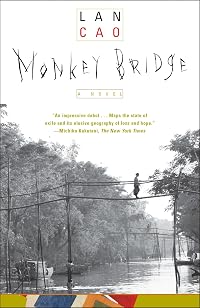
A monkey bridge is a perilous and precarious Vietnamese rope bridge that requires a very delicate balancing act to cross. Mai, the Vietnamese immigrant main character of Lan Cao’s heartbreaking novel has to cross a metaphorical monkey bridge as she simultaneously balances her new life in the United States with her efforts to hold on to her Vietnamese roots and history. Her attempts are complicated even more because the novel’s action takes place in the mid to late 1970’s – a time when the U.S. was trying hard to forget its involvement in an unpopular war in that country.
Mai, who came to the U.S. through the benevolence of an American soldier her family befriended, is joined by her mother, Thanh after the fall of Saigon. Her show more mother has a difficult time adjusting and is dependent on Mai to negotiate and interpret a completely alien culture and lifestyle. When Thanh falls ill, Mai tries to locate her grandfather, Thanh’s father, who was left behind in Vietnam. Mai hopes that his presence will provide comfort for Thanh so that Mai can leave her mother with a support system when she goes away to college.
Immigrant novels abound, but what makes this story unique is the fact that the Vietnam War was so unpopular that once it ended, Americans tried hard to forget it. Unwanted reminders of the war (such as Vietnam vets and Vietnamese refugees) were inconvenient truths who were ignored at best and more typically abandoned. As a result, Thanh makes efforts to present a carefully constructed version of her personal history to her daughter; a history that in the end, she cannot sustain.
It is noteworthy that both mother and daughter have two sets of fathers, each of whom symbolize a distinct and tragic segment of Vietnamese history. Their stories are the story of 20th Century Vietnam.
Cao’s writing is beautiful and successfully blends both ancient Vietnamese mythology and culture with American pop culture.
The author describes the physical shape of Vietnam as a seahorse. Interestingly, she uses that same word to describe Mai’s mother. Mai’s mother is the embodiment of the land and her complicated family history is the history of the country. Balancing past and present, Mai has to navigate her own perilous monkey bridge - an act that requires that she hold on to both her Vietnamese heritage and the new life she is making in the United States. show less
Mai, who came to the U.S. through the benevolence of an American soldier her family befriended, is joined by her mother, Thanh after the fall of Saigon. Her show more mother has a difficult time adjusting and is dependent on Mai to negotiate and interpret a completely alien culture and lifestyle. When Thanh falls ill, Mai tries to locate her grandfather, Thanh’s father, who was left behind in Vietnam. Mai hopes that his presence will provide comfort for Thanh so that Mai can leave her mother with a support system when she goes away to college.
Immigrant novels abound, but what makes this story unique is the fact that the Vietnam War was so unpopular that once it ended, Americans tried hard to forget it. Unwanted reminders of the war (such as Vietnam vets and Vietnamese refugees) were inconvenient truths who were ignored at best and more typically abandoned. As a result, Thanh makes efforts to present a carefully constructed version of her personal history to her daughter; a history that in the end, she cannot sustain.
It is noteworthy that both mother and daughter have two sets of fathers, each of whom symbolize a distinct and tragic segment of Vietnamese history. Their stories are the story of 20th Century Vietnam.
Cao’s writing is beautiful and successfully blends both ancient Vietnamese mythology and culture with American pop culture.
The author describes the physical shape of Vietnam as a seahorse. Interestingly, she uses that same word to describe Mai’s mother. Mai’s mother is the embodiment of the land and her complicated family history is the history of the country. Balancing past and present, Mai has to navigate her own perilous monkey bridge - an act that requires that she hold on to both her Vietnamese heritage and the new life she is making in the United States. show less
An uneven first novel that is by turns compelling and awkward, Monkey Bridge might best be appreciated as a compendium of the ways that post-traumatic stress disorder is experienced and enacted. The voice of the protagonist, a teen who fled Vietnam just before the fall of Saigon, is believable. Since the novel has been described as semi-autobiographical, I would expect this to be the case. The mother's voice in the novel's real time also works; her poetic, literary voice as depicted in her writings rings false, and not just for reasons that make sense within the narrative. Unfortunately, this voice keeps sliding into what reads like an imitation of the mother in Amy Tan's The Joy Luck Club. Still, if these awkward passages can be put show more aside, the novel does an excellent job of depicting the immigrant/refugee experience from a young adult's perspective, the tensions that arise almost immediately between generations of immigrants, and the forces that seem to compel the romantic reconstruction of one's country of origin. show less
This is a beautifully written, semi-autobiographical novel about immigration, coming-of-age, love, mother-daughter relationships, and so much more.
The story is told from two views, mother and daughter, though the daughter’s view predominates. The mother’s story is conveyed in letters and diary entries and appears rarely, but is the more lyrical writing and very effective and affecting.
Both women escaped the war in Vietnam and went to the United States about three years prior to the beginning of the story, which is related in both real time and flashback. The daughter, Mai, was the first to leave Vietnam, accompanied by a U. S. soldier/family friend who housed her until her mother could join her. Mai’s assimilation of English and show more the U. S. culture was much quicker, both because she was younger and had more time to acquire Americanization, than it was for her mother. Also, her mother, Tran, being older and having lived in Vietnam for a much longer time, was not so willing to give up her Vietnamese superstitions and culture. Through Mai and Tran we learn both what it was like to live in Vietnam in the years of the U. S. war and to try to immigrate to a new country and culture. We also learn much about the women’s past lives and hopes for the future.
Recommended. show less
The story is told from two views, mother and daughter, though the daughter’s view predominates. The mother’s story is conveyed in letters and diary entries and appears rarely, but is the more lyrical writing and very effective and affecting.
Both women escaped the war in Vietnam and went to the United States about three years prior to the beginning of the story, which is related in both real time and flashback. The daughter, Mai, was the first to leave Vietnam, accompanied by a U. S. soldier/family friend who housed her until her mother could join her. Mai’s assimilation of English and show more the U. S. culture was much quicker, both because she was younger and had more time to acquire Americanization, than it was for her mother. Also, her mother, Tran, being older and having lived in Vietnam for a much longer time, was not so willing to give up her Vietnamese superstitions and culture. Through Mai and Tran we learn both what it was like to live in Vietnam in the years of the U. S. war and to try to immigrate to a new country and culture. We also learn much about the women’s past lives and hopes for the future.
Recommended. show less
Monkey Bridge is the story of Mai and Thanh, recent immigrants to America from Vietnam. Through the kindness of Uncle Michael, an American GI and family friend, Mai was able to leave before the fall of Saigon; her mother, Thanh, followed through the American airlift shortly after. The novel highlights the struggle for Mai and her mother to assimilate in America. For Mai, the struggle is not too difficult. Within a few months, she has learned to appreciate America’s shopping malls, has gotten used to the chill of Virginia, and speaks American English without a Vietnamese accent. For Thanh, the adjustment is more challenging. In Vietnam, Thanh’s French convent school education gave her fluency in French and a love for the French show more classics. In America, she is just another immigrant who spoke no English.
In their effort to assimilate, Mai and her mother have ignored the riddle that continues to prey on their minds: on the day that her mother was airlifted out of Saigon, Mai’s grandfather, Baba Quan, was left behind. Mai is confused by her mother’s alternating grief for and seeming indifference to Baba Quan. When Thanh suffers a stroke, Mai hears her call out for Baba Quan. This incident sparks Mai’s resolve to find her grandfather, because she believes Baba Quan is the only person who can ease Thanh’s disquiet.
Lan Cao has clearly written an autobiographical novel. In the book’s jacket, the author is described as having left Vietnam in 1975. The photo, naturally, is the requisite black and white. Lan Cao is wearing black, standing against a stark background with her arms folded, unsmiling. Clearly, this is a very serious book about a very serious subject from a very serious writer.
Lan Cao, however, cannot quite reach her ambition. That’s not to say that Monkey Bridge is altogether bad. The descriptions of Little Saigon will ring true for any immigrant who has tried to find a familiar enclave in their adoptive country. Mrs. Bay, Thanh’s best friend, is touching in her zeal; she is so grateful to be given a fresh start that she maintains a cheerful disposition each day, despite her fears for Vietnam. Compared to the flatness of Thanh and Mai, Mrs. Bay is full of life, and it is the passages where she was included that I read with the most enjoyment.
Unfortunately, Monkey Bridge is so clearly autobiographical that the author muddles the narrative. The story itself is interesting, but its execution is ungainly and full of amateur touches. The ending felt cheap and shoddy, complete with maudlin melodrama and a big reveal that came out of nowhere like a bat out of hell. What makes Monkey Bridge so disappointing is that the author was unable to mold such rich, raw experience into something great. Mai had this to say about her mother, Thanh, and it sums up my discontent with this novel:
We were both in the space where all things linger, only to turn unpredictably with the exquisite swiftness of a hard flower. We all enter this space when we wait – for motionless shadows to shift with a moment’s notice, and hopes to become possibilities.
Like Mai, I too held my breath, waiting for the author to spin a tale that would captivate. Sadly, Lan Cao did not deliver because she was unsure whether she wanted to write a novel or a memoir; in the end, Monkey Bridge succeeds as neither.
Originally posted on my Vox and my LJ. show less
In their effort to assimilate, Mai and her mother have ignored the riddle that continues to prey on their minds: on the day that her mother was airlifted out of Saigon, Mai’s grandfather, Baba Quan, was left behind. Mai is confused by her mother’s alternating grief for and seeming indifference to Baba Quan. When Thanh suffers a stroke, Mai hears her call out for Baba Quan. This incident sparks Mai’s resolve to find her grandfather, because she believes Baba Quan is the only person who can ease Thanh’s disquiet.
Lan Cao has clearly written an autobiographical novel. In the book’s jacket, the author is described as having left Vietnam in 1975. The photo, naturally, is the requisite black and white. Lan Cao is wearing black, standing against a stark background with her arms folded, unsmiling. Clearly, this is a very serious book about a very serious subject from a very serious writer.
Lan Cao, however, cannot quite reach her ambition. That’s not to say that Monkey Bridge is altogether bad. The descriptions of Little Saigon will ring true for any immigrant who has tried to find a familiar enclave in their adoptive country. Mrs. Bay, Thanh’s best friend, is touching in her zeal; she is so grateful to be given a fresh start that she maintains a cheerful disposition each day, despite her fears for Vietnam. Compared to the flatness of Thanh and Mai, Mrs. Bay is full of life, and it is the passages where she was included that I read with the most enjoyment.
Unfortunately, Monkey Bridge is so clearly autobiographical that the author muddles the narrative. The story itself is interesting, but its execution is ungainly and full of amateur touches. The ending felt cheap and shoddy, complete with maudlin melodrama and a big reveal that came out of nowhere like a bat out of hell. What makes Monkey Bridge so disappointing is that the author was unable to mold such rich, raw experience into something great. Mai had this to say about her mother, Thanh, and it sums up my discontent with this novel:
We were both in the space where all things linger, only to turn unpredictably with the exquisite swiftness of a hard flower. We all enter this space when we wait – for motionless shadows to shift with a moment’s notice, and hopes to become possibilities.
Like Mai, I too held my breath, waiting for the author to spin a tale that would captivate. Sadly, Lan Cao did not deliver because she was unsure whether she wanted to write a novel or a memoir; in the end, Monkey Bridge succeeds as neither.
Originally posted on my Vox and my LJ. show less
Girl escapes Saigon in 1975 to be reunited with her mother in Falls Church, Virginia. Beautifully written account of old life and traditions and the immigrant experience.
This is the story of Mai, who immigrates to America after the war, and her mother who follows some time after. Mai, being younger, takes on the American language and culture more completely than her mother, who in Vietnam seemed a stronger, more capable and intelligent woman, but in America seems to become foggy and troubled.
After a stroke, Mai's mother's mental state seems to deteriorate further, and Mai hears her calling for Baba Quan, her mother's father who was left behind in Vietnam. This causes Mai to begin a search for a way to bring Baba Quan to America so that he may ease her mother's heart and allow Mai to leave home for college. The story explores the past and relationship of the two, the trauma they suffered in Vietnam, the show more clash between Mai's world of American schooling and science and her mother's of curses and karma, and their desire to care for one another and yet their need to push the other away.
I pretty much read this book twice for school. The first time I had a more favorable impression, but I think that may have stemmed from having a Vietnamese mother myself and some things in it being amusingly familiar. The second time through, it seemed a more average read. Also, the book's conclusion, though I predicted it very early on, felt as if it came rather out of left-field build-up wise, and was also a bit unsatisfying. As I read it the second time I think it just stressed that even more, as I was able to watch and see the build to it...or rather notice the semi-lack thereof.
Usually I'd rate a book on the first impression, but I think the second was really more representative of the actual quality of the book. It's still alright, though. show less
After a stroke, Mai's mother's mental state seems to deteriorate further, and Mai hears her calling for Baba Quan, her mother's father who was left behind in Vietnam. This causes Mai to begin a search for a way to bring Baba Quan to America so that he may ease her mother's heart and allow Mai to leave home for college. The story explores the past and relationship of the two, the trauma they suffered in Vietnam, the show more clash between Mai's world of American schooling and science and her mother's of curses and karma, and their desire to care for one another and yet their need to push the other away.
I pretty much read this book twice for school. The first time I had a more favorable impression, but I think that may have stemmed from having a Vietnamese mother myself and some things in it being amusingly familiar. The second time through, it seemed a more average read. Also, the book's conclusion, though I predicted it very early on, felt as if it came rather out of left-field build-up wise, and was also a bit unsatisfying. As I read it the second time I think it just stressed that even more, as I was able to watch and see the build to it...or rather notice the semi-lack thereof.
Usually I'd rate a book on the first impression, but I think the second was really more representative of the actual quality of the book. It's still alright, though. show less
Members
- Recently Added By
Lists

AP Lit
363 works; 6 members
Author Information

4+ Works 460 Members
Awards and Honors
Awards
Common Knowledge
- Original publication date
- 1997
- People/Characters
- Mai Binh; Tran Binh; Col. Michael MacMahon; Baba Quan; Mrs. Bay; Bobbie
- Important places
- Saigon, Vietnam; Ba Xuyen, North Vietnam; Farmington, Connecticut, USA; Arlington, Virginia, USA
- Important events
- Vietnam War
- Dedication
- To my mother (1925-1992)
- First words
- The smell of blood, warm and wet, rose from the floor and settled into the solemn stillness of the hospital air.
- Quotations
- Now a mere three and a half years or so after her last call to the sky market, the dreadful truth was simply this: we were going through life in reverse, and I was the one who would help my mother through the hard scrutiny o... (show all)f ordinary suburban life.
Aunt Mary couldn’t possibly understand that immigration represents unlimited possibilities for rebirth, reinvention, and other fancy euphemisms for half-truths and outright lies.
His beauty was of a different sort, raw and elegant. He was precisely built, with a self-assured and easy grace that accommodated rather than opposed. As a child I could lie in his arms, and they held me like a sturdy hammo... (show all)ck on a windy day.
In one way or another, my mother and her friends were not much unlike the physically wounded. They had continued to hang on to their Vietnam lives, caressing the shape of a country that was no longer there, in a way not much... (show all) different from amputees who continued o feel the silhouette of their absent limbs. - Last words
- (Click to show. Warning: May contain spoilers.)Outside, a faint sliver of what only two weeks ago had been a full moon dangled like a sea horse from the sky.
Classifications
Statistics
- Members
- 365
- Popularity
- 85,805
- Reviews
- 8
- Rating
- (3.47)
- Languages
- English
- Media
- Paper, Ebook
- ISBNs
- 4
- ASINs
- 3