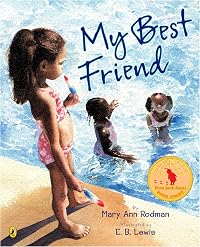
My Best Friend
by Mary Ann Rodman
On This Page
Description
Six-year-old Lily has a best friend all picked out for play group day, but unfortunately the differences between first-graders and second-graders are sometimes very large.Tags
Recommendations



Member Reviews
At almost-five this is Kid's new favorite book. The narrator is a six-year-old girl who desperately wants to be best friends with a seven-year-old who is rude to her; the narrator tries to impress the older girl but nothing works, and eventually she finds a true friend who likes her for herself. The book ends on a hopeful note that maybe when the kids are more mature they can all be friends, but for the time being Lily, the narrator, is happy with her new best friend rather than trying to impress the older Tamika. Kid loves what are for him some fairly complex social situations, and seeing a book full of kids that look like him (all the characters are black, with a few people of other races seen in the background).
My Best Friend takes a different approach to finding friendship, focusing on what many books neglect, difficulties and rejection. Good friendship is not always easy to find. The story of Lily and Tamika, shows just that. Although Lily does not win Tamika’s friendship immediately, she displays essential characteristics; motivation, ambition, and determination. The watercolor inspired illustrations were my favorite aspect of the book. The pictures were beautifully finished and had astonishing details.
I personally love this book! I actually read this a few months ago in the first grade classroom that I was interning for. This book explains what a true friend is and the importance of finding one. In this story, the main character shows a depth of emotion that many children experience and can relate to. My first graders loved it and I feel it could be read to a variety of different age groups. It’s beautifully written and illustrated and many meanings can be derived from this book.
This story is a great example of bullying in my opinion. It is light enough to have young children understand and have older children see the right and wrong in the words. I thought this would be a great book to use for my lesson plan and definitely read to small children to see the way they see in the book. I am curious to see what this book will bring up for high school or college students too, since it is such a big topic in the present day. It was good book to just enjoy, but it had me frustrated with Lily cause she was so young and innocent to not understand what Tamika was doing to her. Life lesson and great illustration to focus on the girls, not their ugly actions.
My best friend is about a young girl, Lily, who only wants one girl, Tamika, to be her best friend. Tamika is a year older and refuses to be her friend because she already has a best friend. Every Wednesday they all go to the pool, and every time Lily tries to make Tamika her best friend. This story shows a different side to friendships which is not every one will be friends, but it does show how friendship is a mutual interest in one another. At the end of the story, Lily becomes friends with another girl her age. This story shows that friendships require a mutual respect for each other as well.
As a parent, I was drawn to this story because it is a sensitive portrayal of the lengths children will go to try to make someone their friend. It can be a difficult lesson to realize that is not possible, friendship takes more than force of will to make it happen.
Curricular connections can be made in social studies with kindergarten and first grade students as part of the students’ social development. Students will listen to the story and then list the qualities that make a good friend. Each student will receive a petal and they will write one quality on the petal. Cooperatively, they will glue petals to the flower stems on a bulletin board, creating a garden of friendship qualities.
Curricular connections can be made in social studies with kindergarten and first grade students as part of the students’ social development. Students will listen to the story and then list the qualities that make a good friend. Each student will receive a petal and they will write one quality on the petal. Cooperatively, they will glue petals to the flower stems on a bulletin board, creating a garden of friendship qualities.
Lily is six and she wants more than anything to be friends a seven year old named Tamika. But Tamika has an agenda of her own and already has a best friend named Shanice. Tamika repeatedly tries to change herself and do and learn things to impress Tamika. She even gives Tamika her toys and shares her popsicles; but nothing works. Throughout all of this, another six year old named Keesha is very friendly to Lily and subtly tries to be her friend, but Lily is so caught up trying to impress Tamika, that she doesn't notice. One day, Lily has had enough and Keesha recognizes Lily's struggle and comforts her. Lily realizes that Keesha already likes her for who she is and they play together and become friends. Appropriate for ages 4-6.
(Pierce show more College Fort Steilacoom Library) show less
(Pierce show more College Fort Steilacoom Library) show less
Members
- Recently Added By
Lists

Children's picture books with kids of color
129 works; 15 members
Author Information
12+ Works 1,105 Members
All Editions
Awards and Honors
Awards
Notable Lists
Classifications
Statistics
- Members
- 347
- Popularity
- 90,818
- Reviews
- 24
- Rating
- (4.20)
- Languages
- English
- Media
- Paper
- ISBNs
- 7