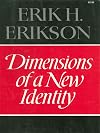
Dimensions of a New Identity
by Erik H. Erikson
57 Members (3.50)
On This Page
Description
In the first lecture, entitled "The Founders: Jeffersonion Action and Faith," Erikson uses selected themes from Jefferson's life to illustrate some principles of psychohistory. In the second lecture, "The Inheritors: Modern Insight and Foresight," Erikson applied his main concepts to the problems of ongoing history. The title of the lectures contains one such concept. "New identity" is the result of radical historical change and is here meant to characterize the emerging American identity as show more first embodied in such men as Jefferson.Erikson first explores certain themes in his examination of the emerging American identity during Jefferson's time. He then attempts to relate the Jeffersonian themes to contemporary problems of repression and suppression, of moralistic vindication, and true liberation by insight.Finally, Erikson maintains that now that children will be born by the privileged choice of parental persons, an adult environment fitting the living and the to-be-living becomes an ethical necessity.There is no question that this work ranks among Erikson's most challenging and seminal books. show lessTags
Recommendations


































Member Reviews
Members
- Recently Added By
Lists

The Great Courses: The Great Ideas of Psychology
61 works; 1 member
Author Information

34+ Works 4,265 Members
Erik H. Erikson, a German-born American psychologist and psychoanalyst, developed theories about the sequence of human development that have had an impact on clinical psychoanalysis, ethics, history, literature, child care, and the emerging interdisciplinary study of the life course. Erikson was an art student, but after undergoing psychoanalysis show more by Anna Freud in Vienna in 1927, he turned to the field of psychology. According to Erikson's life-cycle theory, first published in Childhood and Society (1950), there are eight developmental stages, which are biologically determined but environmentally shaped: infancy, early childhood, play age, school age, adolescence, young adulthood, mature adulthood, and old age. Each of these stages is associated with a particular crisis that the individual must successfully resolve in order to proceed normally to the next stage-for example, identity versus confusion in adolescence. The concept of the identity crisis is now firmly embedded in psychiatric theory. Erikson also studied the relationship between a person's life and the times in which he or she lives; and his historical-biographical studies of Luther and Gandhi are outstanding products of this inquiry. Erikson taught at Harvard University for 30 years (Bowker Author Biography) show less
Classifications
- Genres
- Nonfiction, History, General Nonfiction
- DDC/MDS
- 973.4 — History & geography History of North America United States Constitutional period (1789-1809)
- LCC
- E332.2 .E74 — History of the United States United States Revolution to the Civil War, 1775/1783-1861 By period 1789-1809. Constitutional period Jefferson's administrations, 1801-1809
- BISAC
Statistics
- Members
- 57
- Popularity
- 532,200
- Rating
- (3.50)
- Languages
- English, German
- Media
- Paper, Ebook
- ISBNs
- 3
- ASINs
- 1