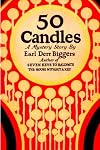
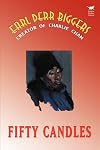
Fifty Candles
by Earl Derr Biggers
On This Page
Description
Fiction. Mystery. Earl Derr Biggers (1884-1933) is best remembered as the creator of Chinese detective Charlie Chan.Biggers had always been interested in mystery fiction, but his interest in Hawaii clearly stems from a 1919 vacation in Honolulu. While there, he read a newspaper article on a Chinese detective named Chang Apana. Apana would become the model for Charlie Chan in Biggers' 1925 novel, "The House Without a Key," and there quickly followed five more Charlie Chan novels. Fifty show more Candles — first published just two years after that 1919 vacation — shows how Hawaii, China, and murder had already begun to come together in Biggers' imagination. The story starts in a courthouse in Honolulu, moves to China, then to fog-shrouded San Francisco. Many of the elements used in the Charlie Chan series are present: Chinese characters (both sinister and sympathetic), the Honolulu legal system, a shrewd detective (in this case, the lawyer Mark Drew rather than a policemen), and a baffling murder complete with red herrings and plenty of suspects. This special edition includes John Betancourt's introduction from the 2001 paperback edition, plus a bonus short story, "The Way to the Island" — a long-lost Earl Derr Biggers tale!. show lessTags
Recommendations



















Member Reviews
Fifty Candles is one of Earl Derr Biggers' earlier works and predates the Charlie Chan novels by four years. Nonetheless, it contains many of the tropes and imagery that would become commonplace in the Charlie Chan series. It starts out, for example, in Hawaii--just two years after Biggers had vacationed there at the Royal Hawaiian Hotel, which would become a setting for some of the Chan mysteries. It also experiments with the mystery puzzle setup in classical form, which will come to dominate the latter novels. But it is the pointed imagery and even phrases the pop out. For example, the beautiful woman making an entry by a stairway; the elegant young sophisticated man who pursues her; the reference to Honolulu and Hawaii as a "melting show more pot" of races and ethnicities; and the defense of the Chinese and their development in his fiction as more than mere backdrops.
It's not all that mysterious. But the atmosphere of a foggy San Francisco night in the waning days of its being an opening to the treaty ports of the Far East still lingers as a worthwhile treat. A short read of less than two hours, Fifty Candles is the prototype for Biggers' later mystery novels. show less
It's not all that mysterious. But the atmosphere of a foggy San Francisco night in the waning days of its being an opening to the treaty ports of the Far East still lingers as a worthwhile treat. A short read of less than two hours, Fifty Candles is the prototype for Biggers' later mystery novels. show less
Ratings
Members
- Recently Added By
Author Information

68+ Works 2,417 Members
Earl Derr Biggers was born in 1884 in Warren, Ohio. He graduated from Harvard University in 1907 with a Bachelor of Arts degree. After college, Biggers went to work at The Boston Traveler, where he wrote a humorous column, and then reviews, until 1911. By that time he had finished his first novel, "Seven Keys To Baldpate," migrated to New York show more with his first novel and also his first comedy, "If You're Only Human" and began writing plays. Biggers wrote magazine articles, stories, novels and plays, including a war play, "Inside The Lines," which ran 500 nights in London in 1915 and 1916. He published two more novels during the 1910s, Love Insurance in 1914 and The Agony Column in 1916, but his main activity was focused on humor writing, particularly in magazines and short stories. In 1919, Biggers decided to quit playwriting and go to California to write for motion pictures. His reputation spread among the public with his most famous creation, Charlie Chan. He developed the character of Charlie Chan for his novel "The House Without A Key" in 1925. He wrote six Charlie Chan novels, all moderately popular. All were adapted to the cinema, except for "Keeper Of The Keys". The Charlie Chan movies were one of the most successful screen series in history, with over 40 movies based on the character. There were also numerous Chan radio adaptations and comic strips, as well as attempts to bring the character to television. Earl Biggers died in Pasadena, California, in April of 1933 at the age of 48, from a heart attack. (Bowker Author Biography) show less
Work Relationships
Classifications
Statistics
- Members
- 36
- Popularity
- 802,823
- Reviews
- 1
- Rating
- (3.80)
- Languages
- English, Polish
- Media
- Paper, Ebook
- ISBNs
- 20
- ASINs
- 6